


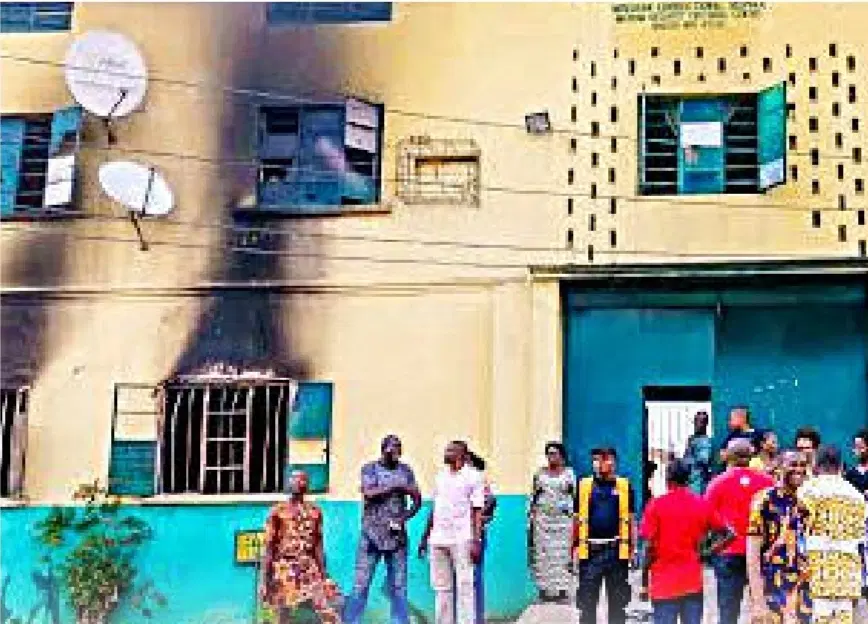
Nigeria’s correctional crisis is intensifying, with the country’s custodial facilities holding 80,812 inmates, including 51,955 people awaiting trial, as overcrowding, ageing infrastructure, inadequate funding, security breaches and concerns over inmate welfare continue to challenge the criminal justice system.
The figures expose a growing problem within Nigeria’s correctional institutions, where thousands of people remain behind bars without being convicted of any offence. Meanwhile, limited healthcare, feeding challenges, alleged corruption and deteriorating facilities have raised fresh questions about the government’s ability to protect the rights of detainees and fulfil the system’s rehabilitation mandate.
According to figures from the Nigeria Correctional Service (NCoS), 51,955 inmates, representing approximately 64 per cent of the total population, are awaiting trial. Another 24,913 have been convicted, while 3,850 fall under other detention categories.
The figures highlight a fundamental contradiction in Nigeria’s correctional system: facilities intended to reform convicted offenders are increasingly occupied by people whose guilt has not been established by a court of law.
Data previously published by the National Bureau of Statistics (NBS) showed that the number of unsentenced inmates rose from 47,610 in 2017 to 53,790 in the second quarter of 2025. During the same period, the total inmate population increased from 69,946 to 81,710.
The persistent growth in inmate numbers has placed additional pressure on facilities, personnel, security arrangements and funding, intensifying concerns about the effectiveness of correctional reforms.
One of the biggest drivers of Nigeria’s correctional crisis is the slow pace of criminal justice administration.
Justice-sector stakeholders have linked the growing population of awaiting-trial inmates to delays in police investigations, late issuance of legal advice, inadequate legal representation for indigent defendants, repeated court adjournments and other procedural bottlenecks.
These delays mean that some detainees spend months or years in custody before their cases are concluded. In certain instances, defendants may eventually be discharged or acquitted after spending significant periods behind bars.
The situation has also attracted judicial scrutiny.
In a judgment delivered on May 15, 2026, the ECOWAS Court of Justice found that prolonged detention of awaiting-trial inmates and the resulting overcrowding in Nigerian correctional facilities violated rights relating to personal liberty, human dignity, fair hearing, the presumption of innocence and trial within a reasonable time.
The National Human Rights Commission (NHRC) has similarly identified prolonged pre-trial detention, arbitrary arrests, torture allegations, denial of access to lawyers and poor detention conditions as continuing human rights concerns.
In its 2026 statement on torture prevention, the commission highlighted reports of excessive use of force, arbitrary arrest and detention, inadequate legal representation, prolonged detention and alleged ill-treatment.
The implications extend beyond overcrowding. They raise questions about the presumption of innocence and whether Nigeria’s criminal justice system is delivering timely and fair trials.
The physical condition of many correctional centres has compounded the problem, with some facilities operating beyond their original capacities and struggling with deteriorating infrastructure.
The House Committee on Reformatory Institutions recently warned that some facilities were built more than a century ago and had deteriorated significantly.
An independent investigative panel established by the Federal Government to examine allegations of corruption, abuse of power and human rights violations within the correctional system also identified serious infrastructure deficits.
The panel assessed 86 custodial facilities across 23 states and the Federal Capital Territory, raising concerns about security risks and infrastructural decay in centres located in states including Delta, Edo, Sokoto and Kaduna.
The challenges include dilapidated walls, inadequate ventilation, obsolete security systems, insufficient operational vehicles and weak perimeter protection.
Beyond creating uncomfortable living conditions, these deficiencies can increase security risks and make it more difficult for correctional authorities to provide effective rehabilitation.
The NCoS has identified the construction and renovation of custodial facilities, procurement of vehicles and security equipment, improvement of information technology systems, biometric registration of inmates and development of prison farms as areas requiring substantial investment.
However, the scale of the infrastructure deficit suggests that significant and sustained funding will be required to address the problem.
Feeding has emerged as another major concern within Nigeria’s correctional system, with a Federal Government investigative panel reportedly finding evidence of inmate malnutrition and alleged abuses in the administration of feeding contracts.
The panel recommended increasing the daily feeding allowance from ₦750 to ₦3,000.
An investigation published by Vanguard in August also reported complaints from inmates and former inmates about the quantity and quality of food provided in some correctional centres. Correctional authorities, however, denied allegations of systemic starvation and defended the existing feeding arrangements.
Budget figures illustrate the financial pressure facing the Service.
According to the NCoS’s 2025 budget performance report, ₦27.28 billion, representing 71.7 per cent of its overhead releases, was spent on inmate feeding. Outstanding food-ration obligations stood at ₦10.75 billion.
For 2026, the Service proposed ₦14.83 billion to feed an estimated 91,100 inmates at a projected rate of ₦1,125 per inmate per day.
The disparity between the reported feeding needs, available resources and the panel’s recommended allowance has intensified concerns about whether inmates are receiving adequate nutrition.
Adequate food is a basic requirement of humane detention. Without sufficient nutrition, inmates may face additional health risks, further stretching already limited medical services.
Allegations of corruption and prohibited activities have added another layer to the correctional crisis.
The Federal Government’s investigative panel examined allegations involving abuse of power, illegal movement of inmates, drug trafficking, unauthorised visits and the smuggling of prohibited items into custodial facilities.
A report based on the panel’s proceedings in April also detailed allegations that some inmates operated businesses from correctional centres, including Point-of-Sale (POS) services, with claims that officials facilitated prohibited activities.
The allegations have raised questions about internal supervision, staff accountability and the ability of correctional authorities to prevent criminal activities behind prison walls.
The NCoS has nevertheless intensified efforts to tackle contraband.
In May, the Service announced the destruction of 1,167 confiscated mobile phones and other prohibited items recovered during nationwide searches. It also reported recovering ₦2.569 million in smuggled cash and said 147 officers had been sanctioned in connection with contraband-related infractions.
A separate incident in August drew national attention when an inmate at the Ibara Medium Custodial Centre in Abeokuta, Ogun State, reportedly appeared live on TikTok using a prohibited mobile phone.
Following the incident, the NCoS removed the officer in charge and two other senior officers pending investigation. The inmate was also transferred to another facility under enhanced security arrangements.
While such enforcement measures demonstrate efforts to address misconduct, the recurring incidents have reinforced concerns about how prohibited items enter custodial centres and whether existing monitoring systems are sufficient.
Security breaches remain a recurring challenge for Nigeria’s correctional authorities.
The NCoS has continued to report escape incidents involving inmates across the country. One notable incident occurred in August 2025, when 16 inmates escaped from the Medium Security Custodial Centre in Keffi, Nasarawa State.
Ageing buildings, inadequate security technology, insufficient operational vehicles and pressure on available personnel can complicate efforts to maintain effective surveillance and prevent escapes.
Funding constraints have further limited the pace at which the Service can address these shortcomings.
For 2025, the NCoS received only ₦3.22 billion, representing 22.2 per cent of its approved capital allocation of ₦14.50 billion. This left ₦11.27 billion unreleased.
The Service has sought substantially higher capital funding for 2026 to improve infrastructure, strengthen security and address other operational gaps.
However, experts and policymakers face the challenge of ensuring that increased funding translates into measurable improvements in facility security, personnel capacity and inmate welfare.
Access to healthcare remains a critical issue in the management of people deprived of their liberty.
The NCoS has recently initiated efforts to improve medical services, including the nationwide distribution of essential medicines, increased attention to mental healthcare and plans to secure broader health-insurance coverage for inmates.
Despite these efforts, human rights organisations continue to raise concerns about access to medical treatment, detention conditions and the treatment of detainees.
The wider challenge of detention standards came under renewed scrutiny in September following the deaths of 37 suspected illegal miners in the custody of the Nigeria Security and Civil Defence Corps (NSCDC) in Niger State.
The deaths did not occur in an NCoS facility, but the incident intensified national concerns about the treatment of detainees across Nigeria’s security and justice institutions.
The government suspended 20 NSCDC personnel and established a 10-member committee to investigate the deaths after reports that 67 detainees had been held in one cell. The Nigerian Bar Association called for a transparent and independent investigation.
The incident underscored the importance of ensuring that everyone held in police, military, NSCDC or correctional custody receives humane treatment, adequate medical attention and protection from abuse.
Nigeria’s correctional system was given a broader mandate in 2019 when legislation transformed the Nigerian Prisons Service into the Nigeria Correctional Service.
The law shifted the institutional emphasis beyond confinement and punishment towards reformation, rehabilitation and reintegration into society.
Under this framework, the NCoS is expected to provide educational and vocational programmes, psychological support, counselling and opportunities for inmates to develop practical skills and generate income.
The legislation also provides for non-custodial measures, including community service, probation, parole and restorative justice.
However, implementation remains uneven.
A 2026 study of medium-security correctional facilities in Kwara State found that vocational training programmes existed in the centres examined but were fully functional in only one. The study also reported that digital learning infrastructure was absent or non-functional across all three facilities assessed, while overcrowding constrained rehabilitation programmes in two.
These findings raise concerns about whether inmates can acquire the education, skills and support needed to rebuild their lives after release.
Rehabilitation requires more than the availability of programmes on paper. It depends on adequate space, qualified personnel, learning materials, healthcare, funding and an environment in which inmates can participate meaningfully.
Where these conditions are lacking, correctional centres risk becoming places of prolonged confinement rather than institutions that prepare offenders for successful reintegration.
One potential response to Nigeria’s correctional crisis is the wider use of non-custodial sentences where legally appropriate.
Measures such as probation, parole and community service can reduce reliance on imprisonment for eligible offenders whose cases do not require custodial detention for public safety.
The NCoS has expanded its non-custodial programmes and reconstituted parole boards to strengthen the reintegration of eligible inmates. However, the scale of implementation remains limited compared with the overall inmate population.
Figures reported by the Service in July indicated that only 1,271 Nigerians were serving non-custodial sentences nationwide.
For 2026, the NCoS proposed ₦37.99 billion to expand non-custodial measures across Nigeria’s 774 local government areas.
If effectively implemented, the expansion could help reduce pressure on correctional facilities while allowing eligible offenders to serve their sentences in the community under appropriate supervision.
However, non-custodial measures cannot replace imprisonment in every case. Their effectiveness will depend on proper eligibility assessments, reliable supervision, coordination with the courts and adequate resources for implementation.
Reducing unnecessary detention, particularly for eligible defendants and offenders, could nevertheless form an important part of a broader reform strategy.
The Federal Government’s response to the correctional crisis has increasingly focused on funding.
The NCoS proposed a total budget of ₦198.85 billion for 2026, including ₦138.30 billion for personnel costs and ₦50.40 billion for recurrent overhead. The Service also requested an additional ₦90.38 billion to strengthen capital expenditure.
It identified ₦30.38 billion in promotion arrears and ₦25.16 billion owed to contractors as outstanding liabilities.
The figures illustrate the competing financial demands facing the institution, including staff costs, inmate feeding, infrastructure, security, healthcare and rehabilitation.
Nevertheless, increased funding alone may not resolve the problems.
The findings of the Federal Government’s investigative panel have placed accountability, procurement procedures, contract administration, oversight and disciplinary mechanisms alongside infrastructure and inmate welfare as essential areas for reform.
Without stronger financial controls and effective monitoring, additional allocations may fail to deliver the intended improvements.
Nigeria’s correctional crisis cannot be solved simply by constructing more detention facilities or increasing the number of officers.
The underlying problems also require reforms across the criminal justice system, including faster investigations, timely legal advice, improved access to legal representation and more efficient court proceedings.
Reducing the number of people held for prolonged periods while awaiting trial is particularly important. Without addressing the inflow of detainees, new facilities could eventually face the same overcrowding that currently affects existing centres.
The government must also improve conditions in custodial facilities, strengthen access to healthcare and adequate nutrition, modernise security systems and ensure that rehabilitation programmes are properly funded.
Allegations of corruption and abuse must be investigated transparently, with disciplinary action taken where wrongdoing is established. Effective oversight is equally important to ensure that public funds allocated to correctional services are used for their intended purposes.
At the same time, the wider implementation of non-custodial measures could help reserve imprisonment for cases where it is legally justified and necessary.
Nigeria’s correctional crisis represents a major challenge for the country’s justice system, human rights protections and public finances.
With 80,812 people reportedly in custody and 51,955 awaiting trial, the figures reveal the pressure facing correctional institutions and the consequences of prolonged delays in the administration of justice.
Ageing facilities, funding shortages, allegations of corruption, security breaches, inadequate welfare and limited rehabilitation opportunities have further complicated the situation.
Although reforms involving non-custodial sentencing, healthcare, vocational training, biometric registration and tighter controls on contraband offer potential solutions, their success will depend on sustained implementation and accountability.
Ultimately, Nigeria must ensure that people lawfully deprived of their liberty are held securely and humanely, that those awaiting trial have their cases determined within a reasonable time, and that convicted offenders receive meaningful opportunities to reform.
The objective should extend beyond keeping people behind bars. It should be to build a correctional system that protects society, respects human dignity, delivers justice and prepares eligible inmates to return to their communities as productive citizens.
Visit www.rapidospace.com for more Nigerian news


