


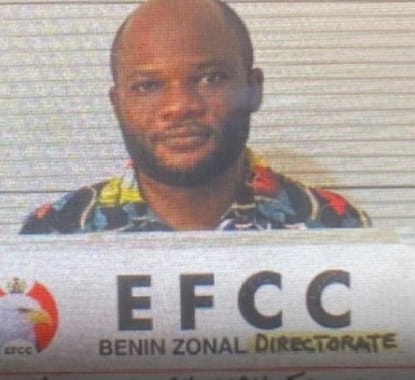
BENIN CITY: A High Court in Edo State has sentenced a man, Chinedu Francis Nwabuisi, to two years in prison without an option of fine for converting more than ₦21.9 million mistakenly credited to his bank account to personal use.
The convict was sentenced by Justice Irele Ifijeh of the Edo State High Court sitting in Benin City after being found guilty of unlawfully converting funds that were erroneously transferred into his account due to a system glitch involving First Bank Plc.
According to the Economic and Financial Crimes Commission (EFCC), Nwabuisi was prosecuted by the Benin Zonal Directorate of the commission over the conversion of ₦21,939,237.27 belonging to First Bank.
The money was reportedly credited to his account in error following a system malfunction. Rather than report the unexpected transaction or return the funds, Nwabuisi allegedly converted the money for his personal use.
During the trial, prosecution counsel, M. S. Dahiru, presented two witnesses, comprising a senior official of First Bank and an EFCC operative, who gave evidence to establish the circumstances surrounding the transaction.
The prosecution also tendered documentary evidence, which was admitted by the court in support of its case.
However, while defending himself, Nwabuisi claimed that he believed the money represented benefits accruing to him from operating a Point of Sale (POS) business with the bank.
The explanation did not persuade the court, which subsequently found him guilty and handed down a two-year prison sentence without the option of a fine.
In addition to the custodial sentence, Justice Ifijeh ordered the convict to restitute First Bank Plc by repaying the sum of ₦21,939,732.27.
The judgment reinforces the legal consequences of treating funds mistakenly credited to a bank account as personal money, particularly where the recipient converts the funds instead of notifying the financial institution.
The EFCC disclosed the conviction in a statement, reiterating its commitment to investigating and prosecuting financial crimes across the country.
RapidoSpace News reports that the case serves as a reminder that an erroneous bank transfer does not automatically make the recipient the lawful owner of the money, and spending such funds can attract criminal liability.


