


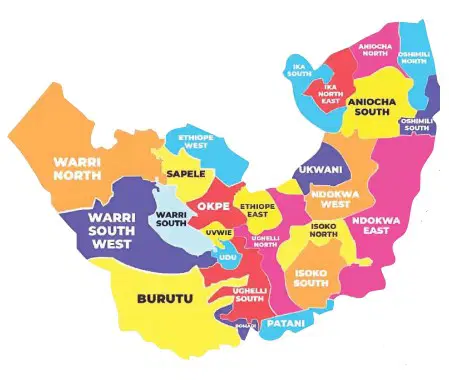
The exclusion of Ughelli South II State Constituency from the Independent National Electoral Commission’s (INEC) recently restored constituencies has sparked renewed criticism, with stakeholders questioning why the electoral body has yet to implement multiple court judgments delivered more than a decade ago.
While INEC restored 22 previously suppressed state constituencies across Delta, Benue, Jigawa, and Kogi states on June 10, 2026, Ughelli South II was conspicuously absent despite earlier court rulings directing its reinstatement.
The omission has reignited debates over selective compliance with judicial decisions and renewed calls for the electoral commission to obey outstanding court orders.
As part of the restoration exercise, Delta State regained six state constituencies:
- Aniocha North II
- Ika North East II
- Sapele II
- Ethiope West II
- Warri South West II
- Warri North II
The commission described the exercise as an expansion of democratic representation.
However, residents of Ughelli South expressed disappointment that their constituency, despite securing favourable court judgments years ago, was excluded from the exercise.
Many have questioned why INEC swiftly implemented more recent court orders while allegedly failing to act on judgments dating back to 2015.
Before the restructuring of electoral constituencies in the late 1990s, Ughelli South Local Government Area was represented by two seats in the Delta State House of Assembly—Ughelli South I and Ughelli South II.
The arrangement existed throughout Nigeria’s First, Second and Third Republics, with separate lawmakers representing different parts of the local government area.
However, during INEC’s 1999 constituency delimitation exercise, the two constituencies were merged into one, reducing the area’s legislative representation.
Critics argue that the decision deprived the oil-producing local government of adequate representation despite its growing population and economic significance.
The legal battle began in 2014 when Chief Godwin Sito and five others approached the Federal High Court in Warri, challenging INEC’s decision to suppress Ughelli South I.
In October 2014, the court ruled that the electoral commission lacked the constitutional authority to abolish the constituency and ordered its immediate restoration alongside the conduct of a by-election.
INEC appealed the judgment.
However, in May 2015, the Court of Appeal sitting in Benin dismissed the appeal in its entirety, affirming that Ughelli South I had lawfully existed before its suppression.
The legal victory was further strengthened in 2017 when the Supreme Court upheld the judgments of both the Federal High Court and the Court of Appeal, effectively exhausting the legal process.
Despite the three judicial victories, the constituency has yet to be restored.
Stakeholders say the latest constituency restoration exercise has intensified concerns over what they describe as selective obedience to court rulings.
According to them, INEC acted quickly on more recent judgments involving other constituencies but has failed to implement the Ughelli South decision for more than a decade.
Legal observers argue that the Nigerian Constitution makes no distinction between old and new court judgments, insisting that all valid judgments remain binding until fully implemented.
Some analysts have also suggested that constituencies affected by prolonged political disputes received quicker attention, while Ughelli South’s relatively quiet legal victory was left unattended.
Some election officials have reportedly attributed the delay to administrative challenges, including the need to redraw electoral boundaries, establish new polling units and conduct fresh constituency delineation exercises.
However, critics reject that explanation, insisting that administrative convenience cannot override binding court orders.
They argue that the constituency boundaries already existed before the 1999 suppression and should simply be restored in accordance with the judgments.
Many residents believe the prolonged delay has deprived the local government of effective legislative representation and constituency development.
With only one lawmaker representing what was originally two constituencies, community leaders argue that several communities have struggled to attract adequate government attention and developmental projects.
Some stakeholders maintain that restoring Ughelli South II would improve political inclusion and ensure more equitable representation for the area’s growing population.
Observers say the controversy surrounding Ughelli South highlights broader concerns about the implementation of judicial decisions by public institutions.
They insist that until INEC formally restores the constituency and updates its electoral map in line with the court rulings, questions over compliance with the rule of law will continue.
For residents of Ughelli South, the issue is no longer about obtaining legal victory—it is about seeing those judgments translated into practical political representation after years of waiting.


