


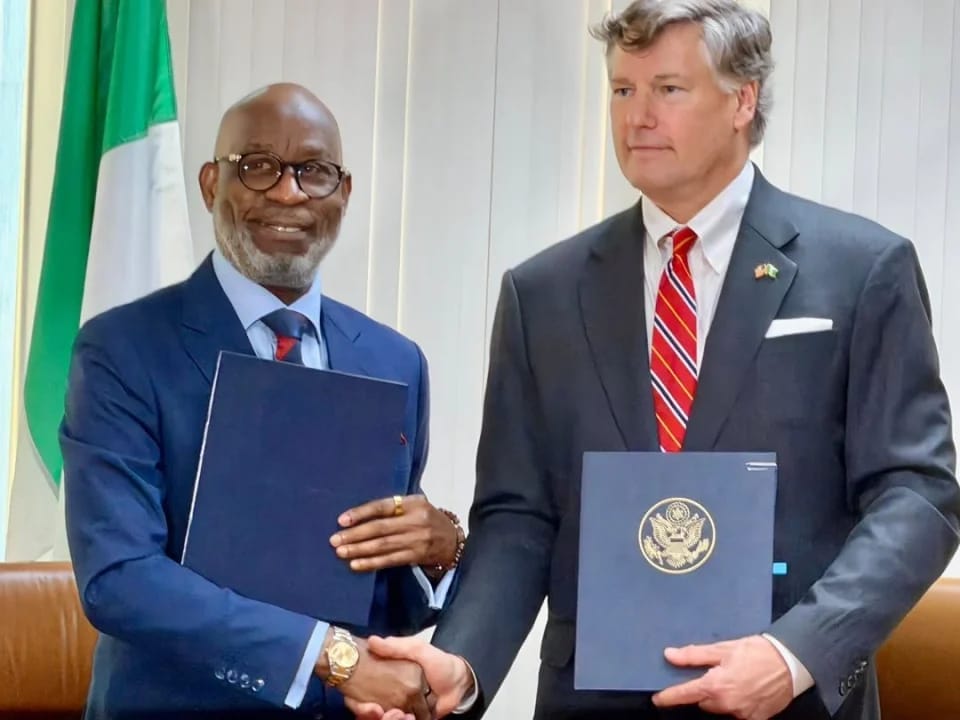
ASABA: Nigeria’s decision to deepen its mining partnership with the United States could mark an important turning point in the country’s long-running search for alternatives to oil dependence. But the significance of the agreement will ultimately be determined not by the ceremony at which it was signed, but by what happens after the signatures.
On September 24, 2026, Nigeria and the United States signed a framework agreement in New York aimed at deepening American investment in Nigeria’s mining sector and strengthening cooperation in geological data and exploration, mineral development and processing, infrastructure and technical capacity. The agreement was signed by Nigeria’s Minister of Solid Minerals Development, Dele Alake, and the US Deputy Secretary of State, Christopher Landau. The Federal Government places the estimated value of Nigeria’s mineral resources at about $700 billion.
The figure is impressive, but it needs to be understood correctly. It represents an estimate of mineral-resource potential, not $700 billion sitting in government accounts or an investment commitment already secured. Indeed, Minister Alake himself acknowledged the distinction when he said the harder work was moving “from agreement to implementation.”
That distinction is crucial.
FROM RESOURCE ENDOWMENT TO ECONOMIC VALUE
Nigeria is not short of natural resources. What Nigeria has historically lacked is the capacity to consistently transform natural-resource endowment into broad-based economic value.
This is the fundamental challenge confronting the mining sector.
Nigeria possesses deposits of lithium, gold, tin, iron ore, phosphate, gemstones and other minerals. The global transition toward new technologies, energy storage, advanced manufacturing and strategic supply chains has also increased the importance of several critical minerals.
Yet possessing minerals is not the same thing as possessing a functioning mineral economy.
A country can extract tonnes of valuable minerals and remain economically poor if the principal economic activities occur elsewhere.
The real prize, therefore, is not simply mining.
It is the value chain:
geological exploration → extraction → beneficiation → processing → refining → manufacturing → domestic consumption and export.
The more stages Nigeria can successfully retain within its economy, the greater the potential for employment, technology transfer, industrialisation, government revenue and entrepreneurial opportunities.
This is why the emphasis on local processing in the new Nigeria–US framework deserves particular attention.
THE PROCESSING QUESTION
For decades, Nigeria has struggled with the structural weakness of exporting commodities and importing higher-value products.
The mining sector must not reproduce this pattern.
If Nigerian lithium is mined in Nigeria, shipped abroad for processing and returns as a component of a high-value manufactured product, Nigeria has captured only a fraction of the economic opportunity.
If, instead, mining is accompanied by beneficiation, processing, refining and eventually manufacturing, the economic equation changes.
It creates demand for engineers, geologists, technicians, transport operators, financial institutions, manufacturers, construction companies, technology providers and professional services.
It creates industrial clusters around mining regions.
It creates opportunities for small and medium-sized enterprises.
It can also provide the foundation for new export industries.
Minister Alake has expressly stated that Nigeria does not want to remain merely a source of raw materials while value is created elsewhere. The framework, according to the Federal Government, is intended to promote stronger local processing, skills development, quality jobs and opportunities for Nigerian businesses.
That is the correct ambition.
The challenge is making it operational.
WHY THE UNITED STATES?
The agreement must also be understood within the changing global politics of critical minerals.
The United States and other major industrial economies are seeking more secure and diversified sources of critical minerals and more resilient supply chains. Nigeria, with its mineral endowment, population, market size and strategic position in Africa, naturally becomes an important potential partner.
Nigeria should welcome this interest—but approach it from a position of enlightened national interest.
Foreign investment is desirable when it contributes to domestic development.
American companies should find Nigeria attractive because of the opportunities the country offers. But Nigeria should equally ensure that Nigerian businesses, workers, communities and institutions are positioned to participate meaningfully in the resulting economic activity.
The objective should not be to choose between foreign investment and Nigerian ownership.
It should be to create an ecosystem in which foreign capital and technology reinforce Nigerian enterprise, skills and industrial capacity.
THE DANGER OF ANOTHER EXTRACTIVE ECONOMY
There is a historical warning here.
Nigeria’s experience with petroleum demonstrates that enormous natural-resource wealth does not automatically produce diversified prosperity.
Oil transformed Nigeria’s economy, but it also contributed to a development model heavily dependent on the extraction and export of a primary commodity.
The country must avoid reproducing that model with solid minerals.
It would be unfortunate if Nigeria moved from being an oil-exporting economy to becoming primarily a mineral-exporting economy without developing the industrial capabilities that convert resources into higher-value products.
The question, therefore, should not simply be:
How much mineral can Nigeria extract?
It should be:
How much economic value can Nigeria retain from every tonne of mineral extracted?
That is the more important development question.
COMMUNITIES MUST NOT BE AN AFTERTHOUGHT
Mining takes place in communities, not in government offices.
The success of the new framework will therefore depend partly on how mining communities are treated.
Land acquisition, environmental degradation, displacement, compensation, employment, community development and artisanal mining are not peripheral issues. They are central to the sustainability of the mining industry.
This is particularly important because Nigeria’s mining sector contains a large informal and artisanal component.
Recent events in Niger State, where dozens of detainees arrested during operations against suspected illegal gold mining died in custody, have again highlighted the human and governance challenges surrounding the enforcement of mining regulations. The circumstances and cause of the deaths remain subject to investigation, but the episode illustrates why enforcement, mining formalisation, safety and human rights must develop alongside investment.
Interestingly, only days before the Nigeria–US agreement, the Minister of Solid Minerals Development advocated a Mine Emergency and Community Development Fund and an African safety facility to support the formalisation of artisanal mining and improve emergency response.
These issues should be treated as part of the same development equation.
Nigeria cannot credibly advertise responsible mineral investment to international investors while tolerating unsafe mining practices, weak environmental safeguards or the exploitation of vulnerable mining communities.
INFRASTRUCTURE WILL DETERMINE THE OUTCOME
There is another critical issue: infrastructure.
Mining projects cannot flourish without reliable roads, rail connections, electricity, water, communications and efficient logistics.
The inclusion of infrastructure in the Nigeria–US cooperation framework is therefore significant.
A mine may contain billions of dollars’ worth of minerals, but if transporting the mineral to a processing facility or port is prohibitively expensive, the deposit may remain commercially marginal.
Nigeria should therefore think beyond individual mining licences.
It should develop mineral corridors that connect mining districts with processing centres, industrial clusters, power infrastructure and export gateways.
Such corridors could become catalysts for regional economic transformation.
THE ROLE OF GOVERNMENT
Government’s role should not be to become the operator of every mine.
Its more important responsibilities are to provide a predictable regulatory environment, accurate geological information, transparent licensing, effective security, infrastructure, environmental regulation and dispute-resolution mechanisms.
Investors need certainty.
Communities need protection.
Workers need safety.
Government needs revenue.
And Nigerian businesses need opportunities.
A functional mining ecosystem must reconcile all four interests.
The Federal Government has already identified geological data and exploration as areas of cooperation with the United States. This could be particularly important because better geological information reduces investment uncertainty and can help distinguish genuine commercial opportunities from speculative claims.
FROM AGREEMENT TO IMPLEMENTATION
This is where the real test begins.
Signing an agreement is comparatively easy.
Turning it into functioning mines, processing plants, infrastructure, skilled Nigerian workers, local enterprises, exports and government revenue is considerably harder.
The Minister himself put it succinctly: “A signature is a promise, results are the proof.”
Nigeria should therefore establish measurable implementation milestones.
How many exploration projects will commence?
How many processing facilities will be established?
How much private capital will be mobilised?
How many Nigerians will be trained?
What proportion of mineral output will be processed locally?
How much will be exported as processed material rather than raw ore?
How many Nigerian companies will participate in the supply chain?
What revenue will accrue to federal, state and local institutions?
What percentage of mining communities will benefit from formal community-development arrangements?
These are the questions that will eventually determine whether the agreement becomes a development instrument or another item in Nigeria’s long catalogue of promising initiatives.
THE OPPORTUNITY IS TOO IMPORTANT TO WASTE
Nigeria should seize the opportunity presented by the renewed American interest in its mineral sector.
But it should do so strategically.
The country must negotiate from the standpoint of mutual benefit, not dependency.
American capital, technology, expertise and access to international markets can complement Nigerian resources, labour, entrepreneurship and domestic markets.
The ultimate objective should be a partnership in which Nigeria does not merely supply minerals to American industry, but gradually develops the capacity to participate in the higher-value segments of the mineral economy.
That is how natural resources become industrial resources.
And that is how industrial resources become national wealth.
CONCLUSION
The Nigeria–US mining agreement is therefore neither a magic wand nor an insignificant diplomatic ceremony.
It is an opportunity.
Its importance lies in the possibility of helping Nigeria move from a predominantly extractive model toward a more integrated mineral economy built around exploration, responsible extraction, processing, manufacturing, skills and infrastructure.
But the opportunity will be lost if Nigeria becomes satisfied with attracting investors merely to dig and export.
The country should be thinking several stages ahead.
Mine here. Process here. Build capacity here. Create industries here. Employ Nigerians here. And retain a progressively larger share of the value here.
Nigeria’s mineral wealth should not merely be something buried beneath Nigerian soil.
It should become a foundation for Nigerian industrialisation.
The real measure of this agreement, therefore, will not be the grandeur of the signing ceremony in New York.
It will be what Nigerians can see, touch and measure years after the ceremony has faded from memory.
From digging to development—that must be the destination.
Frank Odion Apokwu
Public Affairs Analyst and Inclusive Development Advocate