


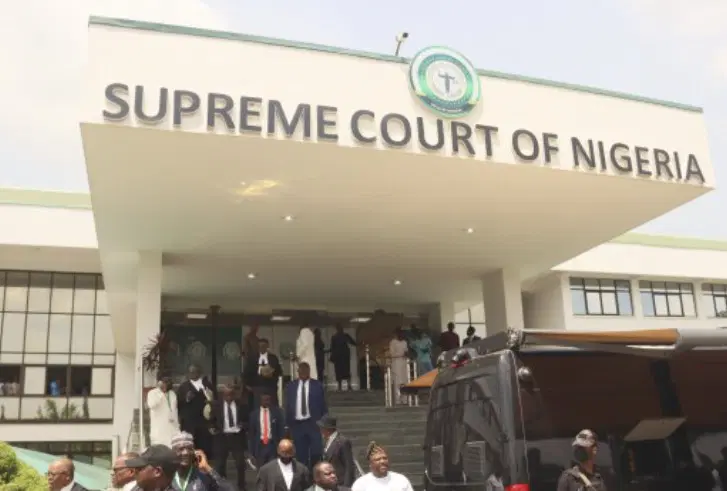
ABUJA: The Supreme Court’s recent decision upholding key provisions of the Electoral Act 2026 has opened a fresh legal and political debate over the eligibility of some candidates preparing to contest the 2027 elections.
The apex court, in a unanimous judgment delivered on September 24, 2026, restored Sections 77(5), 77(6), 77(7) and 84(2) of the Electoral Act after setting aside an earlier Court of Appeal decision that had voided the provisions.
The ruling followed an appeal by the Independent National Electoral Commission (INEC) in a case involving the Zenith Labour Party.
The affected provisions deal principally with political-party membership registers and the procedures parties must follow when nominating candidates.
The Supreme Court held that the provisions were not inconsistent with the 1999 Constitution.
However, the judgment does not automatically disqualify candidates who may be affected by the provisions.
Instead, it creates a legal framework under which individual nominations could face challenges if evidence establishes that the relevant membership, registration, waiver or nomination requirements were not satisfied.
Under the restored provisions, political parties are required to rely on the membership register submitted to INEC within the prescribed period before a primary.
Section 77 also contains requirements concerning party membership registers, while Section 84(2) provides for direct primaries or consensus as methods through which political parties may nominate candidates.
Consequently, questions could arise where a candidate’s membership status, date of joining a political party, waiver, participation in another party’s primary or nomination process is disputed.
Legal experts and political parties have consequently begun examining how the judgment could affect candidates whose political movements or nomination processes occurred close to the relevant deadlines.
The important point, however, is that the Supreme Court did not issue a blanket order cancelling the candidacies of particular politicians.
Any challenge to an individual candidate would still depend on the facts and documentary evidence surrounding that candidate’s nomination.
One of the most prominent cases is that of former Minister of Communications and Digital Economy, Professor Isa Ali Pantami.
Pantami’s situation is not simply a consequence of the Supreme Court’s September 24 judgment.
The Federal High Court in Gombe had separately nullified the PDP governorship primary that produced him and ordered the party to conduct a fresh exercise.
The court found that the process through which Pantami emerged did not comply with the party’s procedures and applicable electoral provisions, including the exclusion of some aspirants who had been screened and cleared to participate.
The court, however, did not grant the request to remove Pantami from the PDP over allegations concerning his membership status.
Following the judgment, the PDP scheduled a fresh governorship primary for September 29, 2026, with Pantami, Khamisu Ahmed Mailantarki and Usman Aliyu Garry cleared to participate.
The legal dispute has nevertheless continued, with lawyers for some of the plaintiffs indicating that appeals and applications concerning the fresh primary remain part of the proceedings.
Attention has also turned to PDP senatorial candidates including Senator Saliu Mustapha in Kwara Central and Kolo Jiya in Kwara North.
Questions have reportedly centred on their previous political affiliations, their movement into the PDP and whether their names appeared on the party’s membership register submitted to INEC within the period prescribed by law.
Another issue is whether waivers granted to new members were sufficient to regularise their participation in the party’s nomination process.
The PDP has disputed suggestions that the Supreme Court judgment automatically invalidated the candidacies.
The party’s position is that the relevant waivers and procedures regularised the membership and nomination processes.
Ultimately, any legal challenge would have to be determined from the documentary record, including the membership register submitted to INEC, the date of submission, the terms of any waiver and the process through which the candidate emerged.
The candidacy of former Ogun State governor’s daughter and former senator, Dr Iyabo Obasanjo, has also attracted attention following the Supreme Court ruling.
Obasanjo resigned from the APC on May 31, 2026, and subsequently returned to the PDP before being presented as its Ogun Central senatorial candidate.
Questions have consequently been raised about whether her name was included in the PDP membership register submitted to INEC within the statutory period before the relevant nomination process.
However, there is no Supreme Court order specifically disqualifying Obasanjo.
Her media aide, Dr Odun Agbalajobi, has rejected suggestions that the apex court judgment invalidated her candidacy, arguing that Obasanjo was not a party to the case decided by the Supreme Court.
A PDP chieftain in Ogun, Adeoye Adewale Adeniran, also accused political opponents of misrepresenting the judgment in relation to her candidacy.
Those statements are political positions rather than judicial findings, meaning the underlying legal question would ultimately depend on the applicable law and documentary evidence.
In Osun State, Senator Olubiyi Fadeyi has also rejected reports suggesting that the Supreme Court judgment ended his bid to return to the Senate.
Fadeyi maintains that no court has issued an order specifically disqualifying him and has defended the process through which he secured the PDP ticket.
The Supreme Court’s judgment itself did not make a candidate-specific finding against Fadeyi.
As with other disputed candidacies, the relevant questions would therefore concern the membership register, applicable waivers and the process through which his nomination was conducted.
The legal implications of the Supreme Court ruling extend beyond the PDP.
Candidates and political parties across the country are now examining their nomination records against the restored provisions of the Electoral Act.
Reports have also raised questions concerning candidates associated with the Social Democratic Party (SDP), Allied Peoples Movement (APM), People’s Redemption Party (PRP) and the APC.
However, claims that particular candidates have already been “disqualified” should be treated carefully unless supported by a specific court order or other authoritative determination.
The Supreme Court ruling establishes the validity of the disputed statutory provisions; it does not, by itself, constitute individual disqualification orders.
The central issue emerging from the judgment is the importance of the membership registers submitted to INEC.
Where a candidate joined a party shortly before a primary, defected from another party, received a waiver or participated in a nomination process under disputed circumstances, the documentary record could become central to any subsequent litigation.
Among the documents likely to come under scrutiny are:
- The political party’s membership register;
- The date the register was submitted to INEC;
- Evidence of the candidate’s membership;
- Any waiver issued to a new member;
- Records of the party primary;
- Evidence of compliance with the party’s constitution and guidelines; and
- Any relevant court orders affecting the nomination.
These records could determine whether an individual nomination survives a legal challenge.
The Supreme Court’s judgment has therefore introduced another layer of legal scrutiny into preparations for the 2027 elections.
Political parties may now need to conduct more detailed reviews of their nomination processes, particularly in cases involving defectors, new members, waivers and candidates whose emergence followed contested primaries.
At the same time, it is important to distinguish between the legal validity of the Electoral Act provisions and the eligibility of individual candidates.
The first has now been addressed by the Supreme Court.
The second remains dependent on the facts, records and, where challenged, decisions in individual cases.
With party primaries and nomination disputes already generating litigation across several states, the restored provisions could become increasingly important as the 2027 election cycle progresses.
For candidates and political parties, the message from the current legal developments is clear: compliance with membership, primary and nomination procedures could face closer judicial scrutiny.
For voters, the unfolding court cases may provide a clearer picture of which candidates have satisfied the statutory and party requirements before the 2027 general electi