


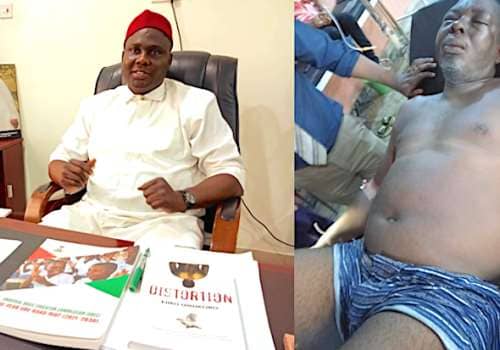
ASABA: The death of Mr. Unity Ekpevbughe Adeda, a Deputy Director in the Delta State Ministry of Secondary Education, has shocked the Delta State public service and raised questions that cannot simply be wished away.
The circumstances surrounding his death are disturbing, disputed and still under investigation.
What Delta State needs now is neither a rush to judgment nor an attempt to minimise the concerns of workers. What it needs is the truth—and the courage to act on the truth when it is established.
According to reports, Adeda was involved in an incident at the Prof. Chike Edozien Secretariat in Asaba on Thursday, September 24, 2026, and subsequently died in hospital. The following day, organised labour shut the State Secretariat in protest and demanded a thorough investigation into what happened.
The police have since commenced a homicide investigation. According to the Delta State Police Command, one suspect, Lucky Adoh, has been arrested while efforts are being made to apprehend two other persons named in the complaint. The police say investigators will examine available video footage, eyewitness accounts, medical records and the actions of all persons connected with the incident.
That is precisely what should happen.
THE ALLEGATION MUST NOT BECOME THE VERDICT
Reports have circulated alleging that Adeda was physically assaulted by aides attached to the Commissioner for Secondary Education, Dr. Kingsley Ashibogwu.
Those are grave allegations.
The Commissioner has denied ordering or participating in any assault and has offered a different account of the events. Other reports have also presented accounts from ministry personnel suggesting that the events immediately preceding Adeda’s hospitalisation were more complicated than the initial reports indicated.
This is precisely why an investigation is indispensable.
At this stage, responsible commentary should distinguish between what is established, what is alleged and what remains to be determined.
The fact that the police have arrested a suspect does not itself establish guilt.
The fact that workers are protesting does not establish the culpability of any particular official.
Conversely, a denial by an accused person does not automatically settle the matter.
The evidence must speak.
That is the essence of due process.
THREE QUESTIONS MUST BE ANSWERED
The investigation should, at the minimum, establish three things.
First, what exactly happened at the Secretariat?
Second, what caused Mr. Adeda’s death?
Third, did the actions or omissions of any person contribute criminally or administratively to his death?
These questions are too important to be answered by rumour, social-media commentary or political sentiment.
If there is video evidence, it should be examined carefully.
If there are eyewitnesses, their statements should be obtained.
If medical records are relevant, they should be professionally evaluated.
If forensic evidence is required, it should be obtained.
And if criminal responsibility is established, the law should take its course.
Nobody should be above the law because of political office, professional position or personal influence.
But nobody should be condemned merely because an allegation has generated public anger.
THE PUBLIC SERVICE MUST HAVE RULES
This tragedy also raises a larger question about the culture of public administration.
The public service is necessarily hierarchical.
Commissioners, Permanent Secretaries, Directors, Deputy Directors and other Officers have different responsibilities and levels of authority.
Disagreements are inevitable.
What must never become inevitable is the use of intimidation or physical confrontation as a means of resolving administrative disagreements.
The public service already possesses mechanisms for dealing with misconduct, insubordination, negligence, disobedience and other breaches of official discipline.
There are queries.
There are investigations.
There are disciplinary committees.
There are representations.
There are decisions and, where applicable, appeals.
The rule of administrative law is preferable to the rule of personal temperament.
This is an important distinction.
Authority must be respected.
But authority must also be exercised within the law and within the established framework of public administration.
Likewise, career officers must understand that professionalism requires respect for lawful authority and compliance with legitimate administrative directives.
The proper relationship is therefore not one of political office holders versus civil servants.
It should be one of authority and professionalism working within the same institutional framework.
HAVING SERVED WITHIN THE SYSTEM
Having spent substantial years in the Delta State public service, including service at the level of Director, I know that tensions can arise between political office holders and career officers.
That is not peculiar to Delta State.
It is an inherent feature of public administration.
Political office holders bring political mandates and policy priorities.
Career public servants bring professional expertise, institutional memory and administrative continuity.
Sometimes the two perspectives will collide.
The strength of a public institution is demonstrated not by the absence of such disagreements but by its capacity to manage them professionally.
That is why the tragedy surrounding Unity Adeda should provoke serious reflection on the quality of workplace leadership, conflict management and administrative discipline within government institutions.
LABOUR’S CONCERN IS LEGITIMATE
The reaction of organised labour is understandable.
If workers believe that a colleague died following an incident at his workplace, they are entitled to demand that the circumstances be investigated.
Workers are entitled to a safe working environment.
They are entitled to dignity.
They are entitled to protection from unlawful violence.
And they are entitled to confidence that complaints concerning their safety will be taken seriously.
The NLC’s intervention has consequently placed workplace safety at the centre of the conversation.
But labour’s legitimate demand for accountability must also be matched by respect for due process.
The investigation should not become a contest between government and labour.
It should be a joint search for the truth.
Indeed, the constitution of an eight-member administrative panel comprising government officials and representatives of organised labour is a potentially important step in that direction. The panel, chaired by the Permanent Secretary in the Office of the Head of Service, has reportedly been given two weeks to establish the circumstances surrounding the incident.
Its work should be allowed to proceed without intimidation, interference or prejudgment.
NO COVER-UP. NO WITCH-HUNT.
There are two dangers Delta State must avoid.
The first is cover-up.
The second is trial by public opinion.
A cover-up would be disastrous because it would deepen public distrust and create the impression that powerful people can escape accountability.
But a premature conclusion would also be dangerous because it could compromise the investigation and unfairly condemn persons before the evidence has been tested.
The correct position is simple:
No cover-up. No witch-hunt.
Let the police investigate the criminal dimension.
Let the administrative panel examine the institutional dimension.
Let the evidence determine responsibility.
Let the law determine consequences.
And let the public know, as far as legally and reasonably possible, what the investigations establish.
WHAT HAPPENS AFTER THE HEADLINES?
Perhaps the most important question is what happens after this controversy leaves the headlines.
If wrongdoing is established, appropriate action must follow.
But even if the investigations establish that the allegations of assault were unfounded, Delta State should not simply close the file and move on.
There are still valuable institutional lessons to be learned.
Government should examine whether its existing mechanisms for managing workplace conflict are sufficiently robust.
Are there effective channels through which a senior civil servant can challenge an administrative directive without being perceived as insubordinate?
Are political office holders adequately trained in public-sector conflict management?
Do ministries have effective procedures for dealing with highly volatile incidents?
Are workers sufficiently aware of their rights and responsibilities?
Can an emerging workplace crisis be de-escalated before it becomes dangerous?
These are not academic questions.
They go to the heart of good governance.
A HUMAN LIFE IS NOT AN ADMINISTRATIVE FILE
In the middle of all the allegations, counter-allegations and institutional reactions, we must not forget the human being at the centre of this tragedy.
Unity Adeda was not merely a Deputy Director.
He was someone’s husband, father, relative, friend and colleague.
For his family, this is not a newspaper story.
It is a devastating personal loss.
For his colleagues, it is a painful reminder of the vulnerability that can exist even within what should ordinarily be a safe workplace.
And for the Delta State Government, it is a test of whether its institutions can respond to a grave crisis with transparency, fairness and courage.
DELTA MUST GET THIS RIGHT
This is therefore not the time for propaganda.
It is not the time for political point-scoring.
It is not the time for collective condemnation.
And it is certainly not the time for institutional defensiveness.
It is time for evidence.
It is time for professional investigation.
It is time for transparency.
And, above all, it is time for justice.
If the evidence establishes that someone unlawfully contributed to the death of Unity Adeda, that person or persons must face the consequences prescribed by law.
If the evidence establishes otherwise, that conclusion must equally be respected.
That is what justice means.
Delta State must demonstrate that public office is a responsibility, not immunity; that workers have dignity, not merely duties; and that the rule of law applies equally to the powerful and the powerless.
The most fitting tribute to Unity Ekpevbughe Adeda would therefore not be another round of accusations.
It would be the establishment of the truth.
And when that truth is established, the courage to act on it.
Frank Odion Apokwu, a former Director of Administration and Project Coordinator in the Delta State Civil Service, is now a Management Consultant, Public Affairs Analyst and Inclusive Development Advocate. He writes from Asaba.
Saturday, 26th September, 2026.



[…] THE DEATH OF UNITY ADEDA: DELTA MUST ESTABLISH THE TRUTH By Frank Odion Apokwu […]