


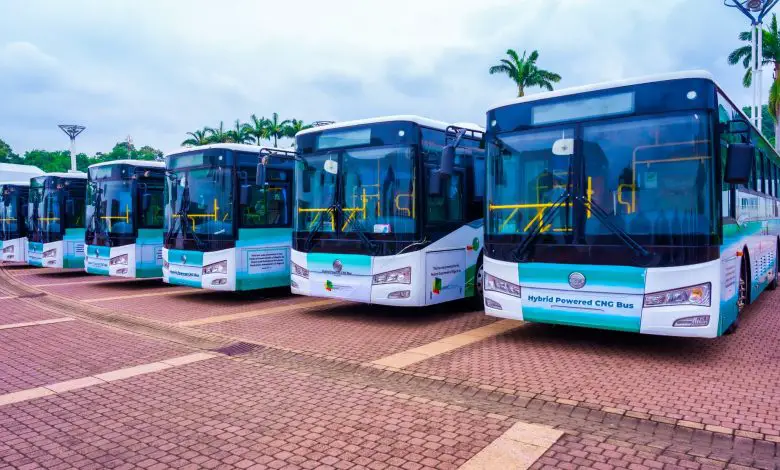
ABUJA: The Federal Government has announced that commuters in several parts of Nigeria are already benefiting from lower transport fares following the expansion of Compressed Natural Gas (CNG) and electric vehicles (EVs) across major routes.
The development is part of the National Affordable CNG Transit Programme, with the government targeting October 1 as a key date for Nigerians to begin seeing more measurable reductions in transportation costs.
President Bola Ahmed Tinubu had directed the Federal Government, state governments and transport operators to accelerate the adoption of alternative-energy vehicles and ensure that savings from lower energy costs are passed on to commuters.
According to the Presidential Initiative on Compressed Natural Gas and Electric Vehicles (Pi-CNG & EV), deployments in seven states and the Federal Capital Territory are already producing fare reductions ranging from 31 per cent to 83 per cent on some routes.
Executive Chairman of Pi-CNG & EV, Barrister Ismaeel Ahmed, said the programme would be judged by its impact on passengers rather than simply by the number of vehicles converted or deployed.
Read also:
- CNG: Why Tinubu Orders States to Cut Transport Fares from October 1
- CNG kits Rolls Out Nationwide By Federal Govt
He explained that states were adopting different models based on their transportation needs, including CNG buses, electric buses, taxis and tricycles.
“If an operator is spending less on energy but the passenger continues to pay the same fare, then our work is not complete, Ahmed said.
Borno State is among the states recording significant activity under the programme.
The state currently has 500 electric tricycles, 20 electric buses and 150 electric saloon cars and taxis operating alongside eight solar-powered charging terminals.
Subsidised fares have reportedly brought transportation costs down to as low as N50 for buses, N100 for taxis and N200 for tricycles.
Borno is also developing CNG infrastructure, with three refuelling stations planned for Maiduguri alongside conversion facilities designed to support wider adoption of gas-powered vehicles.
In Enugu State, 100 CNG buses operated by FEMADEC on behalf of the state government are serving major routes, including the Enugu–Nsukka corridor.
On the route, fares that previously ranged between N3,000 and N4,000 have reportedly fallen to about N1,600 on the CNG-supported service.
The lower fares are also putting competitive pressure on other transport operators serving the corridor.
Abia State has deployed 40 electric buses, with fares subsidised by 50 per cent, while Zamfara is introducing 100 electric taxis expected to operate at fares about 40 per cent below conventional alternatives.
Lagos is also recording reductions on selected CNG-supported routes.
According to Pi-CNG & EV, the Ikorodu–Fadeyi route has dropped from N1,200 to N680, while Ikorodu–Maryland has fallen from N1,000 to N570.
On the Ikeja–Obalende route, fares have reportedly declined from N1,400 to N720.
The reductions come as the government seeks to make alternative-energy transportation a larger component of Nigeria’s public transport system.
Commuters in the Federal Capital Territory are also benefiting from lower fares on selected CNG bus routes.
The Kubwa–Berger and Apo–Nyanya/Maraba routes now cost about N500, compared with N1,000 previously.
Masaka–Berger has dropped to N600 from N1,000, while Berger–Gwagwalada has fallen to N700 from N1,200.
The initiative said an additional 26 buses are expected to join the FCT fleet.
Other states are at different stages of implementing the programme.
In Akwa Ibom, the proposed fare for the Uyo–Ikot Ekpene route is N650, compared with an existing fare of about N1,300.
In Edo State, the proposed Benin–Auchi fare is N4,000, compared with N8,000.
Delta State is also preparing a CNG-supported Warri–Asaba service, with a proposed fare of N4,900 against the current N7,000.
In Jigawa, the proposed Dutse–Kano fare is N2,000, down from about N3,500.
Kaduna State, meanwhile, operates 100 CNG buses that provide free transportation on major routes. The buses reportedly carried about 3.2 million passengers during their first year of operation, with estimated commuter savings of N3.5 billion.
States including Delta, Jigawa, Ogun and Oyo are also developing interventions aimed at expanding access to cheaper alternative-energy transportation.
Pi-CNG & EV said 61 buses in the current deployment are designated for commercial operations across the FCT, Kano, Lagos, Delta, Kaduna, Katsina, Enugu, Borno and Niger states.
The government is also working with partners to establish at least 150 operational CNG refuelling stations before the end of the year as the conversion of vehicles gathers pace.
Markets in Kano and parts of the South-East are among the areas where conversion activity is being expanded.
Ahmed said the October 1 target should be viewed as the beginning of a broader expansion rather than the conclusion of the programme.
He said additional vehicles, routes and supporting infrastructure would be required before the benefits of lower energy costs could reach more commuters across the country.
The initiative is expected to continue working with state governments, transport unions, operators and private investors to expand CNG and EV infrastructure and ensure that reduced energy costs translate into lower transportation fares for Nigerians.


