


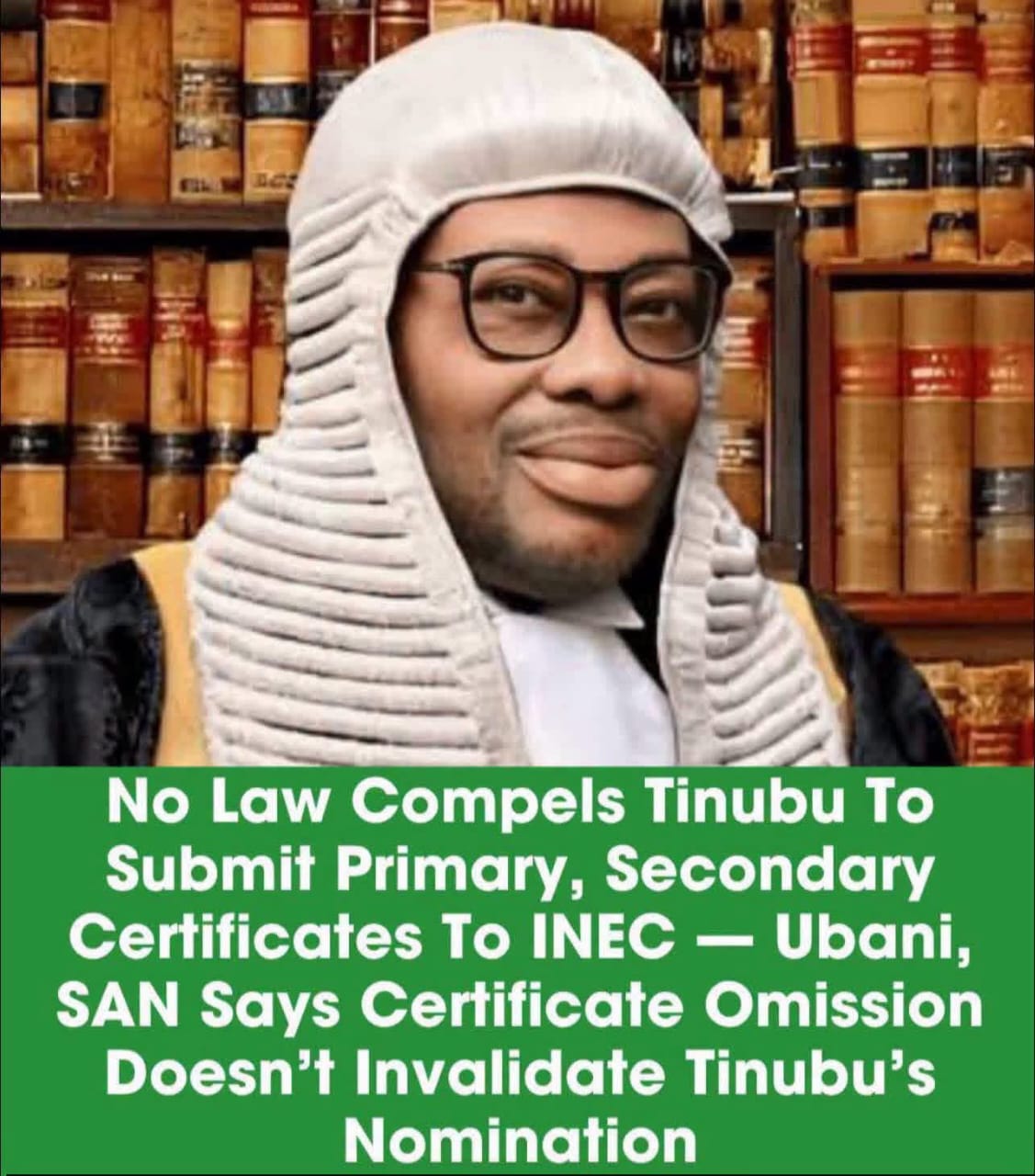
A graphic currently circulating on social media declares:
No Law Compels Tinubu To Submit Primary, Secondary Certificates To INEC — Ubani, SAN Says Certificate Omission Doesn’t Invalidate Tinubu’s Nomination.”
The statement deserves something more valuable than political applause or outrage: legal scrutiny.
The controversy surrounding President Bola Ahmed Tinubu’s educational records has been with us for years. But the present debate provides an opportunity to distinguish between what the Constitution actually requires, what the Electoral Act requires, and what political actors merely assume the law requires.
The first point is fundamental.
What does Section 131 of the Constitution require?
Section 131 of the Constitution of the Federal Republic of Nigeria 1999 (as amended) provides that a person shall be qualified for election as President if, among other things, “he has been educated up to at least School Certificate level or its equivalent.”
Notice what the Constitution says — and what it does not say.
It does not expressly provide that a presidential candidate must submit both a primary-school certificate and a secondary-school certificate to INEC.
Indeed, the Supreme Court has previously interpreted the educational qualification requirement in a manner that is highly relevant to today’s controversy.
In Atiku Abubakar & Anor v INEC & Ors (2020) 12 NWLR (Pt. 1737) 37, the Supreme Court considered the meaning of the constitutional educational requirement. The Court’s reasoning, as subsequently reported and discussed in legal literature, was that mere attendance at primary or secondary school, even without obtaining the corresponding certificate, could satisfy the constitutional requirement; obtaining a certificate is not itself a condition precedent to qualification.
That is a remarkably important authority.
It means we must not confuse the constitutional qualification with possession or production of a particular physical certificate.
But what about the Electoral Act?
This is where the analysis becomes more interesting.
Section 29(2) of the Electoral Act 2022 requires the information submitted by a candidate to be accompanied by an affidavit sworn to by the candidate indicating that he or she has fulfilled all constitutional requirements for election.
Section 29(4) further permits any person to obtain copies of the nomination form, affidavit and other documents submitted by a candidate.
More significantly, section 29(5) provides a mechanism for challenging false information relating to constitutional eligibility, while section 29(6) provides consequences where the court determines that information concerning constitutional eligibility is false.
Thus, there is undoubtedly a legal obligation upon candidates to provide truthful information.
But that is different from saying that every certificate relating to a candidate’s educational history must necessarily be physically submitted to INEC.
That distinction is critical.
So where does Tinubu’s case become controversial?
President Tinubu’s 2022 INEC documentation became controversial because the spaces relating to his primary and secondary education were left blank, while his educational history prominently included his tertiary education. Contemporary reporting confirmed that the primary and secondary-school fields were not completed.
There were also questions surrounding his affidavit and his explanation that academic documents had been lost or stolen during his period of self-exile.
Those are legitimate matters for public scrutiny.
But we must be careful not to jump from:
“He did not provide these particular certificates”
to:
“He was therefore constitutionally disqualified.”
The latter proposition does not automatically follow from the former.
Indeed, Atiku v INEC makes the simplistic certificate argument considerably more difficult to sustain.
Three questions must be separated
The debate becomes much clearer if Nigerians ask three different questions.
1. Did Tinubu satisfy the constitutional educational requirement?
That is a question under Section 131(d) of the Constitution.
2. Was he legally required to submit primary and secondary certificates specifically to INEC?
That is a question of the Constitution, the Electoral Act, INEC’s prescribed nomination procedures and the applicable judicial interpretation.
3. Did he provide any false or misleading information concerning his constitutional qualification?
That is an entirely different legal question.
The third question can potentially have serious consequences because Nigerian electoral law does not protect falsehood merely because a candidate possesses some higher educational qualification.
The Supreme Court has repeatedly treated allegations of false information and qualification as matters governed by the specific constitutional and electoral provisions applicable to them. Abubakar v INEC (2020) 12 NWLR (Pt. 1737) 37, for example, is important on the treatment of false information in nomination documents.
And what about a forged certificate?
This is where another important distinction arises.
Section 137(1)(j) of the Constitution provides that a person shall not be qualified for election as President if he has presented a forged certificate to the Independent National Electoral Commission.
That provision is plainly different from merely omitting a certificate.
Therefore, the propositions cannot reasonably be treated as synonymous:
Omission ≠ forgery.
And:
Failure to submit a certificate ≠ proof that the candidate lacks the qualification.
If, however, a person actually presented a forged certificate to INEC, that raises a completely different constitutional question.
The allegation of forgery itself must also be properly established. Nigerian appellate jurisprudence has consistently recognised the serious evidential burden associated with allegations of criminal conduct such as forgery.
The Supreme Court has already spoken — and that matters
There is another reason why this debate should not be conducted as though the law were an entirely blank page.
In Atiku Abubakar v INEC, the Supreme Court considered the very constitutional educational requirement now being discussed.
The Court’s interpretation substantially undermines the popular proposition that:
“Unless a presidential candidate produces his secondary-school certificate, he cannot constitutionally contest.”
That is simply too broad.
The Constitution requires education up to at least School Certificate level or its equivalent. The judicial interpretation of that provision cannot simply be replaced by popular expectations about what a candidate ought to have submitted.
This does not, however, mean that candidates are entitled to misrepresent their educational history.
There is a world of difference between saying:
> “The Constitution does not require me to submit this particular certificate.”
and saying:
> “I attended a particular school or obtained a particular qualification,” when that statement is false.
The first may be legally defensible.
The second may have serious legal consequences.
The larger issue is integrity, not merely certificates
This is where the Nigerian debate often goes wrong.
A candidate may be legally qualified yet still face legitimate questions about transparency.
Conversely, a candidate may fail to produce a particular document but still be legally qualified under the Constitution.
Law determines qualification.
Integrity determines public confidence.
A President should not merely satisfy the minimum legal threshold. Nigerians are entitled to expect a higher standard of transparency from anyone seeking the nation’s highest political office.
That is why the questions surrounding Tinubu’s educational history cannot simply be dismissed as political propaganda.
But neither should every inconsistency, omission or unanswered question automatically be converted into a declaration of constitutional disqualification.
The balanced conclusion
The claim in the circulating graphic is therefore substantially defensible in its narrow proposition but misleading if interpreted broadly.
No provision of Section 131 of the Constitution expressly says that a presidential candidate must submit both primary and secondary-school certificates to INEC.
More importantly, the Supreme Court’s decision in Atiku v INEC indicates that possession of the physical certificate is not itself the indispensable constitutional condition for presidential qualification.
But this does not give any candidate a licence to provide false information.
Section 29 of the Electoral Act imposes obligations concerning the information and affidavit submitted to INEC, and the law provides mechanisms for challenging false information relating to constitutional eligibility.
Therefore, the intellectually honest position is neither:
Tinubu did not submit his primary and secondary certificates; therefore he was unqualified.
nor:
The Constitution does not require those certificates, therefore every question about Tinubu’s educational records is irrelevant.
Both propositions go too far.
The correct legal position is more nuanced:
The Constitution requires a presidential candidate to have been educated up to at least School Certificate level or its equivalent. It does not expressly make the production of primary and secondary certificates a condition precedent to presidential candidature.
However, any information supplied to INEC concerning constitutional eligibility must be truthful, and any allegation of falsehood or forgery must be determined according to the applicable constitutional, electoral and evidentiary rules.
That is the law as opposed to the politics.
And in a constitutional democracy, we should be mature enough to defend the law even when the result favours the politician we oppose — and to question political conduct even when the politician we support benefits from it.
Frank Odion Apokwu, a
Public Affairs and LL.M. Scholar, writes from Asaba.