


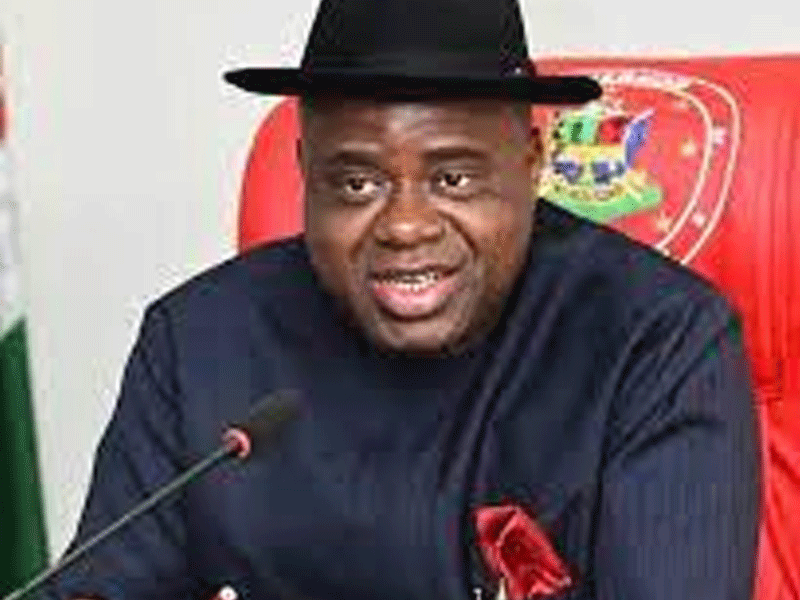
Bayelsa State Governor, Douye Diri, has challenged former Cross River State Governor Donald Duke over his criticism of the Lagos-Calabar Coastal Highway, insisting that the ambitious federal infrastructure project is achievable despite the challenging coastal terrain.
Diri described Duke’s comments as disappointing, arguing that they failed to reflect the progress made in road and bridge construction across Bayelsa State, where several major infrastructure projects have been completed in swampy and mangrove environments.
The disagreement followed Duke’s appearance on Arise Television, where the former governor reportedly described the 750-kilometre Lagos-Calabar Coastal Highway as practically impossible because of the difficult terrain, particularly in Bayelsa.
Duke argued that the extensive swamps in the state would make construction extremely challenging, potentially requiring hundreds of bridges to navigate the affected areas.
However, Diri maintained that modern engineering techniques and existing infrastructure projects in Bayelsa demonstrate that such challenges can be overcome.
In a statement issued by his Chief Press Secretary, Daniel Alabrah, the Bayelsa governor said he was disappointed that a former governor from the South-South region would dismiss the coastal highway project on the basis of the state’s terrain.
Diri suggested that Duke’s criticism might have been influenced by political considerations rather than an assessment of the engineering possibilities and potential benefits of the project.
According to the governor, Bayelsa has successfully constructed dual carriageways, bridges and major roads across swamps, forests and mangrove areas.
He specifically cited the Nembe-Brass Road, the Sagbama-Ekeremor-Agge Road and the Yenagoa-Oporoma Road as examples of infrastructure projects built across challenging terrain in the state’s three senatorial districts.
Diri also highlighted the 630-metre bridge across River Nun at Angiama community in Southern Ijaw Local Government Area, describing it as one of the longest bridges in the region.
The governor further referenced the dualised roads in New Yenagoa City and Glory Drive Phases One, Two and Three as evidence that road construction is possible even in difficult environmental conditions.
He said these projects demonstrated that Bayelsa’s swampy landscape should not automatically be considered an insurmountable obstacle to major infrastructure development.
The Lagos-Calabar Coastal Highway is a major federal infrastructure project designed to connect Nigeria’s southwestern and southeastern coastal areas with the South-South region.
The proposed 750-kilometre route traverses nine coastal states: Lagos, Ogun, Ondo, Edo, Delta, Bayelsa, Rivers, Akwa Ibom and Cross River.
Supporters of the project argue that it could improve transportation, reduce travel difficulties, stimulate investment and open up coastal and riverine communities to greater economic opportunities.
Diri said the project was particularly important to communities in the Niger Delta, where difficult terrain and limited road access have historically complicated transportation and development.
In his response, the governor declared that Duke was wrong to conclude that the highway could not be built, pointing to the infrastructure already constructed in Bayelsa as evidence of what engineering could achieve.
He maintained that the project was both possible and necessary for the development of the region.
The Bayelsa governor also emphasised the historical significance of the coastal highway to the Ijaw people, saying the project had been a longstanding demand of the Ijaw National Congress (INC).
According to Diri, the organisation had advocated the project since its emergence in the 1990s, with successive administrations at the federal level failing to fulfil the demand.
He credited President Bola Tinubu’s administration with eventually undertaking the project after years of requests from the region.
Diri identified the interests of his people as one of the considerations behind his decision to join the All Progressives Congress (APC), arguing that development and the welfare of his constituents remain paramount.
The governor also warned politicians against turning infrastructure development into a political dispute, particularly during election periods.
He said the consequences of politicising development projects are ultimately borne by ordinary citizens, whose votes politicians seek during elections.
The exchange between Diri and Duke highlights differing views over the feasibility of constructing major infrastructure across Nigeria’s coastal wetlands.
While Duke raised concerns about the engineering difficulties posed by Bayelsa’s swampy terrain, Diri pointed to completed road and bridge projects as evidence that those obstacles can be addressed.
The debate also brings renewed attention to the Lagos-Calabar Coastal Highway, a project expected to have significant implications for transportation, commerce and connectivity across Nigeria’s coastal states.
For Diri, the question is not whether the terrain presents challenges, but whether those challenges can be overcome through engineering expertise, adequate planning and sustained investment.
He insists that Bayelsa’s experience provides a practical example of why the coastal highway should not be dismissed as impossible.
By RapidoSpace News
Visit www.rapidospace.com for more Nigerian politics, infrastructure and development news.


