


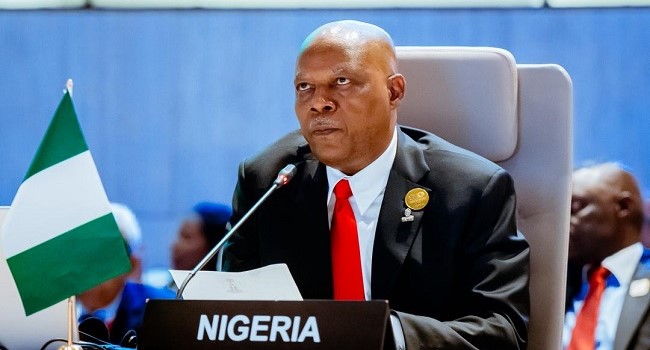
NEW YORK: Vice President Kashim Shettima has urged African countries to move away from the long-standing practice of exporting mineral resources without capturing enough value through local processing, industrialisation and manufacturing.
Shettima made the call in New York while representing President Bola Tinubu at the Africa Minerals Strategy Group(AMSG) High-Level Roundtable, where he stressed the need for stronger continental cooperation in developing Africa’s mineral resources.
The Vice President argued that Africa could not consider itself wealthy if communities located around mineral deposits continued to experience poverty despite the value generated from the resources extracted from their surroundings.
According to Shettima, African countries need to pursue policies that ensure a greater share of the economic benefits from mineral resources remains within the continent.
He cautioned against a situation where African countries compete with one another for foreign investment by offering lower royalties, weaker local-content requirements and excessive concessions.
Read also:
- Shettima to Lead Nigeria’s Delegation to 81st UN General Assembly in New York
- Tinubu Retains Shettima as Running Mate, Officially Launches 2027 Re-Election Bid
Instead, he advocated the development of integrated African markets, regional mineral-processing hubs and cross-border mineral corridors capable of giving the continent greater scale and improving its position in global mineral supply chains.
The Vice President said African countries must focus not only on extracting minerals but also on processing and transforming them into products that can support industries, create jobs and generate greater economic value.
Shettima also highlighted reforms being implemented in Nigeria’s mining sector, including efforts to increase local value addition, improve geological information, formalise artisanal mining and strengthen measures against illegal mining.
He pointed to increasing mining revenues and investments in lithium processing in Nasarawa State as examples of the opportunities available to Nigeria through domestic mineral beneficiation.
The Vice President also expressed support for the AMSG’s Mutual Assured Development (MADE) Framework, which seeks to establish clearer expectations for both governments and investors in Africa’s mining sector.
Under the framework, governments are expected to provide predictable policies and credible institutions, while investors should bring responsible capital, technology transfer, local value creation and sustained investment.
Shettima further called for the Continental Integration and Economic Assurance Declaration to move beyond its signing and become a practical implementation programme.
He said the initiative should be supported by clear timelines, financing arrangements and accountability mechanisms to ensure that its objectives translate into measurable economic benefits.
According to him, the real success of Africa’s mineral strategy should ultimately be reflected in improved roads and railways, factories, competitive African businesses, skilled employment and better living conditions in communities where mining activities take place.
He stressed that possessing large quantities of mineral resources alone does not automatically translate into prosperity.
At the same meeting, Nigeria’s Minister of Solid Minerals Development and Chairman of the AMSG, Dele Alake, proposed the creation of an African Artisanal Mining Formalisation and Safety Facility.
Alake said the proposed facility could help African countries address the dangers associated with informal and poorly regulated artisanal mining.
He referred to recent mining-related fatalities in the Democratic Republic of Congo, the Central African Republic and Sudan, where mine-site collapses resulted in the deaths of numerous workers.
According to the minister, the proposed mechanism could assist member states with cooperative formation and licensing, basic geological support, access to safer mining equipment, occupational health and safety training, environmental rehabilitation and emergency preparedness in major artisanal mining areas.
The New York meeting brought together African ministers, development finance institutions, multilateral organisations and executives from mining, technology and mineral-processing companies.
A representative of the United States Government and Special Adviser to the U.S. State Department on the Bureau of African Affairs, Chris Kulukundis, also attended the meeting and expressed the U.S. government’s readiness to partner with African countries in developing the continent’s mineral resources.
A major outcome of the meeting was the signing of the Continental Integration and Economic Assurance Declaration by participating member countries.
The declaration is expected to provide a framework for greater continental cooperation on critical minerals, including mineral value addition, policy coordination and broader integration of Africa’s mineral economies.
For Africa, the push reflects a growing emphasis on moving beyond the extraction and export of raw minerals towards processing, manufacturing and the development of industries capable of retaining more of the value generated by the continent’s natural resources.



[…] Shettima Urges Africa to Stop Exporting Raw Minerals, Push for Local Processing […]