


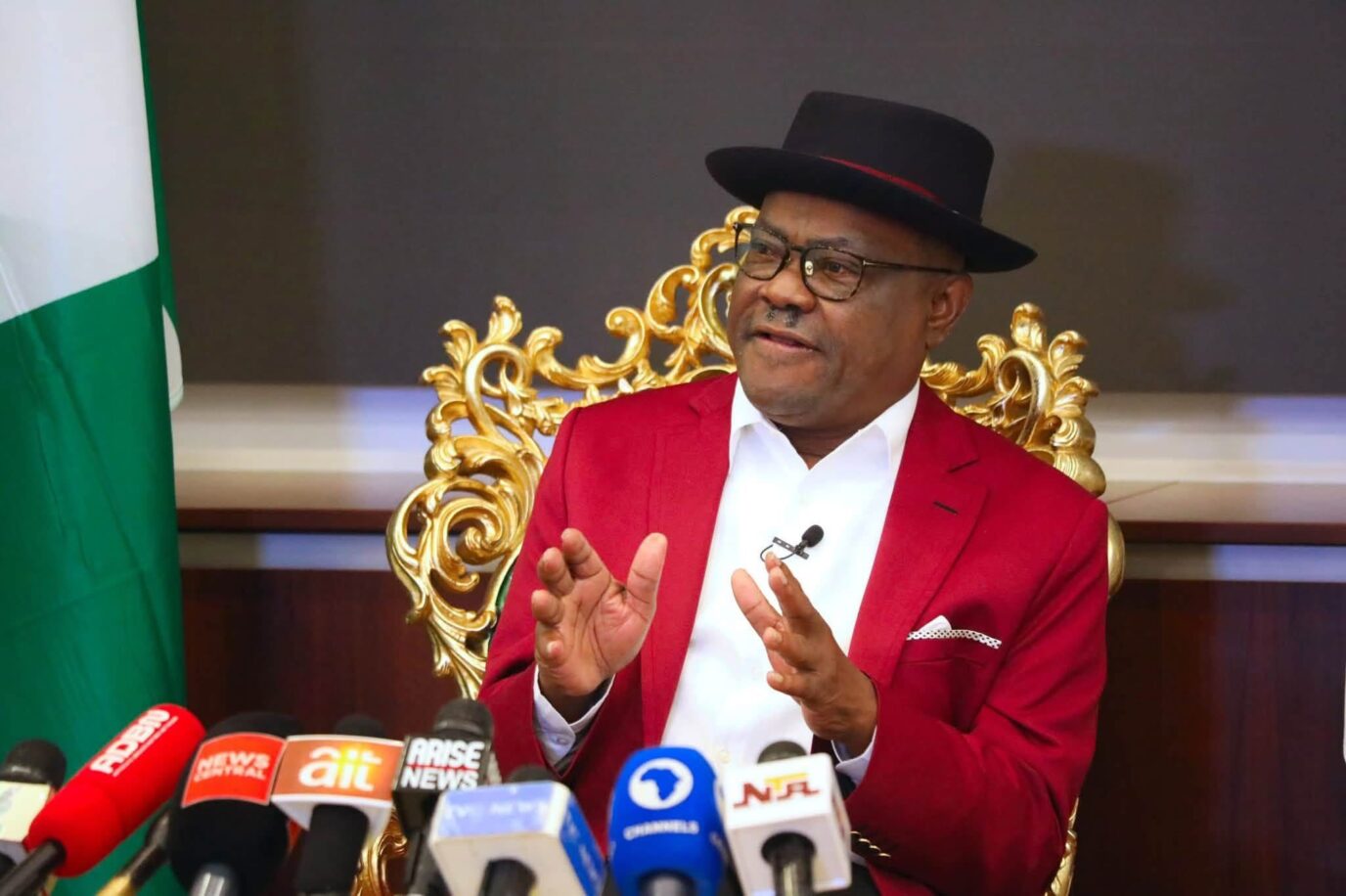
ABUJA: Federal Capital Territory Minister Nyesom Wike has revealed details of the strategy he said the former G5 governors adopted during the 2023 presidential election to prevent then-Peoples Democratic Party (PDP) candidate Atiku Abubakar from benefiting from the party’s strength in the South-South.
Wike said the group deliberately allowed Peter Obi, who contested the 2023 presidential election on the platform of the Labour Party, to make gains in some South-South states because they considered Atiku a major political threat in the region.
He made the disclosure during an appearance on TVC’s Journalists’ Hangout on Monday, September 21, 2026.
According to Wike, the G5 governors believed the PDP had considerable political strength across the South-South and that allowing Atiku to benefit from that strength could improve his chances in the 2023 presidential contest.
He said the group therefore adopted a strategy under which votes in some states could go to Obi rather than Atiku.
“When you talk of South-South, I can tell you what happened. How did he (Obi) win? We, in the G5, had our strategy,” Wike said.
He explained that the group viewed the PDP’s strength in the region as an advantage that could benefit Atiku.
“Our problem would be Atiku. Therefore, instead of Atiku to take it, let it go to the Labour Party,” he said.
Wike specifically identified Edo and Cross River as states where he said the strategy was applied. Reports of his remarks said he explained that the G5 considered the PDP particularly strong in those states.
Wike said Rivers State was treated differently because the group believed an Obi victory there could carry a different political message.
He said he personally opposed allowing Obi to win Rivers, arguing that such an outcome could send a political signal that the group did not want.
“It was only in Rivers, I said, ‘No, Obi would not win here because if he does, it would send a wrong signal somewhere and people would not understand it.’ And we stopped it,” Wike said.
Wike’s comments therefore present the G5’s 2023 approach as a deliberate political calculation aimed primarily at limiting Atiku’s benefit from the South-South, rather than simply an effort to promote Obi.
The FCT minister also argued that the political environment that contributed to Obi’s strong performance in parts of the country in 2023 has changed.
He pointed to the controversy surrounding the Muslim-Muslim presidential ticket during the 2023 campaign as one of the factors that, in his view, contributed to Obi’s support.
In 2023, there was this campaign of Christianity, Muslim-Muslim ticket. And it was serious,” Wike said.
He added that the political circumstances were different ahead of the 2027 election.
Wike further claimed that Obi no longer has the same level of popular support he enjoyed during the previous presidential contest. That assessment is Wike’s political view rather than an independently established measure of current voter support.
Wike also spoke about the 2027 presidential election and said the circumstances surrounding the next contest should not be assessed solely through the experience of 2023.
He questioned how Obi would reproduce his 2023 performance in states such as Cross River, Akwa Ibom and Delta under the current political circumstances.
The minister has also publicly backed President Bola Tinubu’s bid for another term, making his comments part of the wider political debate over the alliances and realignments expected ahead of the 2027 election.
The G5 was formed by five PDP governors who opposed Atiku’s presidential candidacy ahead of the 2023 election.
The group consisted of Nyesom Wike of Rivers State, Seyi Makinde of Oyo State, Samuel Ortom of Benue State, Ifeanyi Ugwuanyi of Enugu State and Okezie Ikpeazu of Abia State.
Their disagreement with the PDP leadership centred largely on the party’s presidential ticket and the demand by the governors that the presidency should return to the South after President Muhammadu Buhari’s eight-year tenure.
The disagreement eventually led the five governors to withhold their support for Atiku during the 2023 presidential campaign.
Makinde has since fallen out politically with Wike, particularly over the FCT minister’s support for Tinubu’s political agenda.
Wike’s latest comments have reopened discussion about the political calculations and alliances that shaped the 2023 presidential election.
His account provides his own explanation of why the G5 did not support Atiku and how the group approached the South-South, particularly in states where the PDP traditionally had significant support.
The comments also highlight the extent to which internal party disputes and regional political calculations influenced the campaign leading into the 2023 election.
As Nigeria moves toward the 2027 election cycle, the disclosure is likely to remain part of discussions about the role of political alliances, incumbency, regional voting patterns and the decisions of influential political actors.
For now, Wike’s account is a description of the strategy he says the G5 adopted in 2023. It should be distinguished from independently verified evidence establishing the extent to which that strategy directly determined individual election results.



[…] Wike Reveals How G5 Governors Let Peter Obi Gain in South-South to Hurt Atiku in 2023 […]