


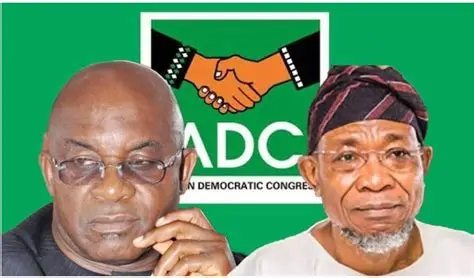
ABUJA: The internal leadership battle within the African Democratic Congress (ADC) has taken a fresh turn, with a Federal High Court ruling against the party’s current national chairman, David Mark, and national secretary, Rauf Aregbesola, in a suit that could reshape who legitimately controls the party going into the 2027 election cycle.
Justice Peter Odo Lifu dismissed objections raised by Mark and Aregbesola against an application filed by ADC chieftain Nafiu Bala Gombe, who sought to amend his originating claims in a leadership dispute suit.
The judge found the objections lacked merit, describing the requested amendment as a routine step in civil litigation rather than an attempt to disadvantage the defendants. He noted the amendment was partly triggered by a change in Gombe’s legal representation and concluded that Mark and Aregbesola would not be prejudiced or denied a fair hearing by allowing it to proceed.
As a consequence of dismissing the objections, the court imposed a ₦500,000 fine on each of the two men a combined ₦1 million payable directly to Gombe. With the objections cleared, Gombe is now free to proceed with his amended claims challenging how Mark and Aregbesola came to occupy their current positions.
At the center of the case is a disagreement over how ADC’s national leadership changed hands. Gombe, who previously served as the party’s deputy national chairman, contends that the process which installed Mark and Aregbesola breached both the ADC’s internal constitution and provisions of the Electoral Act.
He is asking the court to bar the two men from continuing to hold themselves out publicly as the party’s legitimate leaders.
Aregbesola has pushed back firmly on that framing. His position is that the ADC’s National Executive Committee (NEC) lawfully effected the leadership change during a properly convened meeting on July 29, 2025, and that all necessary procedural steps including notifying the Independent National Electoral Commission (INEC) of the meeting on July 1 — were followed. In his view, this makes the emergence of the current leadership fully valid under party and electoral rules.
Beyond disputing the legitimacy question itself, Aregbesola’s camp also raised procedural concerns about Gombe’s litigation conduct alleging that an unsigned version of the ADC constitution was initially submitted as an exhibit, only for a signed version to surface later, after objections had already been raised.
Mark’s legal team separately argued that permitting the amendment at this stage would be unjust, framing it as a departure from natural justice given that the defendants had already filed their formal responses to the original suit.
One detail giving the case added weight is that it arrives after a Supreme Court directive ordering an accelerated hearing of the matter a sign of how urgently the country’s judiciary appears to be treating the resolution of ADC’s leadership question.
Aregbesola’s legal team pointed to this directive in arguing that Gombe’s amendment request, coming after that order, should be viewed with skepticism rather than granted routinely.
The list of defendants in the suit extends beyond Mark and Aregbesola to include the ADC as an institution, INEC, and Ralph Nwosu, a former national chairman of the party underscoring that the dispute isn’t simply a disagreement between two individuals, but a structural question about the party’s chain of leadership legitimacy.
With the objections dismissed and the amendment granted, the case now moves forward on Gombe’s expanded claims. The ruling doesn’t resolve the underlying leadership question it simply clears a procedural hurdle that allows the substantive dispute over ADC’s rightful leadership to be argued more fully in court.
Given the accelerated hearing order from the Supreme Court, further developments in this case are likely to come relatively quickly, and the outcome could have real consequences for how the ADC positions itself ahead of the 2027 general election, a period when internal party cohesion or the lack of it tends to draw significant political attention.


