


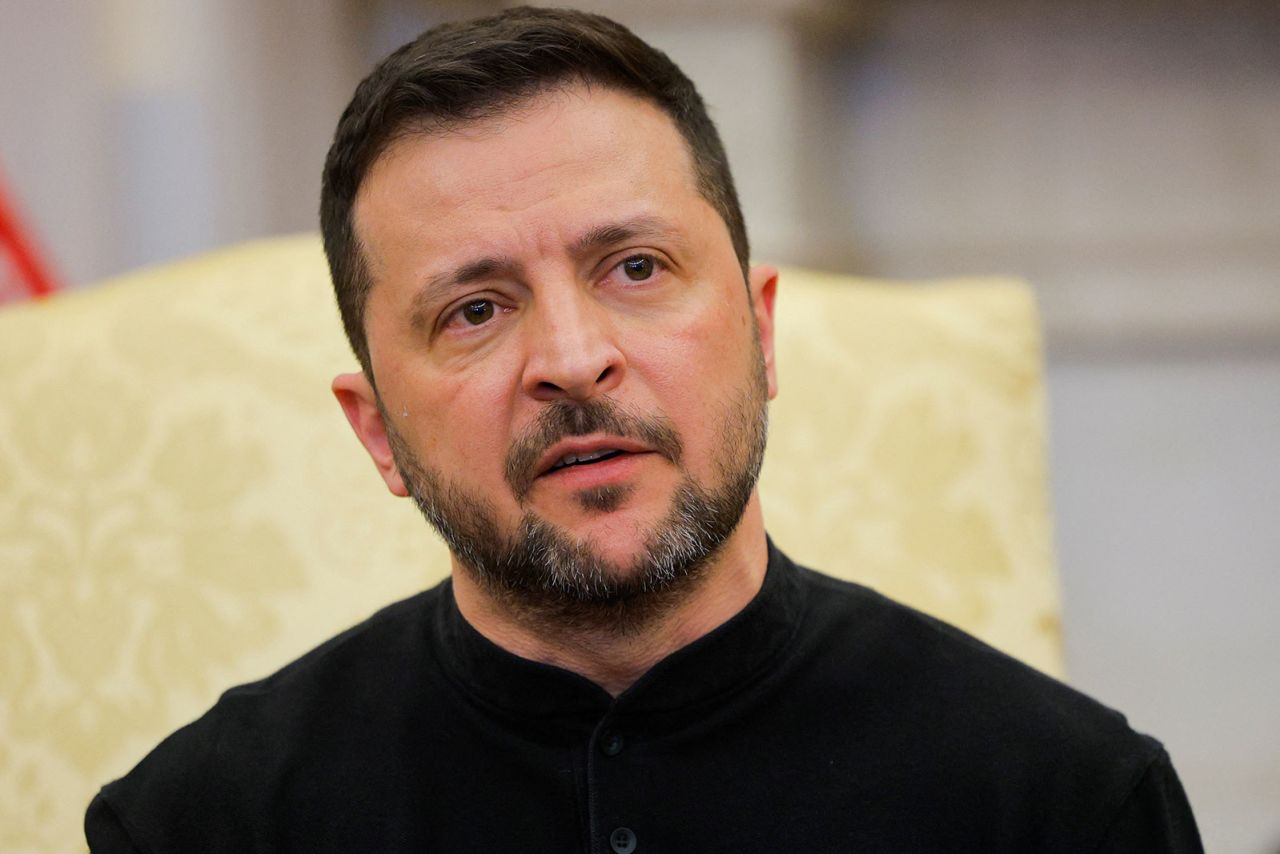
Ukrainian President Volodymyr Zelenskyy has offered to stop attacks on Russian oil refineries and diesel infrastructure if Russian President Vladimir Putin agrees to halt strikes on Ukraine’s energy facilities, as tensions with US President Donald Trump deepen over the nearly five-year war.
In an exclusive interview with ABC News aired on Sunday, October 11, 2026, Zelenskyy defended Ukraine’s attacks on Russian energy infrastructure, arguing that Kyiv was responding to Russia’s repeated strikes on its power facilities and other critical infrastructure.
The Ukrainian leader said his country remained ready for a ceasefire and urged Trump to press Moscow to stop attacking Ukraine’s energy installations.
“I said it to President Trump … to his team and to his people several times: we want peace, we are ready for [a] ceasefire, we are ready to begin from any kind of steps of de-escalation,” Zelenskyy told ABC News anchor Jonathan Karl.
He added that Ukraine would be willing to suspend attacks on Russian refineries if Moscow agreed to a similar commitment.
“Don’t attack us. Don’t kill our children. We will stop attacking your diesel. And I think it’s a fair, fair deal,” he said.
The proposal comes amid growing disagreements between Washington and Kyiv over Ukraine’s military strategy, the impact of attacks on global energy prices and the terms required to end the war that began with Russia’s full-scale invasion in February 2022.
Shortly after Zelenskyy’s interview aired, Trump announced on social media that Russia and Ukraine had agreed to an immediate ceasefire covering energy infrastructure.
“Effective immediately, there is an ENERGY CEASEFIRE in the War between Russia and Ukraine. Both parties have agreed. Do not break it!” Trump wrote.
However, a senior source in the Ukrainian presidential office told ABC News that Zelenskyy and his team had not been informed of the announcement beforehand and learned about it through social media.
The source added that Ukraine had no information confirming the alleged agreement.
The conflicting accounts raised questions about whether a mutually accepted arrangement had been reached and what terms, if any, the two sides had agreed to observe.
The announcement also came amid continued disagreements over attacks on energy facilities, which have become an important part of the conflict.
Trump has repeatedly criticised Ukraine’s strikes on Russian oil refineries, arguing that the attacks could worsen global fuel shortages and increase diesel prices.
Speaking to reporters on Saturday, the US president accused Zelenskyy of refusing to end the war and questioned Ukraine’s decision to continue targeting Russian energy infrastructure.
Trump argued that the attacks were contributing to a wider global energy problem at a time of heightened pressure on fuel supplies.
His comments followed an announcement that the United States had reached a deal with Russia to import 300,000 tonnes of Russian diesel fuel immediately, with additional supplies expected.
Zelenskyy criticised the arrangement, describing it as an apparent sign of weakness that could benefit Moscow by providing resources to sustain its war effort.
The Ukrainian president argued that continued economic engagement with Russia without sufficient pressure could undermine efforts to end the conflict.
He also called on Washington to maintain strong support for Ukraine’s defence and adopt a firmer approach in its dealings with the Kremlin.
The dispute has also raised concerns in Kyiv about the future of American military and intelligence assistance.
According to a senior Ukrainian source cited by ABC News, Ukraine expects the Trump administration could stop sharing intelligence used to track Russian missile launches in response to Kyiv’s refusal to halt strikes against Russia’s oil industry.
Such intelligence has been important to Ukraine’s ability to monitor incoming Russian attacks and support its air-defence efforts.
However, the report did not establish that Washington had formally decided to suspend the intelligence-sharing arrangement.
Any reduction in such support could become a significant issue for Ukraine as it continues to defend its territory against Russian attacks.
The latest disagreement has further strained the relationship between Trump and Zelenskyy, whose dealings have repeatedly been marked by public disagreements over how to end the war.
On Saturday, Trump suggested that Ukraine should elect a new president capable of reaching a peace agreement with Russia.
I suggest they get a new leader who can make a deal. Because he could have made many deals. And for some reason, he never does,” Trump told reporters.
The US president subsequently said he believed Ukraine should hold an election.
Zelenskyy responded by insisting that the choice of Ukraine’s leader belonged to the Ukrainian people rather than foreign governments.
“With all respect to President Trump, it’s up to our society, up to our people to choose one or another leader,” he said.
Ukraine has faced wartime constraints on holding national elections, making the question of when and under what conditions a vote could take place politically sensitive.
In his interview with ABC News, Zelenskyy said he had presented the Trump administration with a proposal under which Ukraine could organise elections if Russia agreed to a complete 60-day ceasefire.
The Ukrainian president said such an arrangement would provide the security conditions necessary to prepare for and conduct a national vote.
“I know that Putin wanted very much to change the president in Ukraine, I understand it. And if President Trump really wants to have some changes during elections, I also shared it with his team: please tell Putin, give us two months, 60 days of total ceasefire, 60 days, and we will organise elections,” Zelenskyy said.
He added that the outcome would be determined by the Ukrainian electorate.
The proposal effectively places the question of elections within the broader debate over whether Russia is prepared to suspend military operations long enough for Ukraine to conduct a vote.
There was no confirmation in the interview that Putin had accepted the proposal.
Zelenskyy also rejected the suggestion that Ukraine’s attacks on Russian refineries were primarily responsible for rising global energy prices.
His comments followed criticism from Trump and technology billionaire Elon Musk, who said on Saturday that Zelenskyy had “gone too far.”
Asked why some prominent American figures were blaming him for the continuation of the war, Zelenskyy argued that they were failing to find an effective way to pressure Putin to stop fighting.
He also pointed to the wider international energy crisis, including the effects of the war in the Middle East and disruptions around the Strait of Hormuz.
Zelenskyy maintained that these developments, rather than Ukraine’s refinery strikes alone, were contributing to the pressure on global fuel markets.
As the conflict approaches its fifth year, Zelenskyy acknowledged the enormous challenges facing Ukraine but insisted that his country had no alternative to defending its independence.
The Ukrainian president appealed for continued unity between Europe and the United States, warning that the consequences of abandoning the country’s defence could extend beyond territorial losses.
“I hope that we will save this unity, Europe and the United States,” he said.
He added that Ukraine would continue defending itself because losing the war could mean losing its homes, freedom and national independence.
The latest exchanges underscore the difficulties confronting diplomatic efforts to end the conflict, with Washington pushing for a settlement while Kyiv insists that any agreement must address Russia’s attacks and provide credible security guarantees.
For now, Zelenskyy’s offer to halt attacks on Russian energy facilities remains tied to a reciprocal commitment from Moscow, while Trump’s announcement of an energy ceasefire has yet to be clarified by the conflicting accounts reported by ABC News.
RapidoSpace News will continue to monitor developments in the Russia-Ukraine war and the diplomatic efforts involving Washington, Kyiv and Moscow.


