


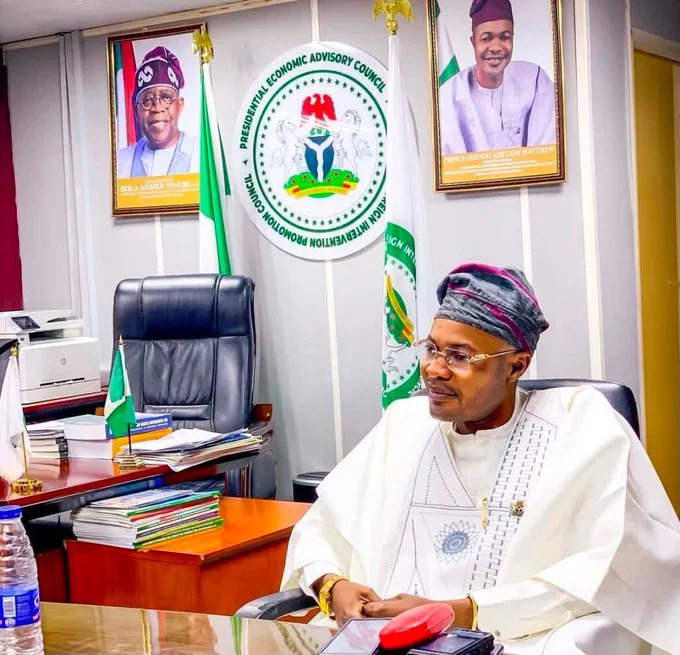
A video featuring Prince Adeniyi Adeyemi Matthew, the man at the centre of the alleged ₦1.3 billion ghost agency scandal, has resurfaced online, reigniting public debate over the controversial government body and its inclusion in Nigeria’s 2026 budget.
The footage, recorded during a press briefing in late June 2026, shows Adeyemi defending his claim as Director-General of the purported Presidential Foreign Intervention Promotion Council (PFIPC) while openly challenging the position of the Presidency and the Office of the Chief of Staff to the President, headed by Femi Gbajabiamila.
The renewed circulation of the video comes as investigations and legal proceedings surrounding the alleged fictitious agency continue to attract national attention.
During the briefing, Adeyemi questioned how an agency the Presidency insists does not exist could appear in official federal budget documents.
According to him, Nigeria’s annual budget passes through several layers of scrutiny before becoming law, making the agency’s appearance in the approved budget difficult to explain.
He argued that the appropriation process involves technical drafting, executive coordination, ministerial contributions, Budget Office reviews, and legislative approval by both chambers of the National Assembly.
Adeyemi said the presence of the council in official records raises serious concerns about the integrity of the country’s budgeting process.
He further questioned at what stage references to an allegedly non-existent agency entered the official documentation and what that implies about the credibility of the approval process.
Adeyemi also claimed that the council maintained several accounts with the Central Bank of Nigeria (CBN), including a Treasury Single Account, a domiciliary account and a pounds sterling account.
He argued that such accounts could not have been opened using fraudulent documentation, especially within the nation’s apex bank.
The embattled claimant further alleged that Chief of Staff Femi Gbajabiamila demanded 48 per cent of the agency’s proposed ₦27.4 billion take-off grant, amounting to approximately ₦12.5 billion.
The Presidency has strongly denied the allegation.
The Federal Government has consistently maintained that the Presidential Foreign Intervention Promotion Council has no legal backing and was never established by any law or executive action.
According to presidential officials, Adeyemi allegedly forged official documents, including appointment letters bearing the names and signatures of senior government officials, to falsely present himself as Director-General of the council.
Authorities also accused him of operating from an office within Phase III of the Federal Secretariat in Abuja, where he allegedly received government officials, diplomats, investors and members of the public while posing as a senior government official.
The controversy escalated after documents showed that an entity listed in the 2026 Appropriation Act as the Presidential Economic Advisory Council/Presidential Foreign Intervention Promotion Council received over ₦1.3 billion in budgetary allocations.
According to available records, the allocation consisted of:
- ₦803 million for personnel costs.
- ₦200 million for overhead expenses.
- ₦300 million for capital expenditure.
The revelation triggered widespread public concern over how a body now described by the Presidency as fictitious was able to receive funding in the national budget.
Adeyemi is currently facing an eightcount charge before the Federal High Court in Abuja.
The charges include alleged forgery, impersonation, false representation and operating a fictitious government agency.
While the Presidency has urged Nigerians to disregard Adeyemi’s claims and allow the judicial process to take its course, the accused insists he is the legitimate head of the council and maintains that the court will ultimately determine the authenticity of his appointment.
As the legal battle unfolds, the resurfaced video has intensified public scrutiny of the controversial agency and raised fresh questions about transparency, accountability and oversight in Nigeria’s budget process.


