


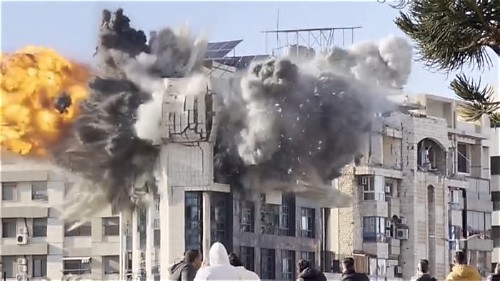
The United States has carried out what it described as a “heavy wave” of military strikes against Iran, marking a significant escalation in the growing conflict between the two countries following an attempted Iranian ballistic missile attack on American forces in the Middle East.
According to the US Central Command (CENTCOM), the strikes targeted dozens of facilities linked to Iran’s Islamic Revolutionary Guard Corps (IRGC), including military command centers, missile and drone installations, coastal defense systems, surveillance facilities, and maritime assets.
The operation was launched in retaliation for Tuesday’s attempted missile attacks on US military bases in Jordan and Iranian attacks on commercial vessels navigating the strategically vital Strait of Hormuz.
Iranian state media reported that at least three civilians, including a two-year-old child, were killed when a residential building in Chah Tangu on Qeshm Island was struck during the attacks. Several other locations across southern and western Iran, including the oil-producing regions of Qeshm and Abadan, were also reportedly hit.
The strikes began around 8:00 p.m. Eastern Time on Wednesday (01:00 BST Thursday) and lasted for approximately one hour.
CENTCOM described the operation as a “powerful response” to Iran’s attempted attacks, adding that all Iranian missiles launched toward US forces had been successfully intercepted.
The latest military action comes amid rapidly escalating hostilities across the Middle East, with the conflict expanding beyond direct US-Iran exchanges.
Earlier this week, the United States and Saudi Arabia jointly conducted strikes against Iran-backed militia positions in Iraq, targeting what Washington described as terrorist logistics and weapons facilities after more than 30 drone attacks allegedly directed by Iran over a 72-hour period.
The Iraqi Popular Mobilisation Forces (PMF), a coalition dominated by Iran-backed Shiite militias, said at least 20 of its fighters were killed during the joint operation. Iraq’s presidency condemned the attacks as a violation of the country’s sovereignty, although US President Donald Trump insisted the strikes had been coordinated with Iraqi authorities.
On Tuesday, Iran’s Islamic Revolutionary Guard Corps announced it had launched missile attacks against a US air base and command center in Jordan, describing the operation as retaliation against what it called American aggression.
The IRGC also claimed responsibility for striking three oil tankers in the Strait of Hormuz, alleging the vessels ignored warnings and traveled through what it described as an unsafe route.
The Strait of Hormuz remains one of the world’s most critical maritime chokepoints, through which a significant share of global oil exports passes. Any disruption to shipping in the area carries serious implications for international energy markets.
Jordan’s military later confirmed that its air defense systems intercepted five Iranian missiles that were headed toward its territory.
Residents of Qeshm Island reported hearing multiple explosions throughout the night.
One resident told BBC Persian he was preparing to leave the island for Tehran because the security situation had deteriorated significantly.
He described repeated electricity outages, unreliable internet services, and continuous loud explosions beginning before dawn, saying residents felt increasingly helpless as tensions intensified.
The latest escalation follows several days of relative calm during which diplomatic contacts were reportedly being explored.
President Donald Trump had earlier described the discussions as “very friendly negotiations,” although Iranian officials denied that any formal talks were taking place.
Following Iran’s attempted missile attack on the US base in Jordan, Trump vowed swift retaliation.
“We’re going to be hitting them very hard because it’s our turn to hit them,” the president told reporters at the White House, adding that Iran had anticipated the response and had appealed for restraint.
Meanwhile, US media outlet Axios reported that Saudi Defence Minister Prince Khalid bin Salman met President Trump in Washington to convey Saudi Arabia’s desire for de-escalation, reflecting growing concern among regional allies over the widening conflict.
In another indication that the conflict is spreading across the region, Egyptian authorities said a fire at one of the country’s ports on Wednesday was caused by a drone strike.
Although Egypt is a key US ally, it had previously avoided direct military involvement in the conflict, making the incident another sign of the war’s expanding regional footprint.
The latest exchanges mark another dangerous phase in the confrontation between Washington and Tehran.
Since the collapse of an April ceasefire in June, both countries have engaged in repeated military strikes, with the United States targeting Iranian military infrastructure while Iran has responded with missile and drone attacks against US interests across the Middle East and assaults on commercial shipping.
Analysts warn that the widening conflict now threatens regional stability, global energy supplies, and international shipping, raising fears that further retaliation from either side could draw more countries into one of the Middle East’s most dangerous confrontations in years.


