


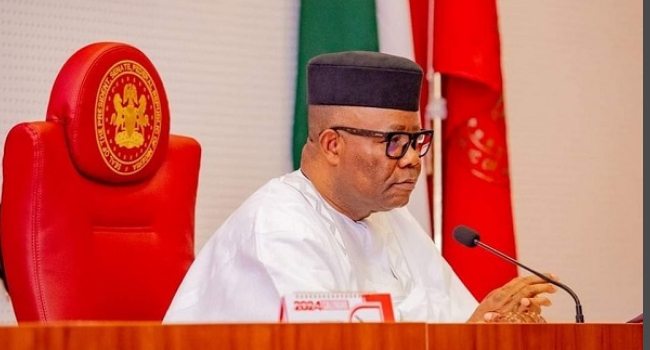
ABUJA: The Senate on Thursday rescinded portions of its recently amended Standing Orders 2026 after lawmakers raised concerns that some of the provisions conflicted with the 1999 Constitution.
The reversal followed mounting controversy over the amendments, which had sparked heated debates within the upper chamber and intensified political calculations ahead of the 2027 general elections.
The move also triggered fresh criticism from the senator representing Edo North, Adams Oshiomhole, who openly called on Senate President Godswill Akpabio to vacate office.
The disputed amendments emerged amid increasing interest by outgoing governors and political heavyweights seeking Senate seats ahead of the 11th National Assembly. Several of them are believed to be positioning for principal offices, including Senate President and Deputy Senate President.
Political observers estimate that at least 10 governors and several former governors are already maneuvering for senatorial tickets through their party structures.
Among those frequently mentioned is Hope Uzodimma, whose second term as Imo governor ends in January 2028. Reports suggest he has obtained nomination forms for a Senate bid, fueling speculation that he may be eyeing the Senate Presidency.
Moving the motion during plenary, Senate Leader Opeyemi Bamidele said a further legislative and constitutional review revealed that aspects of the amendments under Order 2 Subsection 2 and Order 3 Subsection 1 could conflict with Section 52 of the Constitution.
According to him, the Senate possesses the parliamentary authority to revisit and rescind previous decisions when necessary to protect the integrity of its legislative process.
Bamidele told lawmakers that the chamber resolved to withdraw its earlier amendments to the affected sections of the Senate Standing Orders 2026.
The motion was seconded by Senator Enyinnaya Abaribe.
Deputy Senate President Jibrin Barau, who presided over the session, described the motion as a straightforward step aimed at ensuring conformity with constitutional provisions.
He commended the Senate Leader for identifying the constitutional concerns and insisted there was no need for prolonged debate.
Despite the reversal, Oshiomhole criticised the process that led to the amendments, accusing lawmakers of rushing the changes to satisfy vested political interests.
According to him, the speed with which the rules were altered reflected a major flaw in the Senate’s legislative process.
His comments reignited exchanges on the floor, prompting Bamidele to invoke Rule 52(6) of the Senate Standing Orders, which bars senators from reopening already decided matters without a substantive motion.
Bamidele also lamented that controversies surrounding the amendments had overshadowed the Senate’s legislative work and generated what he described as unnecessary drama.
Speaking with journalists after plenary, Oshiomhole argued that the proposed rules created what he called a moral crisis.
He noted that Akpabio himself became Senate Minority Leader during his first term and therefore should not support rules that would prevent newer lawmakers from contesting leadership positions.
Oshiomhole maintained that if the Senate adopted a rule requiring senators to complete eight consecutive years before becoming Senate President, Akpabio would not qualify under such criteria.
He also referenced former Senate President David Mark, arguing that the rules should not be altered merely to narrow the field of eligible contenders.
According to him, broadening eligibility would strengthen internal democracy rather than weaken it.
The Senate also dismissed reports alleging that the Presidency pressured lawmakers into reversing the amendments.
Chairman of the Senate Committee on Judiciary, Human Rights and Legal Matters, Senator Adeniyi Adegbomire, said the decision was purely procedural and arose from internal legislative reviews.
He explained that one of the major issues concerned whether senators-elect should first take their oath of office before participating in the election of Senate presiding officers.
Adegbomire clarified that the rescinded provision related specifically to oath-taking procedures and not the broader issue of eligibility for leadership positions.
What the Controversial Amendments Proposed
Before the reversal, the amended rules introduced stricter requirements for the emergence of Senate presiding officers.
Under the revised Order 4, nomination for presiding offices was to follow a ranking hierarchy beginning with former Senate Presidents, former Deputy Senate Presidents, former principal officers, senators with at least one completed term, former House of Representatives members, and finally first-time senators.
The amendments also introduced a controversial provision under Order 5 stating that any senator seeking a principal office must have served at least two consecutive terms immediately preceding nomination.
The implication was that senators-elect who did not serve in both the 9th and 10th National Assemblies would be disqualified from contesting key leadership positions in the 11th Assembly.
Principal offices in the Senate include Senate Leader, Deputy Senate Leader, Chief Whip, Deputy Chief Whip, Minority Leader, Deputy Minority Leader, Minority Whip and Deputy Minority Whip, while the presiding offices remain the Senate President and Deputy Senate President.