


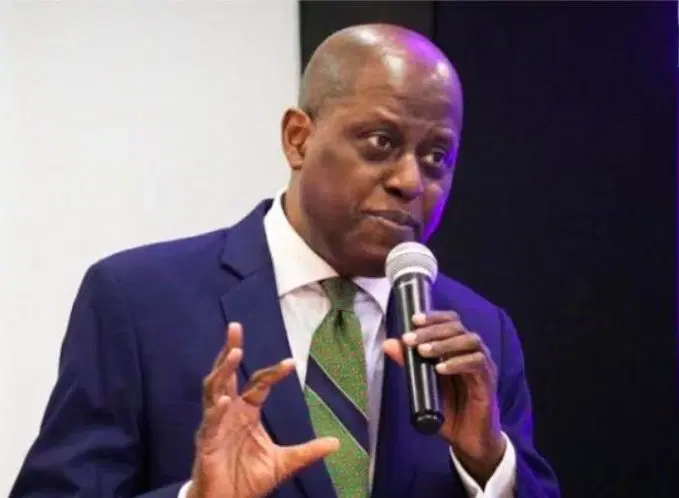
The Governor of the Central Bank of Nigeria (CBN), Olayemi Cardoso, has announced that a revised Foreign Exchange (FX) Manual designed to improve transparency, accountability, and efficiency in Nigeria’s foreign exchange market will officially take effect from June 1, 2026.
Speaking during the unveiling of the fourth edition of the CBN Forex Manual in Abuja, Cardoso said the updated framework represents a major step in the apex bank’s ongoing economic reforms aimed at strengthening macroeconomic stability and boosting investor confidence.
Addressing stakeholders on the theme, Building Confidence in Nigeria’s FX Market: Revised Framework for Transparency and Accountability, the CBN governor described the foreign exchange market as a vital pillar of every modern economy, stressing that its effectiveness depends on clarity, consistency, compliance, and public trust.
According to Cardoso, the revised manual comes at a critical stage in Nigeria’s economic transformation efforts, as the government continues to implement measures designed to stabilize the economy and create conditions for sustainable growth.
He explained that the review became necessary due to significant structural changes in the domestic economy, persistent inflationary pressures, global economic uncertainties, and ongoing reforms within Nigeria’s foreign exchange market.
The CBN chief noted that the previous FX manual was last reviewed in 2018 and that the latest version was developed after extensive consultations with banks, regulators, and other stakeholders across the financial sector.
Cardoso emphasized that successful implementation of the new guidelines would require the cooperation of authorized dealer banks, exporters, importers, government agencies, regulators, and private sector participants.
He stressed that maintaining stability in the foreign exchange market is a collective responsibility shared by both regulators and market operators.
The governor also revealed that the apex bank would strengthen its monitoring and compliance mechanisms to ensure fairness, accountability, and consistency across the foreign exchange ecosystem.
Highlighting recent improvements in market performance, Cardoso disclosed that average daily FX market turnover has risen significantly from approximately $100 million at the beginning of the current administration to between $400 million and $600 million. He added that the market has recorded turnover of up to $1 billion on several occasions in recent months.
According to him, the reforms are expected to deepen market liquidity, reduce dependence on external reserves for interventions, and strengthen investor confidence in Nigeria’s economy.
Providing details of the revised guidelines, the CBN’s Deputy Governor for Economic Policy, Dr. Muhammad Sani Abdullahi, said the new framework introduces several important changes.
Among them is the harmonization of the disbursement structure for Personal Travel Allowance (PTA) and Business Travel Allowance (BTA). Under the new arrangement, 75 percent of approved allowances will be disbursed electronically, while the remaining 25 percent may be paid in cash.
The manual also increases the allowable advance payment for imports from 15 percent to 30 percent, providing greater flexibility for importers.
In another major development, the CBN announced that processing of Form NXP, which is required for export transactions, will become completely free from June 1, 2026.
The revised framework further introduces new provisions governing service exports, including documentation requirements and reporting obligations for businesses operating in the sector.
Additionally, payments for services, fees, and charges in foreign currency will now be permitted where receipts are generated in foreign currency.
The manual also includes fresh guidelines for tuition payments abroad, allowing undergraduate and postgraduate students to access up to $25,000 per semester for educational expenses.
Furthermore, the mandatory requirement for Form A when remitting funds through ordinary domiciliary accounts has been removed, although authorized dealer banks will continue to verify the legitimacy and purpose of such transactions.
Reacting to the new policy framework, the Group Managing Director and Chief Executive Officer of United Bank for Africa (UBA), Oliver Alawuba, praised the CBN for its interventions and reforms in the foreign exchange market.
Alawuba noted that confidence in Nigeria’s economy has improved considerably compared to previous years, when customers regularly approached banks in search of foreign exchange.
According to him, the situation has changed significantly, with banks now increasingly seeking customers willing to trade foreign currency.
He assured the apex bank that commercial banks would maintain discipline, transparency, and strict compliance in implementing the provisions of the revised FX manual.
The new guidelines are expected to mark another milestone in Nigeria’s ongoing efforts to create a more transp


