


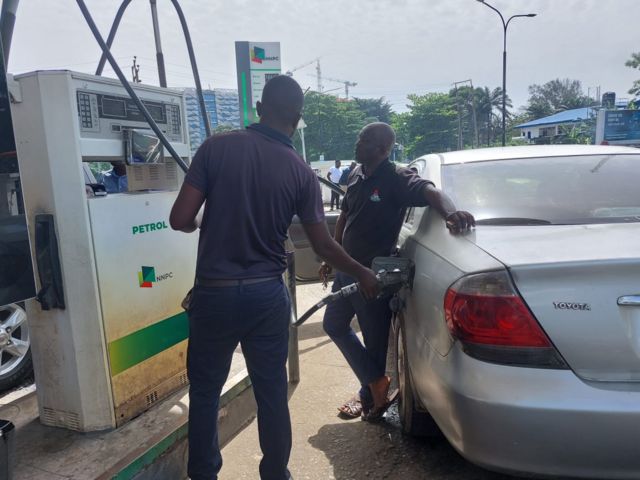
The price of Premium Motor Spirit (PMS), popularly known as petrol, has surged by an unprecedented 643 per cent since President Bola Ahmed Tinubu assumed office in May 2023, raising fresh concerns about the worsening economic hardship facing millions of Nigerians.
Investigations revealed that petrol, which sold for about N175 per litre before the current administration took over, now sells between N1,300 and N1,400 per litre across various parts of the country, making transportation and essential commodities increasingly unaffordable for ordinary citizens.
The dramatic increase followed President Tinubu’s declaration during his inauguration on May 29, 2023, that the fuel subsidy regime had ended. The announcement immediately triggered a sharp rise in fuel prices as marketers adjusted their pump prices to reflect market realities.
At the time of the subsidy removal, petrol prices jumped from below N200 per litre to over N500 per litre almost overnight. The development marked the beginning of one of the most significant economic reforms undertaken by the administration.
The situation worsened following the Federal Government’s decision to float the naira, which resulted in a sharp depreciation of the local currency against major foreign currencies. Since Nigeria was heavily dependent on imported petroleum products at the time, the weaker naira significantly increased importation costs, forcing fuel prices to rise further.
Although the Federal Government maintained that subsidy payments had ended, the Nigerian National Petroleum Company Limited (NNPCL) later admitted that it had been absorbing the difference between landing costs and retail prices, effectively operating an indirect subsidy system.
For months, the state-owned oil company sold petrol at prices below actual import costs while denying reports that it was subsidising fuel. However, officials eventually acknowledged that under-recovery payments existed and that the company was bearing substantial financial burdens to keep prices relatively stable.
Former Chief Financial Officer of the NNPCL, Umar Ajiya, explained that the government had instructed the company to sell petrol at lower prices despite higher landing costs, resulting in huge financial shortfalls.
As market realities caught up with the industry, fuel prices rose beyond N1,000 per litre in several locations across the country.
Hope emerged when the Dangote Petroleum Refinery commenced large-scale petrol production and distribution. The refinery’s entry into the market sparked competition and temporarily pushed fuel prices down to between N800 and N900 per litre, offering some relief to consumers.
However, those gains were short-lived.
Fresh tensions in the Middle East, particularly the conflict involving the United States and Iran, disrupted global oil supply chains and triggered increases in international crude oil prices. The closure of key shipping routes, including the strategic Strait of Hormuz, further worsened supply concerns.
As crude oil prices climbed globally, the Dangote Refinery and other suppliers repeatedly adjusted their ex-depot prices upward, resulting in another round of increases at filling stations nationwide.
Today, motorists in many states are paying as much as N1,300 per litre for petrol, while some remote locations record even higher prices.
The soaring cost of fuel has had a ripple effect on virtually every sector of the economy. Transport fares have increased sharply, food prices continue to rise, and inflationary pressures remain a major challenge for households and businesses.
Economic experts have warned that unless urgent intervention measures are introduced, more Nigerians could be pushed into poverty.
Former President of the Association of Energy Economists, Professor Adeola Adenikinju, described the current situation as a double-edged sword. While Nigeria may benefit from higher crude oil earnings, he noted that ordinary citizens are suffering from the resulting increases in fuel and transportation costs.
According to him, targeted cash transfers and social intervention programmes should be introduced to cushion the effects of the fuel price surge on vulnerable Nigerians.
Similarly, the National President of the Petroleum Products Retail Outlet Owners Association of Nigeria (PETROAN), Billy Gillis-Harry, expressed concern that the government had yet to announce concrete relief measures despite earning more revenue from rising crude oil prices.
He urged authorities to channel part of the additional oil revenue into programmes that would help reduce transportation costs and ease inflationary pressures on consumers.
Gillis-Harry further warned that petrol prices could rise above N1,500 per litre if tensions in the Middle East persist and global supply disruptions continue.
Renowned economist Bismarck Rewane also suggested that the Federal Government could consider supplying crude oil to local refiners under favourable terms in exchange for commitments to maintain affordable fuel prices.
Despite mounting pressure from citizens and industry stakeholders, the Federal Government has ruled out a return to fuel subsidies.
The Minister of Finance and Coordinating Minister of the Economy, Taiwo Oyedele, recently reiterated that the government remains committed to a market-driven pricing system, insisting that subsidy payments distort the economy and are not sustainable.
As Nigerians reflect on three years of economic reforms under President Tinubu, the 643 per cent increase in petrol prices remains one of the administration’s most controversial policies, with many citizens still struggling to cope with its far-reaching consequences.


