


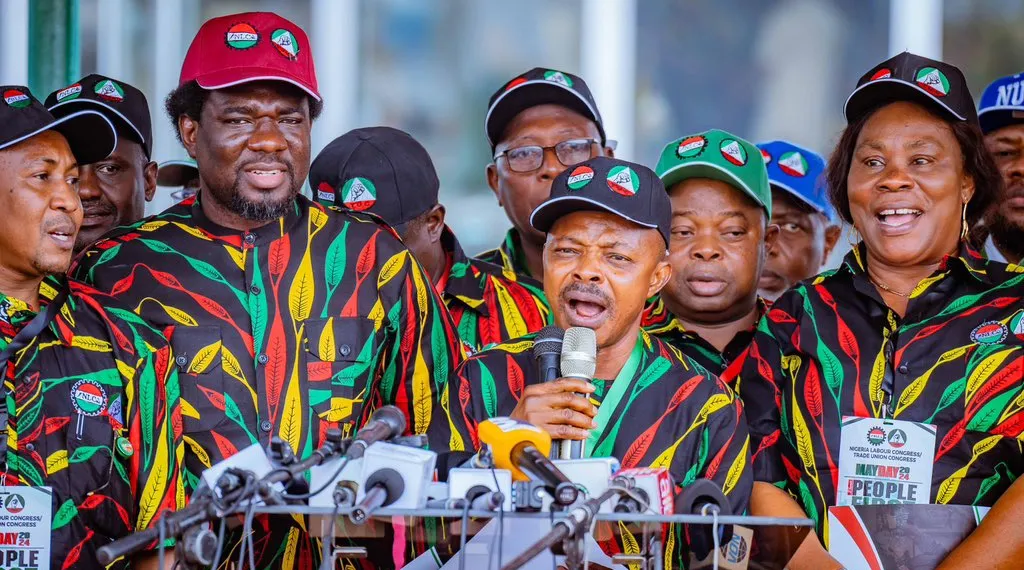
As Nigeria marks its 66th Independence Anniversary, the Nigeria Labour Congress has called on the Federal Government to urgently reduce petrol prices, introduce a nationwide wage award and begin negotiations for a new national minimum wage, warning that rising living costs have severely weakened workers’ purchasing power.
The NLC made the demands in an Independence Day statement signed by its President, Joe Ajaero, titled “Our Hope Depends on the Choices We Make and the Actions We Take.”
The labour centre said the measures had become necessary as millions of Nigerians continued to contend with rising transportation fares, food prices, rent, school fees and other essential household expenses.
According to the NLC, the sharp increase in the price of petrol following the removal of the fuel subsidy in 2023 has had a broad impact on the economy, particularly by increasing transportation costs and pushing up the prices of goods and services.
The NLC said petrol was selling for about N1,430 per litre or higher in major cities, with prices significantly higher in some remote areas.
The union argued that the increase in fuel prices had triggered a chain reaction across the economy, with higher transportation costs feeding into the prices of food, education, housing and other necessities.
It urged the Federal Government to urgently address what it described as the transmission of fuel costs throughout the economy.
The labour organisation maintained that efforts to ease the hardship facing Nigerians would have limited impact unless the government also tackled the effect of high petrol prices on transportation and the wider cost of living.
The NLC also called for the immediate implementation of a nationwide wage award for workers employed by the federal, state and local governments.
The union described the proposed wage award as an emergency measure designed to cushion the impact of declining real incomes, rather than a form of government charity.
The demand comes against the background of the October 2023 agreement between the Federal Government and organised labour following the removal of the petrol subsidy.
That agreement included a N35,000 monthly wage award for federal workers, alongside consideration of similar relief measures for workers at the state and local government levels.
The NLC argued that workers needed urgent financial relief as inflation and rising household expenses continued to erode the value of their earnings.
The labour centre also accused the government of failing to fully implement tax relief measures contained in its October 2023 Memorandum of Understanding with organised labour.
It therefore urged the Federal Government to fulfil the tax-related commitments reached during negotiations and immediately begin discussions on a new national minimum wage.
The NLC argued that the existing N70,000 national minimum wage had already lost significant purchasing power because of inflation.
It called for the immediate establishment of a tripartite committee comprising government, labour and employers to develop and legislate a new wage standard for 2027 before the end of 2026.
The current N70,000 minimum wage was approved by President Bola Tinubu in July 2024, with the President stating at the time that it would be reviewed after three years
The NLC also questioned whether Nigerians had received the infrastructure and social-service benefits that the Federal Government said would result from the removal of the petrol subsidy.
According to the labour organisation, the government had argued that subsidy removal would release resources for infrastructure and social interventions.
However, the union said petrol prices had increased substantially since the policy was introduced, while the expected improvements in infrastructure and social services had not been sufficiently felt by Nigerians.
The NLC therefore questioned how the savings from subsidy removal had been utilised.
In October 2023, the Federal Government and organised labour had agreed on several measures intended to cushion the effect of subsidy removal. These included wage support, tax incentives, compressed natural gas buses and other interventions.
The labour union also criticised Nigeria’s continued dependence on imported refined petroleum products despite the country’s position as a major oil producer.
It called for greater investment in domestic refining capacity, arguing that increased local refining would help reduce the country’s dependence on imported petroleum products.
The NLC noted that Nigeria had significant oil resources but continued to rely heavily on imported refined fuel, while domestic refining capacity had been neglected apart from the efforts of some private refineries.
Beyond wages and petrol prices, the NLC called for stronger investment in public infrastructure and social services.
The union demanded affordable and quality public education, functional healthcare facilities and improved road networks, arguing that these were essential to reducing pressure on households and improving economic productivity.
It also called for a reduction in the cost of governance and greater transparency in the management of public funds.
According to the NLC, government must lead by example at a time when ordinary Nigerians and workers are being asked to make sacrifices because of economic difficulties.
The union argued that what it described as excessive government spending was difficult to justify while workers were struggling to meet basic household needs.
The NLC also raised concerns about youth unemployment and the growing desire among young Nigerians to leave the country in search of better opportunities.
The union urged the government to create meaningful economic opportunities that would enable young people to build sustainable lives in Nigeria.
It argued that young Nigerians needed tangible reasons to believe they could achieve economic security at home rather than relying on dangerous journeys through the Sahara and Mediterranean routes as possible pathways to a better future.
The labour centre said the government should focus on employment, skills, productive industries and other opportunities capable of restoring confidence among young Nigerians
The union further linked insecurity to Nigeria’s economic challenges, arguing that violence has affected farming, education and healthcare delivery in different parts of the country.
According to the NLC, insecurity, poverty, unemployment and inequality are interconnected problems that require a coordinated response.
It stressed that addressing Nigeria’s economic difficulties would require attention not only to economic growth but also to how opportunities and resources are distributed across society.
With Nigeria’s next general elections scheduled for 2027, the NLC also addressed the political environment.
The union said workers should be free to make independent political choices and warned against electoral manipulation, voter intimidation and rhetoric capable of deepening ethnic or religious tensions.
The NLC said it would eventually use its proposed Workers’ Charter to articulate its positions on policies and political candidates when appropriate.
However, it stressed that workers’ organisations should not be treated simply as electoral instruments.
Ajaero said the NLC would, at the appropriate time, use the Workers’ Charter to communicate its views on policies and candidates that it believes are relevant to the interests of the working class.
He nevertheless maintained that workers have the right to independent political thought, judgment and choice.
The NLC said its broader focus would remain on decent wages, safe working environments, accountability and the protection of workers’ welfare.
As Nigeria celebrates 66 years of independence, the labour centre said the country’s economic challenges require collective action and greater accountability from those entrusted with public responsibilities.
The union maintained that Nigerians must have a meaningful voice in determining the country’s direction and called for policies capable of improving living standards and creating sustainable opportunities.
The NLC’s demands come amid continuing concerns over the cost of living, fuel prices, wages, unemployment, infrastructure and social welfare, placing economic relief and workers’ purchasing power at the centre of its Independence Day message.


