


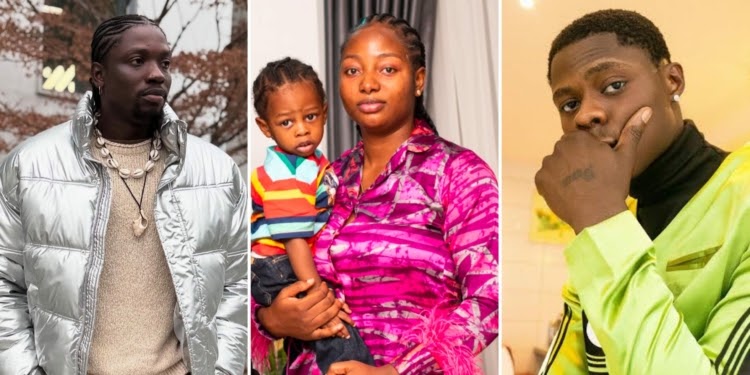
The controversy surrounding the death of Nigerian singer Ilerioluwa Oladimeji Aloba, popularly known as Mohbad, has taken another turn following renewed questions raised by social commentator Martins Vincent Otse, popularly known as VeryDarkMan (VDM), concerning the identity documents and surname of Mohbad’s widow, Wunmi.
The development has reopened a debate that had appeared to have moved away from the circumstances of Mohbad’s death and towards questions concerning his family, estate and widow.
At the centre of the latest controversy is the name Wunmi Aloba, which Mohbad’s widow has publicly used since the singer’s death.
VDM has questioned that identity by drawing attention to an international passport reportedly bearing the name Adebanjo Cynthia Omowumi.
The issue has generated renewed debate online.
However, the existence of different names on identity documents does not automatically establish forgery or criminal conduct.
The authenticity and legal status of the documents remain matters that can be determined through the appropriate authorities and courts.
VDM raises questions over Wunmi’s international passport
According to reports of VDM’s recent intervention, he questioned the discrepancy between Wunmi’s publicly used Aloba surname and the name reportedly appearing on her international passport.
The passport was reportedly renewed in 2024 and bears the name Adebanjo Cynthia Omowumi.
VDM used the alleged discrepancy to question the basis for Wunmi’s continued public identification as Wunmi Aloba.
The development has generated intense discussion because Wunmi has consistently maintained that she was married to Mohbad and was known publicly by his surname.
The dispute therefore goes beyond a simple spelling difference.
It raises questions about what names Wunmi legally used at different points in time and what documents existed during her marriage to Mohbad.
Wunmi says she was married to Mohbad
In her response to the dispute, Wunmi maintained that she was married to Mohbad during his lifetime.
She stated that she was publicly known by the surname Aloba and denied falsely representing herself as “Mrs Aloba.”
According to the response cited in the dispute, Wunmi said that during the lifetime of her husband she possessed official identification documents bearing the Aloba surname.
Her position directly challenges the argument that the Aloba surname was simply adopted after Mohbad’s death.
The question, therefore, becomes documentary.
Which official documents carried the Aloba surname?
When were those documents issued?
Were they valid?
What was the legal basis for the change or use of the surname?
And how does that information correspond with the name contained in her international passport?
These are questions that can be answered through the relevant official records.
Why the passport controversy matters
The identity-document controversy has become important because of the wider disputes surrounding Mohbad’s estate and family.
Questions concerning a widow’s identity can have legal implications in matters involving inheritance, estate administration and representation.
But those implications should not be exaggerated without evidence.
A person may legitimately use different names at different periods depending on marriage, documentation and legal name changes.
Therefore, the mere appearance of “Adebanjo Cynthia Omowumi” on a passport does not independently prove that Wunmi committed fraud.
If VDM’s allegations are to be established, the relevant authorities would need to authenticate the documents and determine whether any unlawful conduct occurred.
Iyabo Ojo and the defence of Wunmi
During the intense public reaction that followed Mohbad’s death, actress Iyabo Ojo became one of the most prominent celebrities supporting Wunmi.
Ojo publicly defended the widow against accusations and said she would stand by her until a court established otherwise.
Her position was based on the principle that allegations should not be treated as convictions.
At the height of the controversy, supporters argued that Wunmi was grieving, caring for her young son Liam and dealing with the emotional consequences of losing her husband.
Those defending her therefore questioned why she was being expected to provide detailed explanations immediately after Mohbad’s death.
Critics, on the other hand, argued that because Wunmi was reportedly close to Mohbad during his final hours, Nigerians were entitled to seek an account of what happened.
The disagreement created two opposing narratives.
One side emphasised Wunmi’s grief and privacy.
The other emphasised the need for transparency.
The surname issue eventually became a major part of the dispute.
Wunmi maintained that she was Mohbad’s wife and had been known publicly as Wunmi Aloba.
The challenge to that position centres on identity documentation.
If official documents existed showing that she legally used the Aloba surname during Mohbad’s lifetime, such records could support her position.
If the documents presented by her opponents establish otherwise, they could become relevant to the dispute.
Ultimately, the issue is not one that should be settled by social-media polls.
It is a documentary question.
Mohbad’s family enters the dispute
The disagreements surrounding Wunmi did not remain limited to social media.
Mohbad’s family also became involved in disputes over his estate, his son, the use of the Aloba surname and the circumstances surrounding his burial.
Members of the family have at different times demanded further investigation and challenged aspects of Wunmi’s position.
Wunmi and her legal representatives have disputed some of those claims.
The result has been a prolonged public dispute between people who were once connected through Mohbad.
The singer’s death therefore produced not only an investigation into his final hours but also a complicated family dispute that continues to attract public attention.
Another major issue that emerged after Mohbad’s death concerns his son, Liam.
Questions about the child’s paternity became part of the wider dispute involving Mohbad’s family.
Calls for DNA testing were made by members of the Aloba family.
Wunmi and her representatives have contested some of the allegations made against her.
The issue has remained emotionally sensitive because it involves a child and should therefore be treated with particular care.
Any definitive determination regarding paternity would have to come from properly conducted scientific testing and the appropriate legal process.
The Mohbad controversy has not ended with social-media arguments.
Legal proceedings have continued around aspects of the case.
A major legal development occurred when a Federal High Court in Lagos fixed September 29, 2026, for judgment in a suit seeking a fresh police investigation into Mohbad’s death.
That development is significant because it demonstrates that some parties remain dissatisfied with the outcome or handling of the original investigation.
At the same time, the coroner’s inquest had already ruled out homicide or foul play and recommended prosecution of the nurse who treated Mohbad.
The two developments illustrate why the case remains complicated.
There are official findings already on record, while separate legal proceedings continue to test other aspects of the matter.
At the heart of VDM’s latest intervention is not simply Mohbad’s death.
He is also questioning the narrative surrounding Wunmi’s identity.
His argument, based on the documents he has referenced, is that there is a discrepancy between the name appearing on an international passport and the surname Wunmi has publicly used.
That discrepancy, he argues, deserves scrutiny.
However, an allegation is not the same as a finding.
The relevant authorities would need to establish whether the documents are genuine, whether any name change occurred, when it occurred and whether any false information was submitted.
Until such questions are formally established, claims of forgery or deliberate misrepresentation should remain described as allegations.
Mohbad’s death has become much more than a celebrity story.
It has become a case study in how Nigerians respond to unexplained or controversial deaths in the age of social media.
Within hours of his death, old videos resurfaced.
Within days, hashtags demanding justice dominated social media.
Within weeks, suspects were arrested.
The singer’s body was exhumed.
A coroner’s inquest was established.
Witnesses testified.
Medical evidence was examined.
And years later, disputes continue.
VeryDarkMan’s latest intervention has now added another dimension.
Rather than allowing the debate to disappear completely, he has placed the spotlight on documents associated with Mohbad’s widow.
One of the most important distinctions in the renewed Mohbad debate is the difference between asking a question and reaching a conclusion.
It is legitimate to ask why two documents appear to contain different names.
It is legitimate to ask whether Wunmi had official documents bearing the Aloba surname during Mohbad’s lifetime.
It is legitimate to ask authorities to authenticate disputed records.
But those questions do not automatically establish that a crime occurred.
Similarly, asking questions about the people present when Mohbad died does not automatically establish that any of them caused his death.
That distinction is particularly important because millions of people consume information through social media, where allegations can spread much faster than corrections.
The latest controversy could ultimately be resolved through documentary evidence.
If there is a dispute concerning Wunmi’s identity, the relevant government agencies can verify her identity records.
If there are questions about her marital status, the relevant legal documents can be examined.
If there are questions concerning Mohbad’s death, the courts and investigative authorities can examine the evidence already available and determine whether further investigation is warranted.
And if VDM’s allegations concerning identity documents are formally challenged, the relevant authorities can determine whether they are substantiated.
Until then, the public should distinguish between what has been established, what has been alleged and what remains unresolved.
The Mohbad story has survived far beyond the singer’s death because it has never been a simple story.
It began with a shocking death and an 11-second video that offered little explanation.
It developed into a national demand for justice.
It drew attention to Mohbad’s previous conflicts with Naira Marley and the Marlian camp.
It led to arrests, investigations and the exhumation of Mohbad’s body.
It brought the nurse who treated him under investigation.
The coroner later ruled out homicide or foul play and recommended prosecution of the nurse.
But the controversy continued through family disputes, estate questions, the Aloba surname issue, paternity questions and legal proceedings seeking further investigation.
Now, VDM has reopened another chapter by questioning the identity documents associated with Wunmi.
Wunmi, meanwhile, maintains that she was married to Mohbad and that she was publicly and officially known by the Aloba surname during his lifetime.
The question of whether the documents establish anything more remains one for evidence and due process.
For Nigerians who have followed the case from the beginning, the renewed debate is a reminder that Mohbad’s death continues to raise questions—not necessarily because every theory circulating online is correct, but because the story has generated a complex mixture of documented facts, legal claims, family disputes, public allegations and unresolved issues.
The responsibility of journalism at this stage is therefore clear: report the claims, identify their sources, examine the evidence and allow competent authorities and the courts to determine what has been established