


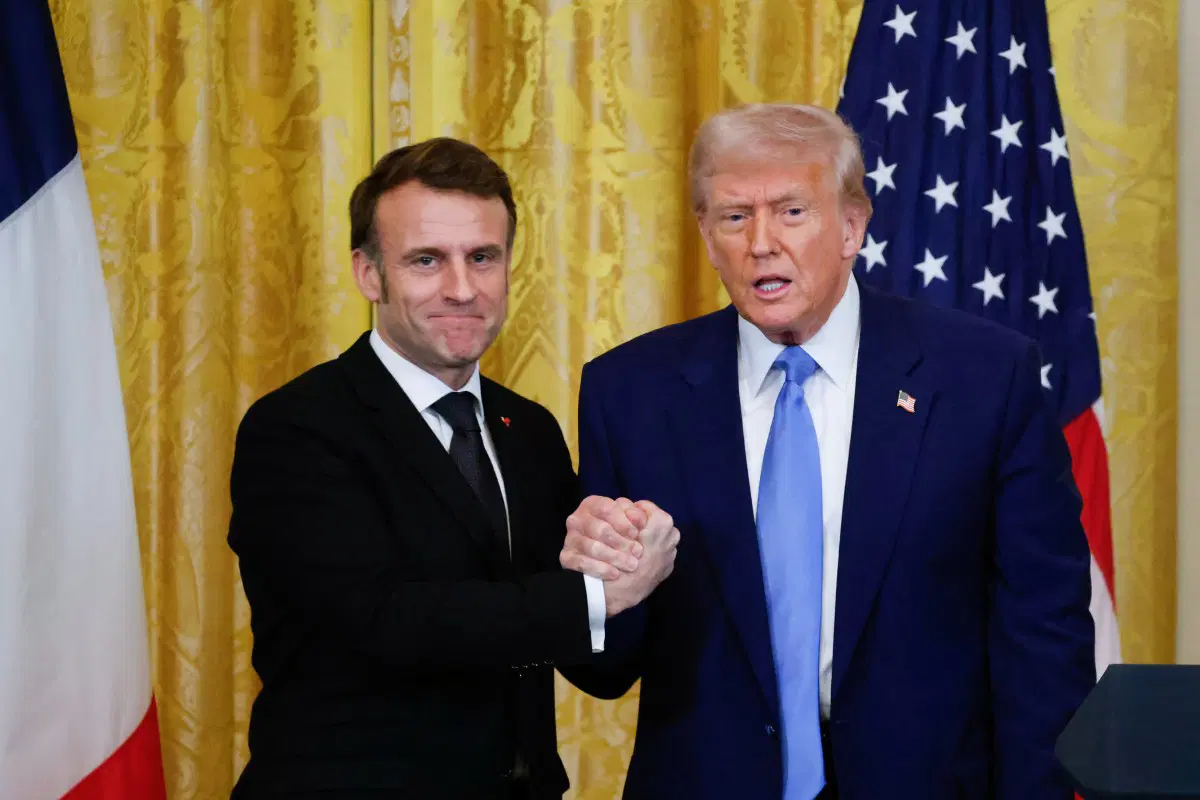
PARIS: French President Emmanuel Macron has criticised foreign leaders for allegedly exploiting the recent wave of riots in France for political advantage, in an apparent swipe at United States President Donald Trump and Israeli Prime Minister Benjamin Netanyahu.
Macron made the remarks on Wednesday, October 21, 2026, while speaking to journalists during a visit to Qatar, as his government struggled to contain the unrest and prepared for another round of demonstrations over the rising cost of living.
Although he did not mention Trump or Netanyahu by name, Macron suggested that political leaders campaigning in their respective countries were using France’s crisis to advance their domestic political interests.
There are people who campaign at France’s expense — leaders who are in campaign mode, whether here in the region or on the other side of the Atlantic,” he told reporters in Doha.
The French president’s comments came amid growing international attention on the unrest, which has damaged France’s image abroad, unsettled financial markets and intensified pressure on his government ahead of the country’s next presidential election.
Trump has linked the violence in France to migrants, jihadists and communists while campaigning for his Republican Party in the United States, using the unrest to reinforce his administration’s hardline immigration message.
The US president also praised French far-right leader Marine Le Pen on Tuesday, as opinion polls suggested she was leading the race for the French presidency.
Netanyahu, who is also facing a challenging political contest in Israel, reportedly attributed France’s crisis to what he described as an “invasion of extremist Islam”.
However, several analysts have challenged claims that migrants are primarily responsible for the unrest.
Macron’s remarks appeared to reflect growing frustration in Paris over foreign political figures using the crisis to promote their ideological positions while France confronts a complex domestic security and economic challenge.
The unrest erupted last weekend, when masked youths clashed with police, looted businesses and vandalised public buildings. The French government has acknowledged that authorities lost control during the violence.
The crisis has also overshadowed nationwide demonstrations against the rising cost of living, which attracted more than half a million people on Saturday, following four weeks of student protests that disrupted activities in several schools.
Ahead of fresh demonstrations planned for Saturday, authorities in Paris and other cities introduced nighttime curfews in areas considered vulnerable to further violence.
Police said the curfew in Paris would be renewed on Wednesday night.
Macron announced plans to chair a meeting with ministers and intelligence officials on Thursday to receive a detailed assessment of the previous weekend’s disturbances.
Prime Minister Sébastien Lecornu, meanwhile, promised a substantial police deployment to maintain order during Saturday’s demonstrations.
Following a meeting with the prime minister, Sophie Binet, leader of the hardline CGT trade union, called for a new phase of protests, including strikes early next month.
Binet said Lecornu had offered no concrete measures or acknowledgement of the unions’ demands.
Justice Minister Gérald Darmanin disclosed that 2,500 people had been taken into custody during and after the unrest. Of that number, 174 had been jailed, while another 917 had been formally prosecuted.
Beyond the security crisis, the unrest has intensified concerns about the economic outlook of the European Union’s second-largest economy.
Financial markets have been unsettled by France’s rising public debt and budget deficit, with investors demanding higher returns on government borrowing.
France’s benchmark 10-year bond yield rose above five per cent on Wednesday, reflecting growing concerns about the country’s fiscal position.
Credit rating agency Moody’s was also expected to review France’s sovereign debt rating on Friday.
The country’s fragmented political landscape has made it difficult for Lecornu’s government to secure broad parliamentary support for a cost-cutting budget that must be adopted before the end of the year.
The combination of street violence, economic pressures and political divisions has further complicated the government’s efforts to restore public confidence.
The crisis could also reshape France’s political landscape ahead of the next presidential election.
A recent poll conducted by Ifop following the riots suggested that Le Pen would win the first round by a substantial margin, with far-left candidate Jean-Luc Mélenchon emerging as her most likely opponent in a potential runoff.
The findings have added to concerns among Macron’s opponents and supporters about the political consequences of the unrest.
Similar, though smaller-scale, disturbances have also been reported in neighbouring Italy and Belgium. Italy’s government has deployed 500 troops to Milan in an effort to curb street violence.
In Greece, thousands of students also took to the streets on Wednesday to protest against the rising cost of living.
Despite the escalating tensions, Macron rejected calls for a state of emergency that would allow soldiers to reinforce police forces against rioters, insisting that existing measures, including curfews, were sufficient.
While the restrictions have helped calm some areas, they have disrupted late-night public transport and affected residents’ movements.
Meanwhile, the Yellow Vest movement, associated with previous anti-government demonstrations in France, announced plans for a march from Paris’s Bastille Square on Saturday, followed by nationwide demonstrations on November 5.
The planned protests could present another major test for Macron’s government as it attempts to restore order, address economic grievances and prevent the crisis from further damaging France’s political stability.