


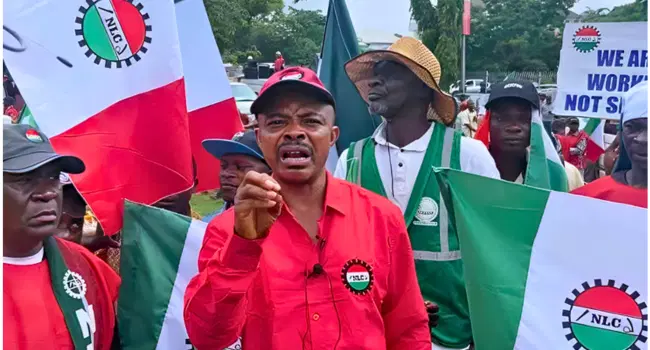
ABUJA: The Nigeria Labour Congress (NLC) has backed calls by public servants for an immediate reduction in the price of petrol to N500 per litre, alongside the introduction of a N500,000 minimum monthly salary for public workers.
The demands were contained in a letter addressed to President Bola Tinubu by the Trade Union Side of the Joint National Public Service Negotiating Council (JNPSNC), as workers expressed concern over the worsening cost-of-living crisis across the country.
The workers also called for the immediate constitution of a committee to begin negotiations for a new national minimum wage ahead of January 2027.
The labour unions gave the Federal Government until Wednesday, September 30, 2026, to respond to their demands, warning that the continuing economic pressure was creating growing tension among workers and other Nigerians.
The JNPSNC said the recent increase in petrol prices to about N1,430 per litre or higher in some locations had further weakened workers’ purchasing power and increased the cost of transportation, food and other essential goods.
The council argued that the removal of petrol subsidy three years ago had produced far-reaching effects across the economy, with higher fuel costs contributing to increases in the prices of commodities and services.
According to the workers, government interventions based primarily on food palliatives are not sufficient to address the underlying economic problems.
The council said a more sustainable intervention would be to reduce the cost of petrol and introduce measures capable of benefiting workers and other Nigerians more broadly.
It called on the Federal Government to consider an intervention mechanism that could bring petrol prices down to N500 per litre.
The workers urged the government to “look inward” and develop measures to stabilise fuel prices at an affordable level, stressing that petrol remains a major driver of economic activity in Nigeria.
The council also proposed the establishment of an intervention fund involving relevant stakeholders in the oil sector to help stabilise prices and ultimately reduce the cost of petrol.
It argued that such a mechanism would have a wider economic impact because lower transportation and energy costs could reduce pressure on businesses, households and consumers.
The JNPSNC further endorsed measures previously attributed to NLC President Joe Ajaero, including the sale of sufficient crude oil in naira to local refineries.
It also called for an expansion of national crude and fuel storage capacity to strengthen Nigeria’s ability to respond to energy emergencies.
According to the position cited by the council, improving local refining and crude supply arrangements could create jobs, generate economic value and contribute to addressing some security challenges associated with economic hardship.
On wages, the public service unions demanded an immediate wage award covering workers at the federal, state and local government levels.
They proposed that the minimum salary payable to an officer on Grade Level 01, Step 1 should be N500,000 monthly under the proposed 2027 salary structure.
The council also called for the harmonisation of salaries across ministries, departments and agencies, while urging state and local governments to undertake corresponding reviews.
The unions asked President Tinubu to direct the National Salaries, Incomes and Wages Commission (NSIWC) to begin discussions with the Nigeria Labour Congress, Trade Union Congress of Nigeria (TUC), JNPSNC and other relevant stakeholders on the proposed wage award and salary review.
The Nigeria Labour Congress has thrown its weight behind the demands, describing them as realistic and legitimate in view of the current economic conditions.
NLC Acting General Secretary Benson Upah said workers’ incomes had failed to keep pace with inflation, resulting in a significant erosion of purchasing power.
He said many workers were struggling to afford transportation to their workplaces and provide basic necessities for their families.
According to Upah, increases in petrol prices have consequences beyond transportation because they affect the prices of food, school fees, goods and other essential services.
He said the situation was affecting not only workers but also other Nigerians, particularly low-income households.
The NLC therefore urged the government to treat the demands as an urgent intervention in response to the country’s economic pressures.
The unions maintained that reducing petrol prices would have effects beyond the pump because fuel costs are closely connected to transportation, production and distribution.
They argued that lower energy and transportation costs could ease some of the pressure currently being experienced by households and businesses.
The council also maintained that the government should explore mechanisms for protecting Nigerians from sharp fluctuations in international oil prices while strengthening domestic refining capacity.
The latest demands come as organised labour continues to push for measures aimed at improving workers’ purchasing power and cushioning the impact of rising living costs.
With September 30, 2026, set as the deadline issued by the public service unions, attention is now focused on the Federal Government’s response to the proposed fuel-price intervention, wage award and preparations for the next national minimum wage review.