


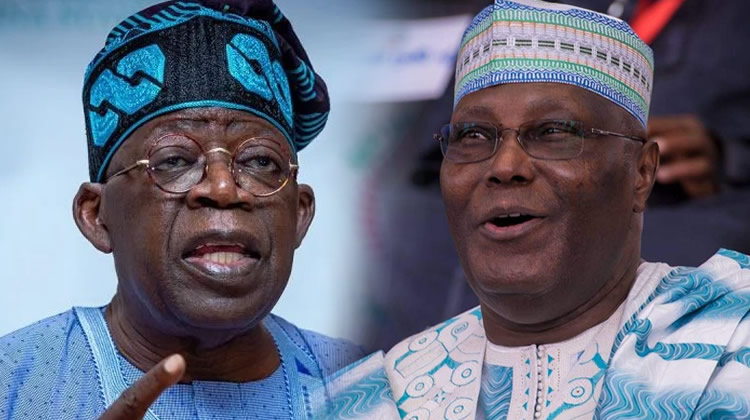
ASABA: The controversy between President Bola Ahmed Tinubu and former Vice-President Atiku Abubakar over the Federal Government’s temporary petrol discount has reopened a fundamental question about Nigeria’s economic reforms: how can government maintain market-based petroleum pricing while protecting citizens from the rising cost of living?
Atiku has accused Tinubu of borrowing the principle behind his proposed production subsidy but reducing it to a temporary retail discount. His argument is that the government has embraced the idea of targeted intervention in petrol pricing while ignoring the more durable framework he proposed to support domestic refining and bring down the cost of petroleum products.
The allegation has generated political debate, but the underlying economic issues deserve more serious consideration than a contest over who conceived an idea first. Nigerians are less concerned about the ownership of a policy than about whether it will reduce transport fares, moderate food prices, protect household purchasing power and provide a more predictable environment for businesses.
The central question, therefore, is not whether a petrol discount is politically attractive or whether a production subsidy is theoretically preferable. It is whether either arrangement can deliver measurable relief without creating new fiscal liabilities, undermining domestic investment or reversing the gains that market-based petroleum pricing is intended to achieve.
On October 8, 2026, the Federal Government announced a temporary petrol discount at National Oil Company Profile (NNPC) retail outlets, with priority for public transport operators. Finance Minister Taiwo Oyedele explained that NNPC Retail would forgo its retail profit margin and sell petrol at cost for the period of the intervention. The government also announced plans to negotiate a ceiling on petrol supply costs and use forward crude sales to domestic refiners as part of a broader effort to moderate price volatility. The NNPC subsequently clarified that its existing retail discount, introduced on October 1, would continue until October 31. These announcements establish the context for the current debate, although the precise relationship between the different measures and their respective timelines requires clear public communication.
The distinction between a retail-margin discount and a government-funded subsidy is important. Under the announced arrangement, NNPC Retail is expected to absorb the immediate reduction in its margin rather than receive a direct budgetary payment to cover the difference between the market price and a government-prescribed price. That is materially different from the former subsidy regime, under which public resources were used to cover part of the cost of petrol.
Nevertheless, the fact that an intervention is not funded through a direct budgetary allocation does not remove the need for accountability. A commercially owned company that surrenders revenue or reduces its margin must be able to explain the business rationale, the financial implications and the authority under which the decision was taken. The government should also clarify how the arrangement will be accounted for and whether it can be sustained without weakening the company’s commercial obligations to the Federation.
The temporary discount may provide some immediate relief, particularly to eligible transport operators and motorists who can access participating NNPC outlets. Its limitations, however, are equally evident. A discount available through one retail network does not automatically translate into a uniform reduction in petrol prices nationwide. Nor does cheaper petrol at selected stations necessarily produce lower transport fares or food prices. Those outcomes depend on how operators respond, the competitive conditions in the market and the extent to which savings are passed on to consumers.
Atiku’s production-subsidy proposal approaches the problem from a different point in the petroleum supply chain. He advocates a framework under which qualifying petroleum products refined in Nigeria and sold to Nigerian consumers would receive production support, subject to a spending ceiling, budgetary provision and independent auditing. The stated objective is to reduce production costs for domestic refiners and make the resulting savings available to consumers.
The proposal has an economic rationale worth examining. Greater domestic refining capacity can reduce dependence on imported finished petroleum products, strengthen supply security and create opportunities for investment, employment and industrial development. A carefully designed production-support mechanism could, in principle, help domestic refiners withstand temporary international price shocks while moderating the cost of locally refined products.
However, lower input costs do not automatically guarantee lower pump prices. Refining efficiency, financing costs, crude procurement, exchange-rate movements, storage, transportation and distribution margins all affect the final price paid by consumers. Unless the mechanism establishes a credible relationship between public support and measurable consumer benefits, the intervention could end up supporting producers without delivering proportionate relief to households.
There is also a fiscal question. If the proposal involves supplying crude oil to refiners below its market value, the difference represents an economic cost to the Federation even if the government does not make a direct cash payment. That cost could reduce the revenue available for public expenditure and transfers to the three tiers of government. A production subsidy must therefore be assessed not only by its effect on petrol prices but also by its opportunity cost: what public services, infrastructure or other priorities might be sacrificed to finance it?
The proposal requires a clearly defined subsidy rate, an annual spending ceiling, transparent eligibility criteria, independently verified production and sales volumes, safeguards against diversion and smuggling, and a credible mechanism for demonstrating that consumers receive the benefit. Without those details, the promise of a capped and audited intervention remains a policy intention rather than a fully costed programme.
The question of whether Tinubu copied Atiku’s idea must be approached with similar care. The two approaches share the broad objective of reducing the burden of high petrol prices, but they differ in design. Atiku’s proposal centres on support for qualifying domestic production, while the announced NNPC measure involves a temporary reduction in the retailer’s margin. The government’s additional proposals concerning forward crude sales and a negotiated supply-cost ceiling introduce further policy instruments, but their existence does not, by itself, establish that the administration copied Atiku’s complete framework.
Atiku is entitled to question the consistency of the government’s position, particularly if officials previously rejected his proposal as economically impracticable. The administration, in turn, should explain the reasoning behind its earlier objections and identify what distinguishes its present approach from the alternative it previously criticised. Such clarification would be more useful than an exchange of political insults or demands for apologies.
Good public policy should not become the exclusive property of the politician who first advocates it. Governments should be willing to consider proposals from opposition parties, independent experts, industry stakeholders and civil society. Equally, opposition figures should expect their proposals to withstand scrutiny on cost, legality, implementation and measurable results. The proper test of an idea is whether it works, not whose name is attached to it.
The legal framework is another important consideration. Section 205(1) of the Petroleum Industry Act 2021 provides for wholesale and retail petroleum prices to be determined under unrestricted free-market conditions. Any production subsidy, price ceiling or other intervention must therefore be examined against the applicable statutory framework and the legal basis for the proposed mechanism. Its economic appeal cannot substitute for legal compliance. Where a measure requires legislative action, regulatory clarification or additional safeguards, those requirements should be identified and addressed openly.
The government must also explain the relationship between its temporary discount and its commitment to petroleum-market reform. If the discount is a short-term commercial response to exceptional price volatility, the administration should publish the criteria for its termination or extension. If the government intends to introduce a more permanent stabilisation framework, it should disclose how the risks and costs will be allocated among refiners, importers, retailers and consumers. Predictability matters because investors require confidence that market rules will not change arbitrarily, while citizens need assurance that reform will not leave them without protection against severe economic shocks.
Above all, the debate should move beyond petrol prices as an isolated indicator of economic welfare. Fuel costs influence transportation, farming, food distribution, electricity generation and the operating expenses of small businesses, but they are not the only determinants of the cost of living. A farmer may benefit from cheaper fuel and still face insecurity, expensive fertiliser, inadequate storage and poor roads. A transport operator may obtain discounted petrol but retain existing fares. A small business may save on fuel while continuing to struggle with financing costs, unreliable electricity and distribution expenses.
Consequently, any petroleum-relief programme should form part of a broader strategy to reduce the cost of producing and distributing essential goods and services. That strategy should include better public transportation, more reliable electricity, improved agricultural logistics, effective competition, targeted support for vulnerable households and sustained investment in infrastructure. The government must also monitor transport fares and essential-goods prices so that claims of success are supported by evidence rather than announcements.
A credible way forward would begin with transparency. NNPC should publish the scope, duration and financial implications of its discount, including the eligibility conditions and the basis for any extension. The government should explain how public transport operators will be prioritised and how the promised relief will be assessed. If production support is adopted, its funding ceiling, legal basis, safeguards and expected consumer benefits should be made public before implementation. Independent audits and periodic reviews should establish whether the intervention is achieving its objectives at an acceptable cost.
There must also be a clear distinction between temporary relief and long-term reform. Emergency measures may be justified when international price shocks impose severe pressure on households and businesses, but they should not become permanent obligations without rigorous evaluation. Conversely, market-based pricing should not be used as a reason to disregard the hardship that price volatility imposes on citizens who have limited capacity to absorb sudden increases in essential expenses.
The Tinubu administration is entitled to defend its retail-margin discount as a commercially funded measure rather than a restoration of the former subsidy regime. Atiku is equally entitled to argue that a temporary discount does not address the structural issues his production-subsidy proposal seeks to tackle. Both positions should be judged against evidence of cost, legality, sustainability and consumer benefit.
Ultimately, Nigerians need more than a temporary reduction in petrol prices or a political argument over who proposed an intervention first. They need an economic policy framework that makes energy more affordable, encourages efficient domestic refining, protects public revenue and reduces the cost of transportation, food and productive activity.
The real measure of leadership is not the ability to claim ownership of an idea or to announce a relief package. It is the ability to design a policy that works, explain how it is financed, implement it transparently and demonstrate that its benefits reach the people for whom it was intended.
Nigeria should therefore turn this controversy into an opportunity for a more informed debate about petroleum pricing, domestic refining and social protection. The government should be prepared to learn from credible opposition proposals, while the opposition should be prepared to demonstrate the financial and practical viability of its alternatives. Neither side should allow political rivalry to stand in the way of evidence-based policymaking.
The ultimate beneficiary of sound public policy should be the Nigerian citizen. Whether relief comes through a temporary retail discount, a carefully designed production-support mechanism or a broader price-stabilisation framework, its success must be measured by tangible improvements in household welfare, business confidence and national economic resilience. That is the lesson this controversy should leave behind: Nigerians need results, not a contest over political ownership of ideas.
Frank Odion Apokwu is a Public Affairs Analyst. He writes from Asaba.
Sunday 11th October, 2026


