


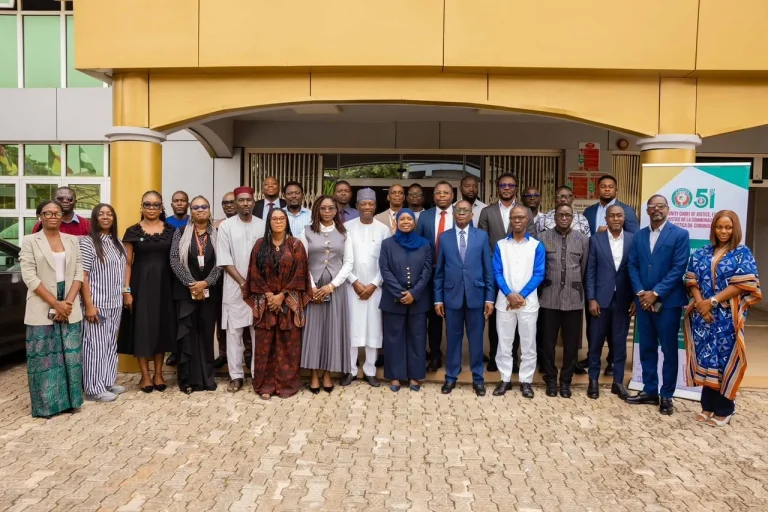
The President of the Community Court of Justice of the Economic Community of West African States (ECOWAS), Justice Ricardo Gonçalves, has urged journalists across member states to use their platforms to promote compliance with judgments delivered by the regional court.
Gonçalves made the call on Wednesday in Abuja, where he was represented by the Vice President of the Court, Justice Sengu Koroma, at the opening of a three-day training programme for journalists covering the ECOWAS Community Court of Justice.
ECOWAS Court Seeks Stronger Media Role
The ECOWAS Court president said journalists have an important responsibility in creating public awareness about the court’s decisions and encouraging member states to fulfil their obligations under regional treaties.
He urged journalists to use their media platforms to engage governments on the need to faithfully implement decisions of the court in accordance with their treaty obligations.
According to him, the responsibility for enforcing ECOWAS Court judgments rests with member states, but compliance with the decisions remains below expectations.
Gonçalves also stressed the importance of accurate and responsible reporting of judicial proceedings, noting that inadequate understanding of the court’s mandate and procedures had contributed to gaps in media coverage.
He explained that the Community Court of Justice is the principal judicial organ of ECOWAS, responsible for interpreting and applying ECOWAS legal instruments, promoting the rule of law and safeguarding human rights across the region.
He therefore urged journalists covering the court to develop a clear understanding of its mandate, jurisdiction, composition, structure, competence, practice and procedures.
The ECOWAS Court president said accurate judicial reporting would help citizens understand the role of regional judicial institutions, their decisions and the implications of those decisions for individuals and member states.
Gonçalves further advised journalists to clearly distinguish between arguments presented by parties in a case and the actual findings and decisions of the court.
He said journalists must avoid bias, sensationalism, misinformation and disinformation when reporting court proceedings, stressing the need to accurately present the findings, reasoning and decisions of the ECOWAS Court.
The three-day training brought together journalists from ECOWAS member states and is designed to deepen participants’ understanding of the court and improve reporting of its proceedings.
Participants are expected to interact with resource persons from the court’s Registry and Research Departments, alongside experts in journalism and judicial reporting.
The Head of Public Information and External Relations of the Community Court of Justice, ECOWAS, Ms Elohor Ovadje, said the programme would strengthen journalists’ knowledge of the court’s processes and improve the quality and accuracy of reports on its activities.
She said the training was also designed to promote fairness and objectivity in media coverage while increasing public awareness of the court’s mandate, jurisdiction and jurisprudence.
Ovadje added that the programme is expected to strengthen media advocacy for compliance with ECOWAS Court decisions and facilitate the establishment of a network of journalists specialising in judicial reporting.
According to her, the initiative would also help strengthen trust and cooperation between the court and the media while increasing public interest in the activities of the ECOWAS Court.
She expressed confidence that journalists participating in the training would benefit from the practical experience and use it to improve the quality of their reportage on the court.


