


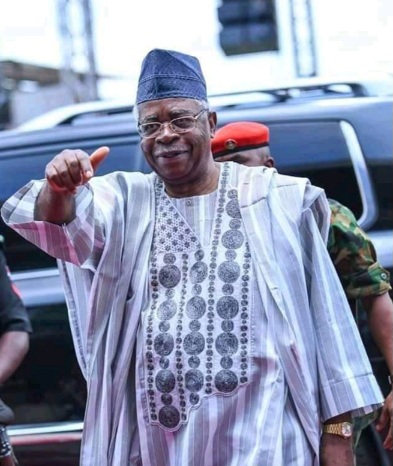
Danjuma’s Backing Strengthens Tinubu’s 2027 Re-election Bid as Middle Belt Leaders Rally Behind President
A high-profile delegation led by former Defence Minister, General Theophilus Yakubu Danjuma (retd.), has signalled growing political support for President Bola Tinubu ahead of the 2027 general election, with the influential elder statesman subsequently declaring support for the President’s second-term ambition.
The political landscape ahead of Nigeria’s 2027 presidential election may be witnessing a significant shift following the November 5, 2026, visit of former Minister of Defence, Lieutenant General Theophilus Yakubu Danjuma (retd.), and a delegation of prominent Middle Belt and North-Central leaders to President Bola Ahmed Tinubu at the Presidential Villa, Abuja.
The meeting, which attracted considerable political attention, brought together influential political figures, serving governors, former military chiefs and representatives of the Middle Belt, reinforcing speculation about an emerging coalition of support for Tinubu’s re-election campaign.
Although the Presidency confirmed the meeting through photographs, details of the closed-door discussions were not formally disclosed. However, subsequent political statements, particularly Danjuma’s endorsement of Tinubu’s second-term ambition, have provided a clearer indication of the political significance of the engagement.
Members of the delegation included Plateau State Governor Caleb Mutfwang, Taraba State Governor Agbu Kefas, Minister of Defence Christopher Musa, former Speaker of the House of Representatives Yakubu Dogara, former Chief of Army Staff General Ishaya Bamaiyi, All Progressives Congress (APC) National Chairman Nentawe Yilwatda, businessman Thomas Etuh and President of the Middle Belt Forum, Dr Pogu Bitrus.
The visit was followed by an open declaration of support for President Tinubu’s 2027 re-election bid by Danjuma, one of Nigeria’s most influential military veterans and political figures.
The endorsement was communicated on his behalf by General Ishaya Bamaiyi during the 20th anniversary and fundraising ceremony of the Adamawa State Government House Chapel in Yola.
At the event, Danjuma also donated ₦250 million towards the expansion of the chapel and construction of chaplaincy quarters.
Former Speaker Yakubu Dogara had earlier indicated that the delegation’s visit to the Presidential Villa was intended to demonstrate support for Tinubu’s second-term ambition.
The argument underpinning the political position, as presented by supporters of the initiative, is that the North has already completed eight years in power under former President Muhammadu Buhari, making it appropriate for the South to complete its own eight-year presidential tenure under Tinubu.
This position is being presented as a question of political fairness, national balance and continuity in the country’s leadership arrangement.
Another important dimension of Danjuma’s political alignment with Tinubu concerns the controversy surrounding the APC’s Muslim-Muslim presidential ticket during the 2023 general election.
The same-faith ticket generated considerable debate, particularly among Christian communities in the Middle Belt and other parts of Northern Nigeria, where concerns were raised about religious representation and inclusiveness in national governance.
However, supporters of Tinubu’s administration argue that the appointment of several Christians from the Middle Belt to strategic positions in the Federal Government has helped address some of those concerns.
They maintain that such appointments have strengthened confidence among sections of the Christian community and demonstrated the administration’s commitment to accommodating different religious and ethnic interests.
For Danjuma and other political figures supporting the President, sustaining national cohesion and ensuring that different communities feel represented in government remain important considerations.
Beyond the political calculations surrounding the 2027 election, regional security and community stability were also identified as important issues associated with the engagement.
Danjuma has historically maintained a strong public position on Nigeria’s security challenges, particularly the activities of armed groups, bandits and other criminal elements.
The retired general previously attracted national attention when he urged Nigerians to defend themselves against armed attacks, expressing concerns about the capacity of security institutions to adequately protect vulnerable communities.
His emergence as a prominent figure in efforts to build political support for the incumbent administration represents an important development in the evolving relationship between influential Northern leaders and the Tinubu government.
The November meeting was also not his first engagement with the President in 2026. Danjuma had earlier visited Tinubu at the Presidential Villa on February 28, 2026.
The political implications of Danjuma’s endorsement have generated considerable discussion, particularly regarding the potential influence of prominent Christian leaders in the Middle Belt on the 2027 presidential contest.
For the APC, the involvement of Danjuma, alongside serving governors and influential regional stakeholders, could strengthen its political standing in areas where the party faced questions about religious representation during the last presidential election.
The development may also complicate opposition efforts to mobilise Christian voters around concerns about the Muslim-Muslim ticket.
However, the political significance of the endorsement should not be mistaken for a unanimous position among Christians or the diverse ethnic nationalities of Northern Nigeria.
The Middle Belt is politically and socially diverse, with different communities, religious groups and political interests. Consequently, the support of influential individuals does not automatically translate into the collective endorsement of an entire region.
Nevertheless, Danjuma’s political stature, military background and longstanding relationships across Northern Nigeria give his endorsement considerable symbolic importance.
Danjuma’s alignment with Tinubu ahead of the 2027 election also highlights the changing political calculations within Northern Nigeria.
The region has historically played a decisive role in presidential elections because of its population and electoral strength. However, competing political interests, religious differences and ethnic considerations have often made it difficult for Northern political leaders to maintain a common position.
The emergence of influential figures rallying behind Tinubu could therefore represent an attempt to build a broader political consensus ahead of the next general election.
At the same time, the development raises questions about the extent to which elite endorsements can translate into grassroots electoral support, particularly in a region where economic hardship, insecurity, unemployment and governance concerns remain major issues for voters.
For Tinubu, however, Danjuma’s endorsement represents a potentially valuable political boost as the President seeks to consolidate support beyond the traditional APC political structure.
With the 2027 general election approaching, the extent to which this emerging alliance can influence voting patterns across the Middle Belt and Northern Nigeria will remain an important factor in the country’s unfolding political contest.