


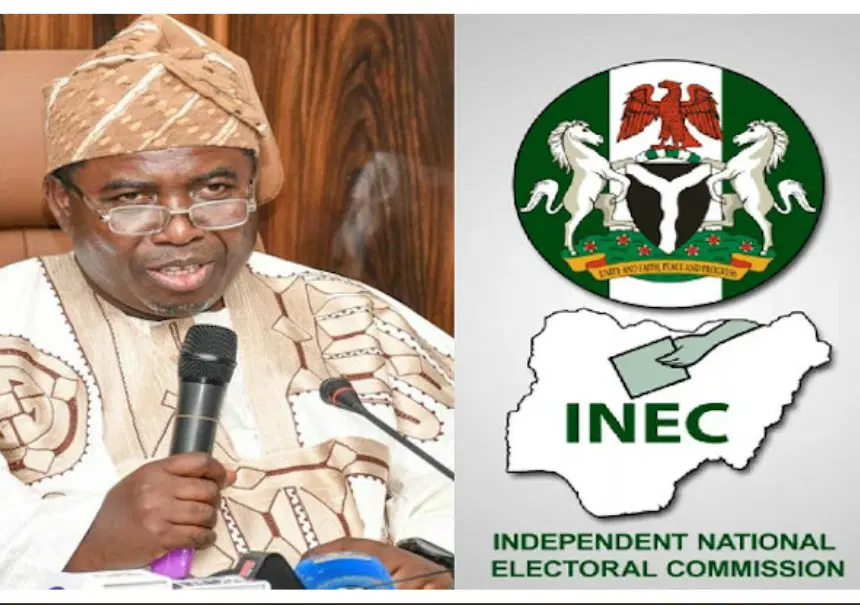
The Independent National Electoral Commission (INEC) has ruled out fully automated voter accreditation and election result collation in the 2027 general elections, assuring Nigerians that the choice of their next leaders will remain in the hands of voters, not artificial intelligence (AI).
INEC Chairman, Professor Joash Amupitan, SAN, made the position clear on Wednesday in Abuja, declaring that algorithms would not be allowed to determine the outcome of the 2027 elections.
“Algorithms will not, and must never, decide the 2027 vote,” Amupitan said.
According to INEC’s Wednesday bulletin, the chairman spoke while delivering the keynote address at the Artificial Intelligence and Democracy Forum 2026, organised in collaboration with Yiaga Africa.
Amupitan explained that critical electoral decisions, including voter accreditation, result collation and candidate qualification, would not be fully automated or delegated to autonomous systems.
He stressed that human accountability, legal oversight and judicial review would remain essential throughout the electoral process.
Responding to the forum’s central question, “Will Algorithms Decide the 2027 Vote?”, the INEC chairman gave an unequivocal answer: no.
He maintained that the constitutional right to choose Nigeria’s leaders belongs exclusively to the Nigerian people.
INEC Raises Alarm Over AI-Generated Election Disinformation
Beyond the use of technology in election administration, Amupitan warned that artificial intelligence could pose a serious threat to the credibility of the 2027 elections by making it easier to produce and circulate convincing false information.
He said the electoral commission was confronting a digital environment that had changed significantly since the 2023 general elections, with AI capable of influencing what voters see, believe and trust.
“The greatest threat we face is not the hacking of a ballot box, but the hacking of the voter’s mind,” he stated.
The INEC chairman explained that generative AI had made it considerably easier to create convincing deepfake videos and cloned audio recordings featuring candidates or electoral officials making statements they never made.
Such fabricated content, he warned, could mislead voters, undermine public confidence and interfere with informed electoral decisions.
Amupitan identified possible scenarios in which manipulated videos or audio recordings could falsely announce a candidate’s withdrawal, claim that an election had been postponed or circulate inflammatory ethnic and religious statements.
He also warned that criminals and other malicious actors could impersonate the INEC chairman, Resident Electoral Commissioners and other officials to distribute fake election guidelines, announce unauthorised results or instruct voters to remain at home.
According to him, the rapid spread of such material could create confusion within minutes, making the identification and correction of false information increasingly important during the election period.
INEC Establishes AI Unit to Monitor Election Threats
In response to the emerging risks, Amupitan disclosed that INEC had established an Artificial Intelligence Unit within its Information and Communication Technology Directorate.
The unit, he said, had been equipped with real-time digital monitoring tools, deepfake detection software and data analytics expertise to help the commission identify and respond to technology-driven threats.
He added that any AI tool deployed for logistics, database management or operational support would undergo rigorous audits to assess its explainability, fairness and security before implementation.
INEC is also developing a Digital Strategy aimed at auditing the information environment and working with technology platforms to debunk and label AI-generated content relating to electoral processes.
The chairman called on Meta, X, Google, TikTok and Telegram to act quickly against unlabelled synthetic media impersonating election officials, candidates and security personnel.
He also urged technology companies to enforce disclaimers on political advertisements and restrict political micro-targeting based on ethnicity, religion or local origin.
Political parties and candidates, meanwhile, were encouraged to sign an Ethical AI Code of Conduct committing them to avoid deepfakes, synthetic impersonation, deceptive political advertisements and coordinated networks of automated bots.
Despite his warnings, Amupitan said INEC did not regard artificial intelligence solely as a threat to democracy.
He described the technology as a potentially valuable tool for improving administrative accuracy, election planning and institutional integrity.
For example, AI could be used to conduct parallel statistical checks on polling-unit result sheets uploaded through the eEC8A system.
Such checks could help identify mathematical inconsistencies, unusual data-entry patterns and poor-quality images for further administrative review.
However, he emphasised that these technological checks would not replace the legally prescribed human process for collating and declaring election results.
AI-powered geographical analysis could also help the commission plan the deployment of ad hoc staff, vehicles, boats and sensitive election materials to polling locations ahead of voting.
According to Amupitan, Nigeria’s 2027 general elections are expected to involve more than 103 million registered voters across 774 local government areas and 176,846 polling units.
He said 10 of the 14 major operational milestones under the Electoral Act 2026 had been successfully completed.
Amupitan’s remarks place voter choice and human responsibility at the centre of INEC’s preparations for the 2027 elections.
The two-day Artificial Intelligence and Democracy Forum brought together electoral officials, political party representatives, civil society organisations, security agencies, technology companies and media practitioners.
Among those in attendance was Abdoulaye Sylla, chairman of Senegal’s Electoral Commission and chairperson of the ECOWAS Network of Electoral Commissions.
The INEC chairman maintained that although algorithms could support administrative operations, they lacked the constitutional responsibility and civic obligations required to determine who governs Nigeria.
They do not have a conscience, they do not have a country, and they do not have a vote,” he said.
He added that the commission’s responsibility was to ensure that the voices of Nigerians remained clear despite the growing influence of digital technology.
“On election day in 2027, it will be the thumbprint of the Nigerian citizen, guided by their own will and their own hopes, that decides our future,” Amupitan said.
With political activities gathering momentum ahead of the 2027 general elections, INEC’s position signals that technology may assist election planning and fraud detection, but fully automated voter accreditation and result collation will not replace human accountability under the commission’s stated policy.


