


The race for Aso Rock in 2027 could be heavily influenced by voting patterns in Nigeria’s North-West and South-West, as fresh voter registration figures highlight the electoral weight of the two geopolitical zones.
According to figures attributed to the Independent National Electoral Commission (INEC) in a Vanguard report, the North-West has 25,083,411 registered voters, while the South-West has 19,614,274.
Combined, the two regions account for 44,697,685 registered voters, representing more than 43 per cent of Nigeria’s total 103,428,715 registered voters ahead of the 2027 general elections.
The figures underline the strategic importance of the two regions as political parties intensify preparations for the next presidential contest.
However, the large voter population does not automatically guarantee victory for any candidate, as turnout, political alliances, party structures, voter sentiment and the distribution of votes across the country will remain decisive.
With more than 25 million registered voters, the North-West stands as Nigeria’s largest geopolitical voting bloc, placing it at the centre of the calculations of presidential candidates.
Kano, Kaduna and Katsina are among the states with significant electoral influence, while the region’s diverse political interests could make it difficult for any candidate to secure overwhelming support.
The North-West has historically played a major role in presidential elections, but voting patterns show that the region cannot be treated as a single political constituency.
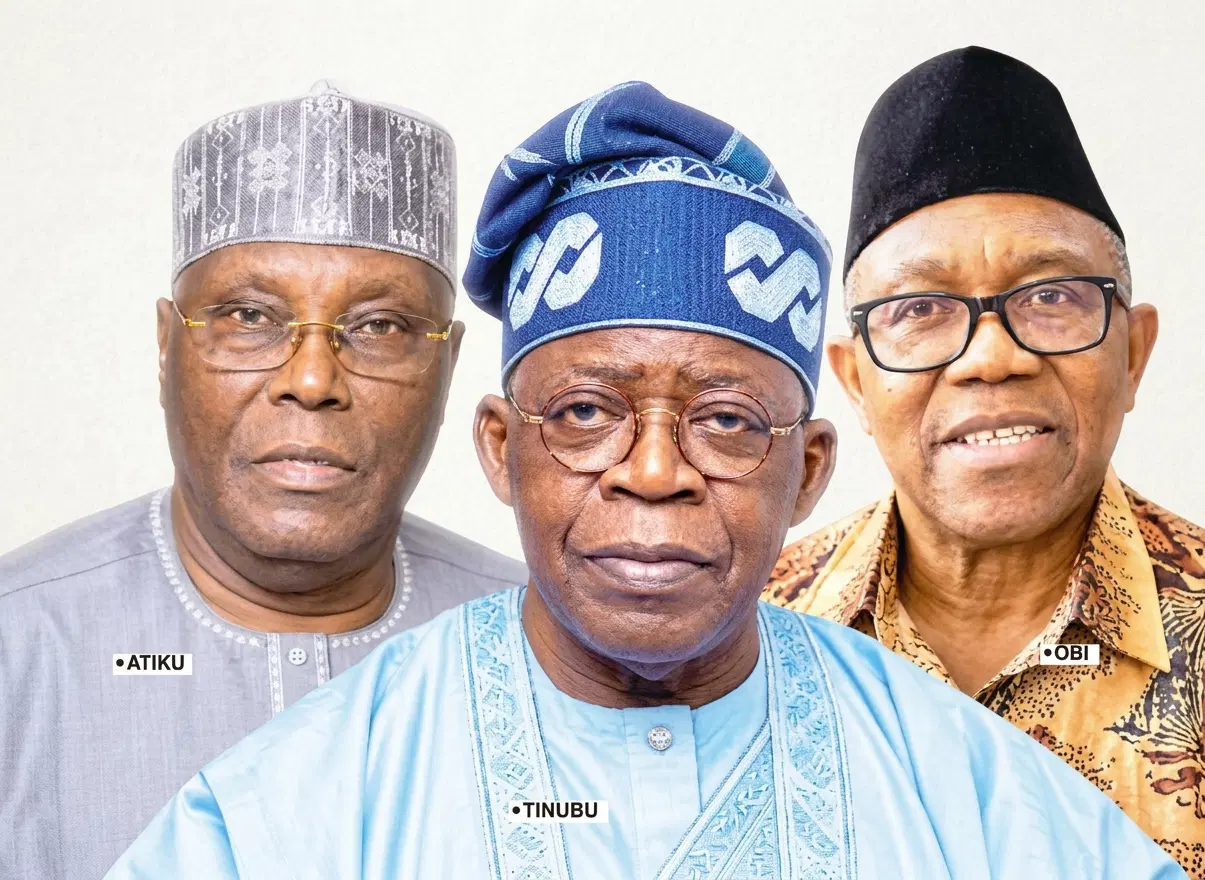
In the 2023 presidential election, former Vice-President Atiku Abubakar defeated Tinubu in Kaduna State, polling 554,360 votes against Tinubu’s 399,293 votes, according to the figures cited in the report.
Rabiu Kwankwaso, meanwhile, won Kano State for the New Nigeria Peoples Party (NNPP), further demonstrating the region’s competitive political landscape.
For Tinubu, defending and expanding his support in the North-West could prove critical to his re-election ambition.
For opposition figures, the region offers opportunities to challenge the ruling party, particularly amid voters’ concerns about insecurity, economic hardship and the cost of living.
The South-West remains a major political base for Tinubu, whose political network and longstanding influence in the region have shaped his presidential ambition.
The region has 19,614,274 registered voters, with Lagos alone accounting for 7,488,633, according to the reported INEC figures.
Despite Tinubu’s established political presence, the South-West is not guaranteed to deliver uniform support to the president.
The 2023 presidential election demonstrated this reality when Peter Obi defeated Tinubu in Lagos State by 9,848 votes.
Obi polled 582,454 votes, while Tinubu secured 572,606 votes in the state.
The outcome showed that urban voting patterns, local political grievances, party loyalty and candidate appeal could significantly influence results, even in a presidential candidate’s traditional political territory.
Ahead of 2027, Tinubu will be seeking to consolidate his influence across the region, while opposition candidates could attempt to capitalise on voter dissatisfaction and political divisions.
The 2023 election demonstrated the importance of combining regional strength with a wider national coalition.
Tinubu won the presidency with 8,794,726 votes, defeating Atiku, who received 6,984,520 votes, and Obi, who secured 6,101,533 votes.
The reported zonal breakdown showed that Tinubu received 2,542,979 votes in the South-West and 2,652,235 in the North-West.
His performance in the North-West was therefore slightly higher than his tally in his home region.
The distribution of votes across the country, combined with the division of opposition support among major candidates, played an important role in the outcome.
The experience has reinforced the argument that neither regional dominance nor a strong home base is sufficient on its own to secure the presidency.
Veteran journalist and political analyst Simon Kolawole, reflecting on the 2023 outcome, was quoted as saying that Tinubu did well in “two out of three the South-West and the core North.
The broader electoral calculation, however, requires candidates to expand beyond their strongest regions and secure meaningful support in other parts of the country.
For Atiku and Obi, the challenge ahead of 2027 will include building broader electoral coalitions while navigating competing political ambitions, party structures and possible alliances.
Atiku will need to translate his northern support into a wider national coalition, while Obi faces the task of expanding his appeal beyond areas where he performed strongly in 2023.
Opposition fragmentation could also shape the contest, particularly if multiple candidates compete for overlapping voter bases.
For Tinubu and the All Progressives Congress (APC), the advantage of incumbency, party machinery and established political networks could be significant.
Nevertheless, the administration’s performance on the economy, job creation, living costs and insecurity is expected to influence voters’ decisions.
The choice of running mates, strength of state-level party organisations, relationships with influential political figures and mobilisation of supporters could also shape the outcome.
Although the North-West and South-West collectively account for more than 43 per cent of registered voters, the actual number of people who participate in the election will determine how much electoral power those figures translate into.
Voter turnout, accreditation, election-day logistics and the distribution of ballots among candidates could alter expectations.
Nigeria’s presidential election also requires candidates to meet constitutional conditions beyond securing the highest number of votes nationally.
Under Section 134 of the Constitution, a presidential candidate must obtain the highest number of votes cast and at least one-quarter of the votes in at least two-thirds of all states and the Federal Capital Territory, subject to the applicable constitutional provisions.
This makes nationwide political outreach and coalition-building essential.
The North-West and South-West may shape the arithmetic of the 2027 presidential election, but neither region can independently guarantee victory.
Ultimately, the contest for Aso Rock will depend on which candidate can convert voter registration figures into actual votes, maintain political alliances, withstand local electoral surprises and build support across Nigeria’s diverse political landscape.


