

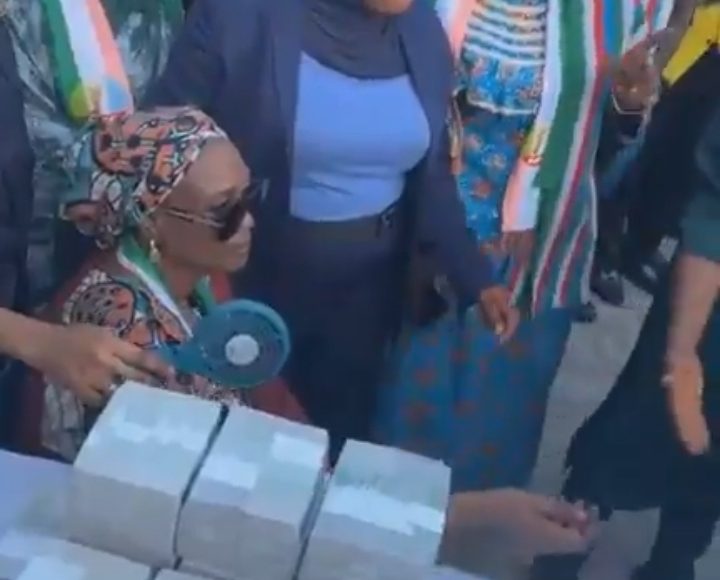
A cash distribution programme launched by Hajiya Maryam Wadada, wife of APC governorship candidate Senator Ahmed Wadada, has sparked a heated debate in Nasarawa State after a video of women receiving cash went viral on social media.
Maryam Wadada reportedly launched a Women Empowerment Scheme aimed at supporting women across the state’s 13 local government areas.
Under the programme, 6,500 women are expected to receive ₦50,000 each, putting the reported value of the initiative at ₦325 million.
The exercise reportedly began around August 10 in Awe and is expected to continue through mid-August.
According to the organisers, the money is intended to provide start-up capital for small businesses, including petty trading and groundnut processing.
But the timing of the programme has become the major talking point.
With Nigeria heading towards the 2027 general elections, critics have questioned whether the cash distribution should be regarded purely as an empowerment initiative or whether it could influence voters.A video showing the distribution of cash to women has circulated widely online, attracting strong reactions from Nigerians.
Some critics described the exercise as an attempt to buy political support, while others questioned why such a large cash programme was being carried out so close to an election.
Some social media users also called on anti-corruption and electoral authorities to examine the development.
However, the available report does not establish that the beneficiaries were asked to vote for any candidate in exchange for the money.
That distinction is important because a cash empowerment programme and electoral vote-buying are not necessarily the same thing.
The controversy essentially boils down to one question:
Is the ₦325 million programme genuinely designed to help women build businesses, or could it become a political tool ahead of the 2027 election?
The organisers describe the initiative as economic empowerment, with the funds intended to help women establish or strengthen small businesses.
Critics, however, argue that the timing, scale and method of distributing cash to thousands of women deserve closer scrutiny.
The debate has therefore moved beyond the money itself to the wider question of how politicians and political actors provide financial assistance during election periods.
The viral video generated a flood of reactions.
Some Nigerians accused politicians of taking advantage of economic hardship, arguing that cash handouts can make voters vulnerable during elections.
Others defended the programme, saying women struggling with the rising cost of living should not be prevented from receiving legitimate financial assistance simply because an election is approaching.
There were also calls for authorities to establish whether the programme violated any electoral or financial regulations.
But social media reactions and allegations alone cannot prove that an electoral offence has been committed.
The controversy is likely to continue as political activities gradually intensify ahead of the 2027 elections.
For Maryam Wadada and the organisers, the challenge will be to demonstrate clearly that the programme is an empowerment initiative rather than an inducement for political support.
For the public, the bigger question remains:
When does political empowerment cross the line into vote-buying?
Until evidence establishes that the cash was distributed in exchange for votes or political support, the ₦325 million programme remains an empowerment scheme surrounded by controversy and questions over its timing.
.