


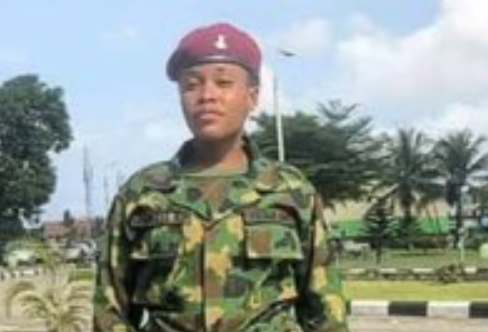
Former Nigerian soldier Ruth Ogunleye, who accused senior military officers of sexual harassment and alleged that her complaints were ignored by military authorities, has reportedly been arrested and taken into custody, reigniting public interest in a controversial case that began in January 2024.
According to a report published by SaharaReporters on Monday, October 26, 2026, a source familiar with the development claimed that Ogunleye was taken from Lagos and transferred to a correctional facility while awaiting trial.
However, the report contains conflicting information about her destination. While one section states that she was moved to Kaduna State, a statement attributed to the unnamed source refers to a prison in Abuja. The specific offence she is alleged to have committed, the court handling the matter and the circumstances surrounding her reported arrest have not been disclosed.
The report also attributes the arrest to an alleged order by Defence Minister General Christopher Gwabin Musa (retd.), who previously served as Chief of Defence Staff. That claim has not been independently verified, and no official confirmation establishing the minister’s involvement was identified in the reports reviewed.
The development is particularly sensitive because Ogunleye previously accused senior officers of sexual harassment, intimidation and maltreatment, claiming that her attempts to obtain redress did not produce the outcome she expected.
Ogunleye came into the national spotlight in January 2024 after publishing a video on social media in which she accused senior Nigerian Army officers of harassment and intimidation.
At the time, she specifically accused Colonel I.B. Abdulkareem of making unwanted sexual advances and alleged that her difficulties within the military increased after she rejected those advances.
She also named Colonel G.S. Ogor and Brigadier General I.B. Solebo in allegations concerning her treatment while serving in the Nigerian Army.
According to her account, she faced intimidation and other forms of maltreatment and encountered difficulties when she attempted to seek assistance through military channels.
Ogunleye further alleged that her father’s efforts to intervene did not resolve the situation. She claimed that the treatment she experienced affected her career and made it difficult for her to continue serving.
The allegations attracted considerable public attention and prompted calls for the military to investigate the claims and explain how complaints against senior officers are handled.
The Nigerian Army subsequently announced that it had commenced an investigation into the matter.
A report published by TheCable on January 14, 2024, documented Ogunleye’s allegations and the Army’s initial response, in which the institution said appropriate action would be taken after its investigation.
In September 2024, the Nigerian Army announced that its investigation had found no evidence to substantiate the sexual-harassment allegations against Colonel Abdulkareem.
The Army said the Nigerian Army Corps of Military Police had investigated the complaint and examined the available evidence and testimonies.
Speaking at a press briefing in Abuja on September 24, 2024, the then Director of Army Public Relations, Major General Onyema Nwachukwu, said the investigation concluded that Abdulkareem had not committed the offence of sexual harassment alleged by Ogunleye.
The Army rejected the central allegations against the colonel and defended the process through which the matter had been investigated.
It also disclosed that Ogunleye had been recommended for discharge on medical grounds and that medical assessments informed the decision to end her military service.
According to the Army, she was discharged on June 14, 2024, following medical evaluations.
The institution maintained that its handling of the case followed established procedures. Its findings, however, were disputed by Ogunleye, who continued to question aspects of the investigation.
The Army’s position and Ogunleye’s objections became central to the public debate surrounding the case.
Reports by Channels Television and The Guardian Nigeria documented the Army’s findings and its decision to discharge Ogunleye from service.
Beyond her allegations against the officers she named, Ogunleye said she sought intervention from senior military officials but did not receive the assistance she expected.
In an interview monitored by SaharaReporters in September 2024, she said she had approached several senior officers, including General Christopher Musa, who was then Chief of Defence Staff.
She alleged that her attempts to obtain redress were unsuccessful because the officers she approached were senior to her alleged offender.
Her complaint raised broader questions about the procedures available to junior military personnel who believe they have been mistreated by superior officers.
However, her allegations concerning the response of senior officials remain claims made by Ogunleye and should not be treated as independently established findings of misconduct.
Musa’s role in the earlier complaint is now attracting renewed attention because the latest arrest report attributes the alleged detention to an order by the Defence Minister.
That assertion requires independent verification. The available reports do not establish whether Musa ordered the arrest, whether the alleged detention is connected to Ogunleye’s earlier complaint or whether a separate matter is involved.
After the Army announced its conclusions in September 2024, Ogunleye challenged aspects of the investigation and called for the matter to be reviewed.
She alleged that the investigative process had not adequately considered her evidence and witnesses. She also expressed concern that the findings might have been affected by interference.
Those claims were her account of the process and have not been established as proof that the investigation was manipulated.
In October 2024, she appealed to the then Chief of Army Staff, Lieutenant General Taoreed Lagbaja, for a review of the findings.
Musa, who was Chief of Defence Staff at the time, also commented publicly on the possibility of a review, expressing confidence that the original findings would remain unchanged.
His comments concerned the earlier investigation. They do not, on their own, establish any connection between him and the reported arrest in October 2026.
The dispute left Ogunleye and the Army maintaining different positions: the military said its investigation had cleared the officer she accused, while Ogunleye questioned whether her complaints had received adequate consideration.
During her efforts to seek redress, Ogunleye referred to Section 179 of the Armed Forces Act, which provides a complaint procedure for certain serving military personnel who believe they have been wronged.
The provision establishes channels through which eligible personnel may raise grievances with their commanding officers and, under specified circumstances, escalate their complaints.
Ogunleye argued that her attempts to obtain redress through military procedures had not produced the outcome she sought.
The provision is relevant to understanding her account of how she pursued her complaint while in service. However, it does not establish that her original allegations were true, nor does it determine the legal basis of her reported arrest after leaving the military.
Any separate criminal allegation against her would need to be addressed through the applicable legal procedures and supported by evidence.
Likewise, the existence of an internal military investigation does not remove the importance of transparency when allegations of misconduct are raised or when a former service member is reportedly detained.One of the immediate questions arising from the latest report concerns Ogunleye’s whereabouts.
SaharaReporters’ account refers to Kaduna State in its opening paragraphs but later quotes its source as saying she was moved to an Abuja prison.
The discrepancy has not been explained in the report, making it difficult to establish her exact place of detention from the information currently available.
The report also does not identify the agency that carried out the arrest, the specific charge against her, the court before which she is expected to appear or whether a court has issued a remand order.
These details are important because a report that someone is awaiting trial does not, by itself, establish that a formal charge has been filed or that a court has ordered continued detention.
The relevant authorities would need to clarify whether Ogunleye has been arrested, where she is being held, the legal grounds for her detention and the next steps in any proceedings against her.
SaharaReporters said it contacted Army spokesperson Colonel Appolonia Anele for information about the reported arrest and Ogunleye’s legal status but did not receive a response at the time of its report.
No official statement confirming the specific charges or resolving the discrepancy over her detention location was included in the reports reviewed for this article.
The allegation that Defence Minister Christopher Musa ordered Ogunleye’s arrest is among the most significant claims in the latest report.
However, the claim is attributed to an unnamed source, and the material reviewed does not independently establish that the minister issued such an instruction.
It is therefore important to distinguish the reported allegation from a confirmed official action.
The Defence Ministry and the relevant security or correctional authorities would need to clarify the circumstances of the reported arrest, identify the legal authority responsible and address whether the minister had any role in the matter.
It is equally important not to assume that the reported arrest is a direct consequence of Ogunleye’s previous sexual-harassment allegations. The available information does not establish that connection, and the arrest could concern a separate matter.
Until further details emerge, claims about the motive for the reported detention should be treated cautiously.
The reported arrest has renewed questions about due process, military accountability and the treatment of individuals involved in disputes with powerful institutions.
Under Nigeria’s Constitution, an arrested or detained person has rights that include being informed of the grounds for the arrest, access to legal representation and being brought before a court within the applicable constitutional time limits.
The exact legal requirements depend on the circumstances and the nature of the alleged offence. An arrest does not amount to a conviction, and any allegation against Ogunleye must be determined through a lawful process.
At the same time, allegations of sexual harassment must be assessed on the evidence, and the outcome of the Army’s earlier investigation should be accurately represented. The Army said its investigation did not substantiate the allegations against Abdulkareem, while Ogunleye disputed aspects of the process.
The public record should not be used to presume guilt on either side without sufficient evidence.
The immediate need is for clear information about Ogunleye’s reported detention, the alleged offence, the authority responsible and the legal proceedings, if any, that have commenced.
The reported arrest has added another development to a case that has attracted public attention since early 2024.
For now, several essential questions remain unanswered: whether the arrest has been officially confirmed, what charge Ogunleye may be facing, where she is being detained and whether the alleged order by Musa can be substantiated.
The Nigerian Army and Defence Ministry have not been quoted in the available reports as providing a substantive explanation of these latest claims.
Clarification from the relevant authorities would help establish whether the reported detention is connected to an independent legal matter or to the earlier dispute involving Ogunleye’s complaints against senior officers.
Until that information becomes available, the allegations surrounding the arrest should not be treated as proven facts.
Visit www.rapidospace.com for more breaking news, investigations and updates from Nigeria and around the world.