


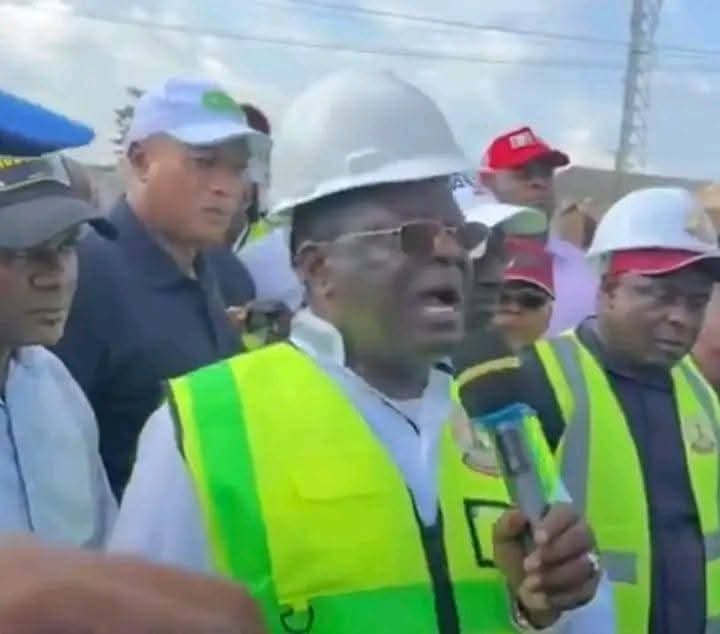
ASABA: There are moments in public administration when an official acknowledgement of failure can become either the beginning of genuine accountability or merely another chapter in the long history of official explanations.
The statement by the Minister of Works, Senator David Umahi, during his inspection of the distressed Benin–Asaba Expressway on August 25, 2026, presents precisely such a moment.
The Minister apologised to commuters. He expressed disappointment with the concessionaire. More significantly, he said he took responsibility for what he described as the concessionaire’s “misdeed and destruction of public assets.” He also acknowledged that the road was not in its present condition when it was handed over and directed the Ministry to arrest concessionaires who remove asphalt from existing roads.
That is an unusually forthright admission from a serving Minister.
It deserves to be acknowledged.
But an apology, however sincere, cannot by itself repair a highway.
The people of Edo and Delta States—and indeed millions of Nigerians who depend on this strategic corridor—now need something more tangible: accountability, emergency action and results.
FROM APOLOGY TO ACTION
The Benin–Agbor–Asaba corridor is not merely another federal road.
It is an economic artery connecting communities, businesses, markets and people across Edo and Delta and linking important commercial routes beyond the two states. Its collapse therefore has consequences far beyond inconvenience.
Motorists have reportedly spent hours and, in some cases, days trapped in gridlock. The situation has become sufficiently serious to generate protests and widespread public outrage.
The Federal Government has now recognised the urgency.
President Bola Tinubu has directed the Ministry of Works to do whatever is necessary to restore the road, according to Umahi. The Minister has also announced that the Federal Government intends to review concessioned roads across the country to ensure that contractual obligations are being fulfilled and that the arrangements serve the public interest.
This is the right direction.
But Nigerians should now ask: what happens after the inspection?
THE 30-KILOMETRE QUESTION
One of the most disturbing allegations made by the Minister is that the concessionaire removed more than 30 kilometres of asphalt without completing the rehabilitation, thereby exposing the road to further deterioration.
Umahi had made this allegation even before his inspection, saying that the concessionaire removed the asphalt and left the road in a condition that has now subjected motorists to severe hardship.
This allegation must not simply disappear into the news cycle.
It requires a proper technical and contractual investigation.
Who authorised the removal?
Was the removal consistent with the concession agreement and approved engineering design?
What did the supervising consultants recommend?
Was drainage supposed to precede pavement removal?
What quantity of asphalt was actually removed?
What became of the removed material?
What payments had been made to the concessionaire?
Were milestones achieved?
Were government inspectors satisfied with the work?
And, most importantly, who bears responsibility for the consequences?
These questions are too important to be answered through political statements or social-media arguments.
They require documentation.
THE CONCESSIONAIRE MUST ALSO BE HEARD
A balanced assessment requires that the concessionaire’s position be heard.
The Benin–Asaba Expressway Concession Company Limited (BAECC) has argued that heavy rainfall and the enormous volume of traffic complicated the construction of drainage infrastructure and affected the pace of rehabilitation. Its chief executive said the company had undertaken palliative works and remained committed to completing the project.
That explanation cannot simply be dismissed.
At the same time, neither rainfall nor traffic can become a permanent justification for leaving a major highway in a condition that endangers road users.
Indeed, the project consultant reportedly told the Minister that the concessionaire had been instructed to construct drainage first but failed to follow that instruction, contributing to the deterioration of the road.
This is precisely why an independent technical audit is necessary.
We should establish the facts before assigning blame.
BUT UMAHI HAS MADE AN IMPORTANT ADMISSION
Perhaps the most consequential statement made by the Minister was not his criticism of the concessionaire.
It was his admission that government itself bears responsibility for failing to properly assess the competence of concessionaires.
That admission deserves serious reflection.
If government awards a strategically important public asset to a private operator without adequately establishing that the operator possesses the financial, technical and managerial capacity to deliver, government cannot subsequently wash its hands of the consequences.
A concession does not mean abdication.
The road may be concessioned, but the public interest remains public.
Government remains the regulator, contracting authority and ultimate guarantor of the public interest.
Therefore, if the concession model has failed in this instance, the appropriate response is not necessarily to abandon public-private partnerships altogether.
Rather, government must strengthen due diligence, supervision, performance monitoring, enforcement and termination mechanisms.
THE CONCESSION MODEL MUST BE PUT UNDER THE MICROSCOPE
The Benin–Asaba Expressway was concessioned to BAECC under a long-term arrangement. The project envisages substantial reconstruction and expansion, with tolling intended to support the investment and maintenance obligations.
There is nothing inherently wrong with using private capital to develop public infrastructure.
Indeed, given Nigeria’s enormous infrastructure deficit and fiscal constraints, private-sector participation may be indispensable.
But concessioning a road must never become an excuse for transferring public assets to private operators without sufficiently robust safeguards.
The Federal Government’s proposed review of concessioned roads across the country is therefore welcome.
That review should be comprehensive.
It should examine:
1. The technical competence of every concessionaire;
2. The financial capacity of each operator;
3. Compliance with contractual milestones;
4. Quality of construction and rehabilitation;
5. Traffic-management obligations during construction;
6. Drainage and environmental requirements;
7. Performance guarantees and penalties;
8. The adequacy of government supervision; and
9. The circumstances under which a concession can be suspended or terminated.
The review should culminate in a publicly accessible report.
Nigerians have a right to know whether the concession model is delivering value for money.
EMERGENCY ACTION CANNOT WAIT FOR THE RAINY SEASON
BAECC has reportedly announced an accelerated programme, including drainage works and pavement reconstruction, with a more intensive recovery programme expected after the rainy season.
That may be part of the permanent solution.
But motorists currently trapped on the corridor cannot wait for a long-term construction schedule.
The immediate priority must be to make the road safe and passable.
The Federal Government should therefore deploy competent emergency contractors and equipment where necessary, without waiting for the contractual dispute to paralyse the entire corridor.
This is not about replacing the concessionaire prematurely.
It is about protecting human lives, economic activity and the public interest while the contractual and technical questions are being resolved.
Umahi himself has indicated that government intends to bring in a contractor to make the road motorable in the interim.
That commitment should be implemented immediately.
THE MINISTER DESERVES CREDIT—BUT MUST ALSO BE HELD TO HIS WORD
There is a temptation in political discourse to interpret every official statement through the prism of partisan loyalty.
We should resist that temptation.
When a Minister acknowledges failure, apologises to citizens and accepts responsibility, we should acknowledge the positive development.
But precisely because Umahi has accepted responsibility, he must now be held to the standard created by his own statement.
The public should not have to hear another apology six months from now.
They should see a rehabilitated road.
They should see functioning drainage.
They should see proper traffic management.
They should see contractors working.
They should see contractual obligations enforced.
And they should see consequences where public assets have been unlawfully or negligently damaged.
Accountability means more than accepting blame. It means correcting the failure and ensuring that it does not recur.
A NEW TEST FOR THE FEDERAL MINISTRY OF WORKS
The Benin–Agbor–Asaba crisis has therefore become bigger than one road.
It is now a test of whether Nigeria can make public-private infrastructure partnerships work.
It is a test of the Federal Ministry of Works’ regulatory capacity.
It is a test of concession management.
It is a test of engineering supervision.
It is a test of political accountability.
And, ultimately, it is a test of whether government can listen when citizens cry out.
Minister Umahi has opened the door by saying, in effect: “We have a problem, and I accept responsibility.”
The next step must be:
“Here is what went wrong. Here is who is responsible. Here is what we are doing about it. Here is when the road will become motorable. And here is how we will ensure that this never happens again.”
That is the difference between an apology and accountability.
CONCLUSION
The people of Edo and Delta do not need another political argument about who is to blame.
They need their road back.
The Federal Government should therefore treat the Minister’s intervention as the beginning of a transparent, time-bound recovery programme—not the conclusion of the matter.
Let the concession agreement be reviewed.
Let the engineering records be examined.
Let the alleged removal of asphalt be independently verified.
Let the concessionaire’s defence be heard.
Let government supervision be scrutinised.
Let emergency repairs commence.
Let those found culpable face appropriate sanctions.
And let Nigerians be regularly informed of progress.
**Minister Umahi has apologised. That is commendable.
Now let the apology become action.
Let action become accountability.
And let accountability finally become a road that Nigerians can travel on safely.**UMAHI HAS APOLOGISED. NOW LET THE BENIN–AGBOR–ASABA ROAD CRISIS BECOME A TEST OF ACCOUNTABILITY
By Frank Odion Apokwu, DSC, LLB, FNIM, FSM, FIMC, CMC
There are moments in public administration when an official acknowledgement of failure can become either the beginning of genuine accountability or merely another chapter in the long history of official explanations.
The statement by the Minister of Works, Senator David Umahi, during his inspection of the distressed Benin–Asaba Expressway on August 25, 2026, presents precisely such a moment.
The Minister apologised to commuters. He expressed disappointment with the concessionaire. More significantly, he said he took responsibility for what he described as the concessionaire’s “misdeed and destruction of public assets.” He also acknowledged that the road was not in its present condition when it was handed over and directed the Ministry to arrest concessionaires who remove asphalt from existing roads.
That is an unusually forthright admission from a serving Minister.
It deserves to be acknowledged.
But an apology, however sincere, cannot by itself repair a highway.
The people of Edo and Delta States—and indeed millions of Nigerians who depend on this strategic corridor—now need something more tangible: accountability, emergency action and results.
FROM APOLOGY TO ACTION
The Benin–Agbor–Asaba corridor is not merely another federal road.
It is an economic artery connecting communities, businesses, markets and people across Edo and Delta and linking important commercial routes beyond the two states. Its collapse therefore has consequences far beyond inconvenience.
Motorists have reportedly spent hours and, in some cases, days trapped in gridlock. The situation has become sufficiently serious to generate protests and widespread public outrage.
The Federal Government has now recognised the urgency.
President Bola Tinubu has directed the Ministry of Works to do whatever is necessary to restore the road, according to Umahi. The Minister has also announced that the Federal Government intends to review concessioned roads across the country to ensure that contractual obligations are being fulfilled and that the arrangements serve the public interest.
This is the right direction.
But Nigerians should now ask: what happens after the inspection?
THE 30-KILOMETRE QUESTION
One of the most disturbing allegations made by the Minister is that the concessionaire removed more than 30 kilometres of asphalt without completing the rehabilitation, thereby exposing the road to further deterioration.
Umahi had made this allegation even before his inspection, saying that the concessionaire removed the asphalt and left the road in a condition that has now subjected motorists to severe hardship.
This allegation must not simply disappear into the news cycle.
It requires a proper technical and contractual investigation.
Who authorised the removal?
Was the removal consistent with the concession agreement and approved engineering design?
What did the supervising consultants recommend?
Was drainage supposed to precede pavement removal?
What quantity of asphalt was actually removed?
What became of the removed material?
What payments had been made to the concessionaire?
Were milestones achieved?
Were government inspectors satisfied with the work?
And, most importantly, who bears responsibility for the consequences?
These questions are too important to be answered through political statements or social-media arguments.
They require documentation.
THE CONCESSIONAIRE MUST ALSO BE HEARD
A balanced assessment requires that the concessionaire’s position be heard.
The Benin–Asaba Expressway Concession Company Limited (BAECC) has argued that heavy rainfall and the enormous volume of traffic complicated the construction of drainage infrastructure and affected the pace of rehabilitation. Its chief executive said the company had undertaken palliative works and remained committed to completing the project.
That explanation cannot simply be dismissed.
At the same time, neither rainfall nor traffic can become a permanent justification for leaving a major highway in a condition that endangers road users.
Indeed, the project consultant reportedly told the Minister that the concessionaire had been instructed to construct drainage first but failed to follow that instruction, contributing to the deterioration of the road.
This is precisely why an independent technical audit is necessary.
We should establish the facts before assigning blame.
BUT UMAHI HAS MADE AN IMPORTANT ADMISSION
Perhaps the most consequential statement made by the Minister was not his criticism of the concessionaire.
It was his admission that government itself bears responsibility for failing to properly assess the competence of concessionaires.
That admission deserves serious reflection.
If government awards a strategically important public asset to a private operator without adequately establishing that the operator possesses the financial, technical and managerial capacity to deliver, government cannot subsequently wash its hands of the consequences.
A concession does not mean abdication.
The road may be concessioned, but the public interest remains public.
Government remains the regulator, contracting authority and ultimate guarantor of the public interest.
Therefore, if the concession model has failed in this instance, the appropriate response is not necessarily to abandon public-private partnerships altogether.
Rather, government must strengthen due diligence, supervision, performance monitoring, enforcement and termination mechanisms.
THE CONCESSION MODEL MUST BE PUT UNDER THE MICROSCOPE
The Benin–Asaba Expressway was concessioned to BAECC under a long-term arrangement. The project envisages substantial reconstruction and expansion, with tolling intended to support the investment and maintenance obligations.
There is nothing inherently wrong with using private capital to develop public infrastructure.
Indeed, given Nigeria’s enormous infrastructure deficit and fiscal constraints, private-sector participation may be indispensable.
But concessioning a road must never become an excuse for transferring public assets to private operators without sufficiently robust safeguards.
The Federal Government’s proposed review of concessioned roads across the country is therefore welcome.
That review should be comprehensive.
It should examine:
1. The technical competence of every concessionaire;
2. The financial capacity of each operator;
3. Compliance with contractual milestones;
4. Quality of construction and rehabilitation;
5. Traffic-management obligations during construction;
6. Drainage and environmental requirements;
7. Performance guarantees and penalties;
8. The adequacy of government supervision; and
9. The circumstances under which a concession can be suspended or terminated.
The review should culminate in a publicly accessible report.
Nigerians have a right to know whether the concession model is delivering value for money.
EMERGENCY ACTION CANNOT WAIT FOR THE RAINY SEASON
BAECC has reportedly announced an accelerated programme, including drainage works and pavement reconstruction, with a more intensive recovery programme expected after the rainy season.
That may be part of the permanent solution.
But motorists currently trapped on the corridor cannot wait for a long-term construction schedule.
The immediate priority must be to make the road safe and passable.
The Federal Government should therefore deploy competent emergency contractors and equipment where necessary, without waiting for the contractual dispute to paralyse the entire corridor.
This is not about replacing the concessionaire prematurely.
It is about protecting human lives, economic activity and the public interest while the contractual and technical questions are being resolved.
Umahi himself has indicated that government intends to bring in a contractor to make the road motorable in the interim.
That commitment should be implemented immediately.
THE MINISTER DESERVES CREDIT—BUT MUST ALSO BE HELD TO HIS WORD
There is a temptation in political discourse to interpret every official statement through the prism of partisan loyalty.
We should resist that temptation.
When a Minister acknowledges failure, apologises to citizens and accepts responsibility, we should acknowledge the positive development.
But precisely because Umahi has accepted responsibility, he must now be held to the standard created by his own statement.
The public should not have to hear another apology six months from now.
They should see a rehabilitated road.
They should see functioning drainage.
They should see proper traffic management.
They should see contractors working.
They should see contractual obligations enforced.
And they should see consequences where public assets have been unlawfully or negligently damaged.
Accountability means more than accepting blame. It means correcting the failure and ensuring that it does not recur.
A NEW TEST FOR THE FEDERAL MINISTRY OF WORKS
The Benin–Agbor–Asaba crisis has therefore become bigger than one road.
It is now a test of whether Nigeria can make public-private infrastructure partnerships work.
It is a test of the Federal Ministry of Works’ regulatory capacity.
It is a test of concession management.
It is a test of engineering supervision.
It is a test of political accountability.
And, ultimately, it is a test of whether government can listen when citizens cry out.