


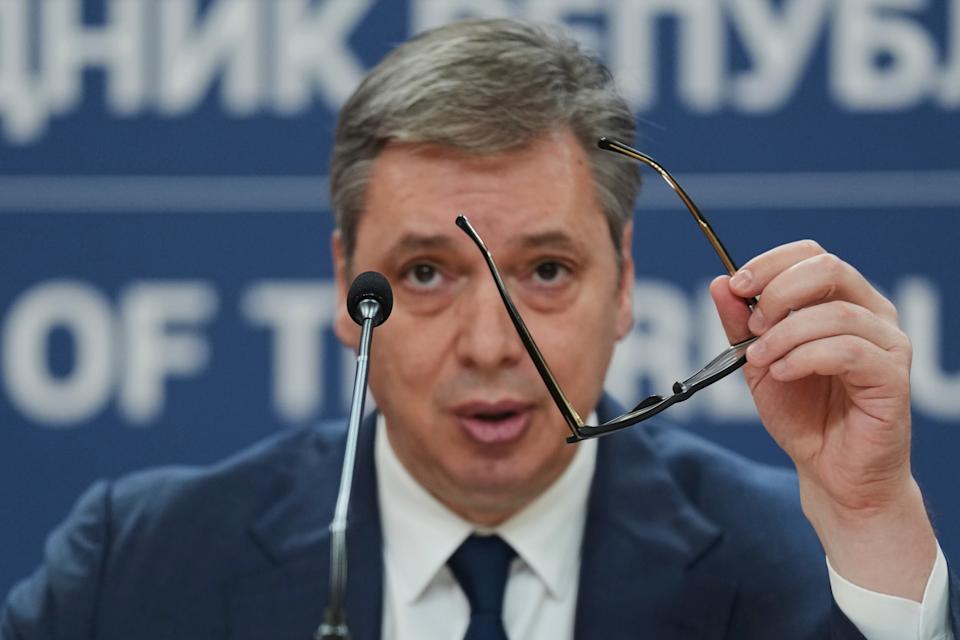
Serbia’s long-serving leader, Aleksandar Vučić, has conceded defeat in the country’s parliamentary election, marking a major political shift after years of protests against his government over corruption, alleged abuses of power and concerns about democratic freedoms.
Vučić announced on Sunday, October 25, 2026, that his Serbian Progressive Party (SNS) had lost to the student-backed Students’ List movement, which emerged as a formidable challenger after nearly two years of nationwide demonstrations.
According to the Associated Press, Vučić acknowledged the defeat after his party’s projections indicated that the opposition movement had secured a parliamentary majority.
It is now clear that we have lost and the Students’ List has won,” Vučić told supporters at his party’s election-night gathering.
He said his party expected the Students’ List to win between 135 and 140 seats in the 250-member parliament, while the SNS would secure approximately 105 seats.
The reported outcome triggered celebrations in Belgrade, the capital, and other Serbian cities, as supporters of the student-led movement took to the streets to celebrate what they described as a victory for democracy and political change.
Vučić and his political allies had dominated Serbian politics for approximately 14 years, with the president maintaining considerable influence over the country’s political institutions and public life.
However, his popularity came under increasing pressure following the collapse of a concrete canopy at a railway station in Novi Sad in 2024, which killed 16 people.
The tragedy triggered widespread demonstrations, particularly among university students, who accused the government of corruption, cronyism and failures in the renovation work associated with the station.
The protests gradually developed into a broader movement demanding accountability, stronger democratic institutions and an end to alleged abuses of political power.
Despite previously overcoming a fragmented opposition, Vučić faced a significant challenge from the Students’ List, a movement that mobilised young people and other citizens dissatisfied with the country’s political direction.
Unlike conventional political parties, the Students’ List adopted an approach centred on a broad coalition of candidates, including professionals, athletes, farmers and artists.
University students helped organise the movement, but did not directly appear on its electoral list, an approach intended to emphasise collective leadership rather than dependence on a single political figure.
During the campaign, its supporters travelled through urban centres and rural communities, seeking to reach voters who had become disillusioned with established political leaders.
The movement focused on rebuilding democratic institutions, tackling corruption and strengthening accountability in government.
One of its candidates, Radomir Saicic, described the reported victory as the product of citizens who continued to believe in political change despite the challenges they faced.
This is a victory over fear,” he said, adding that the result carried responsibility for those who would take office.
Following Vučić’s concession, crowds gathered in Belgrade and other cities, celebrating the result with songs, chants and car horns.
Some demonstrators dismantled fences and tents at a central Belgrade park where supporters of Vučić had maintained a camp for more than a year.
The atmosphere reflected the depth of public frustration among opponents of the outgoing political leadership, although the election also exposed divisions within Serbian society.
Vučić continued to command support among many voters, who regarded him as a leader capable of steering the country through international uncertainty.
While conceding defeat, he blamed independent media and alleged interference by unnamed European countries and what he described as an “American deep state” for his party’s loss.
The election attracted international attention because Serbia is a candidate for membership of the European Union.
European Commission President Ursula von der Leyen congratulated the student movement, saying Serbian voters had turned out in record numbers to shape their country’s future.
She also expressed the EU’s readiness to support reforms involving the rule of law, media freedom, anti-corruption measures and democratic institutions.
However, election monitors reported irregularities, including alleged pressure on voters and attempted vote-buying. Concerns had also been raised about the safety and fairness of the campaign, media independence and reports of surveillance and cyberattacks targeting activists.
The final political transition will therefore be closely watched by Serbia’s citizens and international partners.
Vučić’s reported defeat represents a significant moment for Serbia after years of political dominance by his party and sustained public protests.
The rise of the student-led movement demonstrates how youth mobilisation and public dissatisfaction can reshape the political landscape, particularly when established opposition parties struggle to gain widespread support.
The incoming parliamentary leadership now faces the challenge of translating its campaign promises into concrete reforms, restoring public trust and addressing the corruption allegations that helped fuel the protests.
Whether the political change will lead to lasting democratic reforms and closer integration with the European Union remains to be seen.
Source: Associated Press (AP).
Visit www.rapidospace.com for more international news and political updates.