


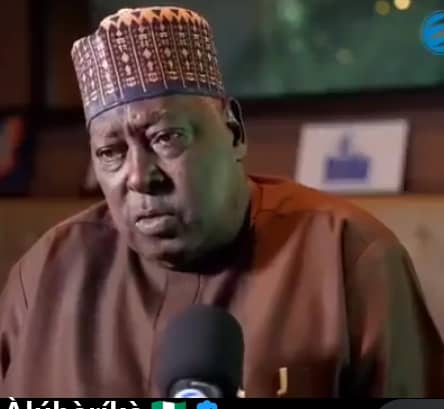
ABUJA: Fresh political conversations have resurfaced over the alliance between former Kaduna State Governor Nasir El-Rufai and President Bola Ahmed Tinubu, following recent remarks by former Secretary to the Government of the Federation (SGF), Babachir Lawal, who dismissed the popular belief that El-Rufai backed Tinubu in the 2023 presidential election out of personal loyalty or a long-standing political friendship.
Lawal argued that the two politicians were never particularly close allies, a claim that has reignited discussions about the political calculations behind the 2023 presidential race and the long-term ambitions that may already be shaping Nigeria’s post-2027 political landscape.
His comments have prompted renewed questions: Was El-Rufai’s support for Tinubu simply a strategic political decision? And was the bigger picture always about positioning the North for another shot at the presidency in 2031?
Among political observers, one theory has gained increasing attention. It suggests that El-Rufai’s support for the emergence of a Southern presidential candidate under the All Progressives Congress (APC) may have been driven less by regional sentiment and more by long-term political calculation.
Supporters of this argument contend that if former Vice President Atiku Abubakar, a Northern candidate, had won the presidency in 2023 and served the constitutionally permitted two terms, power would likely have remained in the North until 2031, making another Northern presidential bid politically difficult until 2039.
By supporting Tinubu, a Southern candidate, proponents of this theory argue that the North could legitimately seek to reclaim power after Tinubu’s tenure, thereby reopening the contest in 2031.
Some analysts speculate that such a political arrangement could potentially benefit ambitious Northern politicians, including El-Rufai.
However, there is no public evidence that El-Rufai supported Tinubu for this reason, nor has the former Kaduna governor declared any intention to contest the presidency in 2031.
Another issue that continues to generate debate is whether El-Rufai expected to become Tinubu’s running mate after the APC presidential primary.
Instead, Tinubu settled for former Borno State Governor Kashim Shettima, a decision that surprised many political observers at the time.
Although neither Tinubu nor El-Rufai has publicly confirmed that such expectations existed, political commentators have repeatedly suggested that missing out on the vice-presidential slot may have disappointed the former Kaduna governor.
Even so, El-Rufai remained one of Tinubu’s most visible campaign figures, vigorously defending the APC candidate and participating in major campaign activities across the country.
His active role demonstrated that, whatever personal disappointment may have existed, he remained committed to delivering victory for the party.
One of the defining moments of the 2023 presidential campaign occurred at Chatham House in London.
During the event, Tinubu invited El-Rufai to answer a question on national security instead of responding himself.
The incident immediately generated widespread debate.
To Tinubu’s supporters, it reflected the confidence he had in El-Rufai’s competence and deep understanding of governance and security issues.
Critics, however, interpreted it as a carefully choreographed campaign strategy designed to showcase the strength and diversity of Tinubu’s policy team.
To date, neither Tinubu nor El-Rufai has suggested that the episode carried any hidden political meaning, leaving much of the interpretation in the realm of political commentary.
Following Tinubu’s inauguration in May 2023, relations between the two leaders initially appeared cordial.
President Tinubu nominated El-Rufai for a ministerial position, but the nomination was eventually withheld after the Senate declined to confirm him.
The failed confirmation marked a turning point.
In the months that followed, El-Rufai became one of the administration’s most outspoken critics, openly questioning several government policies and leadership decisions.
The political distance between both men widened further when El-Rufai eventually left the APC for the Social Democratic Party (SDP), a move widely interpreted as one of the most significant political realignments ahead of the next election cycle.
Babachir Lawal’s assertion that Tinubu and El-Rufai were never genuine political allies has added fresh fuel to an already active political conversation.
Some analysts believe the relationship between the two leaders was always based on shared political interests rather than deep personal trust.
Others argue that what appeared to be a formidable alliance in 2023 was merely a temporary coalition formed to achieve electoral victory.
Once that objective had been accomplished, they say, competing political ambitions naturally resurfaced.
Whether that assessment is accurate remains open to debate.
As discussions continue, it is important to separate established facts from political interpretation.
It is a matter of public record that El-Rufai actively campaigned for Tinubu during the 2023 election. It is equally undisputed that he was later nominated for a ministerial appointment, failed to secure Senate confirmation, became increasingly critical of the Tinubu administration, and eventually left the APC for the SDP.
Beyond those facts, however, many of the claims dominating political discourse remain speculative.
There is no public evidence that El-Rufai backed Tinubu primarily to pave the way for a Northern presidency in 2031. Likewise, there has been no official confirmation that he expected to be Tinubu’s vice-presidential candidate.
Neither President Tinubu nor El-Rufai has publicly endorsed these interpretations or acknowledged that such considerations influenced their political decisions.
With political alignments already beginning to shift ahead of the 2027 general elections, analysts believe the evolving relationship between President Tinubu and Nasir El-Rufai will remain one of Nigeria’s most closely watched political stories.
Whether their partnership was founded on genuine political conviction, strategic necessity, or a combination of both may only become clear as Nigeria moves closer to another electoral cycle.
For now, Babachir Lawal’s remarks have succeeded in reviving an important national conversation—not only about the alliances that shaped the 2023 presidential election but also about the strategic calculations that could influence Nigeria’s leadership transition in 2031.
As events continue to unfold, one thing appears certain: the Tinubu–El-Rufai political story is far from over, and its next chapter could significantly shape Nigeria’s future political landscape.
If you’d like, I can also make this more investigative and feature-style—similar to articles published by The Africa Report, Premium Times, or TheCable—with richer political context and stronger narrative flow.