


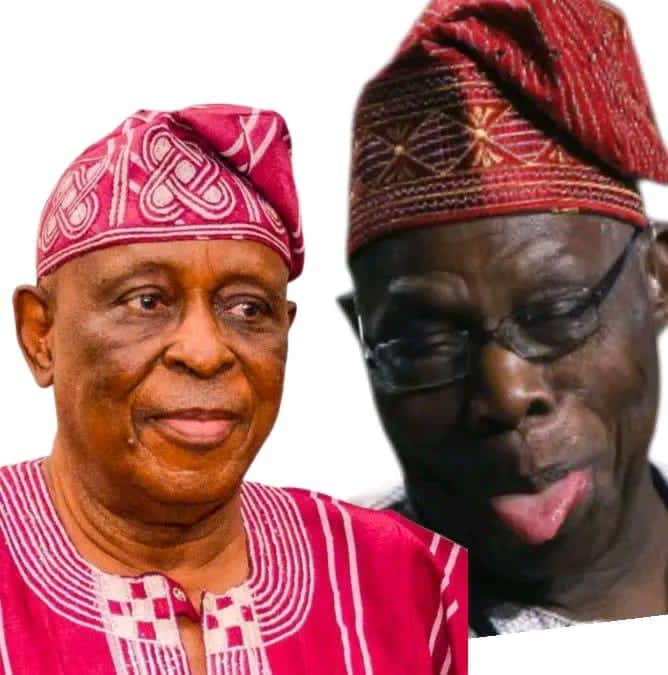
ASABA: History is rarely a settled destination. More often, it is a contested terrain where participants revisit old battles, not merely to recount events, but to shape how posterity remembers them. The recent exchange between former President Olusegun Obasanjo and former Ogun State Governor Chief Olusegun Osoba over the political intrigues surrounding the 2003 elections is one such moment.
On one side stands Osoba, who reportedly accused Obasanjo of deceiving the Alliance for Democracy (AD) governors and Afenifere leadership. On the other stands Obasanjo, whose lengthy rebuttal rejects the allegation outright, insisting that he deceived no one and that many of the strategic political decisions of the time were “above Osoba’s head.”
For students of Nigerian political history, this is more than a disagreement between two elder statesmen. It is a reminder that history is often written through competing memories.
The significance of Obasanjo’s letter lies not merely in its length or candour but in the breadth of issues it raises. He presents himself as a nationalist who consistently sought dialogue across political divides. According to him, his consultations before contesting the presidency extended beyond party lines and across Nigeria’s geopolitical zones. He argues that his efforts to bring members of the AD into government after 1999 reflected a commitment to national integration rather than political conquest.
Conversely, the narrative attributed to Osoba suggests a different interpretation: that these engagements ultimately weakened the AD and paved the way for the dramatic political reversal of 2003, when five of the six Southwest governors lost their seats, leaving only Lagos State under the control of the party.
These are fundamentally different interpretations of the same historical events.
Obasanjo’s letter also contains serious allegations concerning internal power struggles within the Presidency, the impeachment saga involving the National Assembly, and political understandings allegedly reached between various actors. Such assertions, while historically important, remain the perspective of one principal participant. They deserve careful examination alongside documentary evidence and the recollections of other actors before they can be accepted as established historical fact.
This distinction is crucial.
Political memoirs, interviews and open letters are invaluable primary sources. They provide insight into how leaders perceived events and justified their decisions. Yet they are not substitutes for objective historical inquiry. Every participant inevitably narrates history through the lens of personal experience, political interest and retrospective justification.
Indeed, what makes democratic societies mature is not the absence of competing narratives but the willingness to subject those narratives to critical scrutiny.
The controversy also highlights a broader truth about Nigerian politics. Alliances are often fluid, ideological boundaries are frequently blurred, and today’s political adversary may become tomorrow’s ally. The events leading to the 2003 elections demonstrated the complexity of coalition-building in Nigeria’s evolving democracy, where personalities, regional interests and national calculations intersected in ways that defied simplistic explanations.
There is another lesson worth drawing.
The passage of time often transforms political disagreements into historical debates. As key actors age, their testimonies become increasingly valuable—not because they are infallible, but because they enrich the historical record. The responsibility then shifts to scholars, journalists and citizens to compare these accounts with archival materials, electoral data, contemporaneous reports and the testimonies of other participants.
No single narrative should enjoy a monopoly over history.
Perhaps the greatest value of the Obasanjo-Osoba exchange is that it encourages a new generation to revisit one of the defining political transitions of Nigeria’s Fourth Republic. It invites fresh research into the collapse of the Alliance for Democracy in much of the Southwest, the consolidation of the People’s Democratic Party during that era, and the broader implications for Nigeria’s democratic development.
Ultimately, the question is not simply whether Obasanjo or Osoba is right.
The more enduring question is whether Nigerians are willing to preserve their political history through rigorous documentation rather than partisan recollection. Democracies thrive when history is investigated, not merely inherited; when evidence prevails over emotion; and when competing narratives are tested against verifiable facts rather than accepted on the authority of personalities.
As this latest exchange reminds us, history does not belong to those who speak the loudest. It belongs to those who leave behind the most credible evidence.
That is the enduring challenge—and the enduring responsibility—of every democracy.
Frank Odion Apokwu, DSC, LLB, FNIM, FSM, FIMC, CMC is a Public Affairs Analyst, Management Consultant and Public Policy Commentator. He writes from Asaba Delta State


