


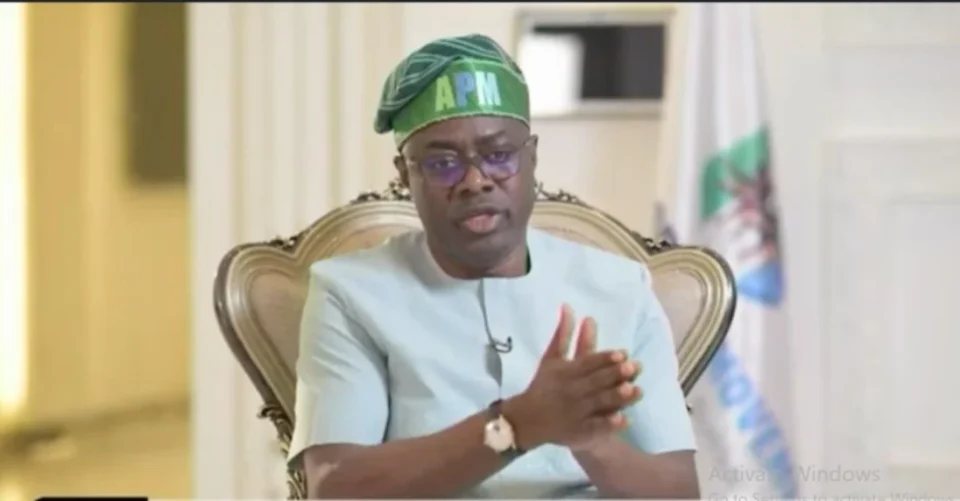
IBADAN: Oyo State Governor, Seyi Makinde, has confirmed that opposition leaders are holding active consultations on the possibility of forming a broad political alliance to challenge President Bola Ahmed Tinubu and the ruling All Progressives Congress (APC) in the 2027 presidential election.
Makinde disclosed that discussions were already underway among key political figures, including former Vice President Atiku Abubakar and former Labour Party presidential candidate Peter Obi, as opposition politicians consider ways to overcome political divisions and present a stronger challenge to the ruling party.
The governor made the disclosure during an interview with ARISE News anchor, Ojy Okpe, on Friday, November 13, 2026. He explained that his involvement went beyond expressing interest in an opposition alliance, insisting that consultations were actively taking place.
“We’re still discussing,” Makinde said.
When asked whether he was open to an alliance with other leading opposition figures, the governor made it clear that the process had moved beyond preliminary conversations.
“Not only that I’m open, we’re actively discussing this,” he said.
His comments provide a fresh indication that opposition leaders are continuing efforts to explore a common political strategy ahead of the 2027 general elections, despite disagreements over party platforms, leadership positions and the question of who should emerge as the presidential candidate.
Although Atiku and Obi remain prominent figures in the discussions, Makinde was careful not to declare support for either politician. Instead, he argued that the opposition must approach the selection of a presidential candidate through objective assessment rather than personal loyalty, political sentiment or individual ambition.
The Oyo governor maintained that opposition leaders must consider several factors before deciding who should lead a possible coalition into the 2027 presidential contest.
According to him, the evaluation should include candidates’ manifestos, records in public office, previous political performance and the general mood of Nigerians.
He argued that the opposition would make a serious mistake if it selected a candidate simply because of popularity or emotional attachment without carefully examining the available evidence.
“To arrive at a decision, you need data,” Makinde said.
He further explained that the process would require political leaders to sit together, examine their respective policy proposals and assess what each potential candidate could offer the country.
“We just won’t say, ‘Oh, okay,’ take emotional decision and say, ‘Oh, it’s you.’ We have manifestos now, we have certain things in that manifesto.
“We will sit down, we have maybe historical performance. We also have the sentiment of the people. All of those things will come together and arrive at a decision,” he added.
The position suggests that Makinde wants the opposition’s eventual choice to be determined by a combination of policy direction, leadership capacity, governance records and public acceptance.
It also highlights one of the major challenges facing the opposition: balancing the political influence of established presidential contenders with the need to identify a candidate capable of attracting support across Nigeria’s different regions and political constituencies.
Makinde also declared that he was prepared to work with Atiku Abubakar if consultations and available evidence established that the former vice president was the strongest candidate around whom opposition parties should unite.
During the interview, Okpe specifically asked whether the governor would support an arrangement involving Atiku if the former vice president emerged as the most suitable option for the opposition.
Makinde answered in the affirmative, stressing that his political position should not be interpreted as a refusal to cooperate with any particular individual.
“I’m willing to work with any Nigerian,” he said.
The statement is significant because it indicates that the governor is not ruling out cooperation with any of the major opposition figures, even as discussions continue over the most viable political arrangement.
However, his response should not be interpreted as an endorsement of Atiku’s presidential ambition. Makinde did not announce support for the former vice president or Peter Obi, maintaining instead that the final decision should follow an assessment of the candidates and the country’s political circumstances.
The governor’s position also leaves room for negotiations involving other political leaders who may emerge as potential contenders or influential participants in the proposed coalition.
Explaining how politicians with competing interests could work together, Makinde drew an analogy from his experience in the oil and gas industry.
He noted that companies operating in the same sector do not necessarily remain permanent rivals. Depending on the nature of a project or commercial opportunity, businesses may compete, collaborate or enter into arrangements that serve their respective interests.
According to him, political relationships can operate in a similar manner, with politicians who currently occupy different positions finding common ground when circumstances make cooperation necessary.
Applying the analogy to the 2027 presidential election, Makinde said the eventual relationship among opposition figures would depend on the outcome of ongoing consultations.
“Depending on what we see between now and the election time, we may be rivals, we may be collaborators, we may be — one may be the client of the other,” he said.
His remarks suggest that the proposed alliance is not necessarily limited to a straightforward arrangement in which one politician becomes the presidential candidate and all others simply withdraw their ambitions.
Rather, the negotiations could involve different political roles, compromises and forms of cooperation, depending on what the participating leaders consider most beneficial to their common objective.
The governor further insisted that any agreement reached among opposition politicians must be guided by national interest rather than personal ambition.
When asked whether he was prepared to work with other political leaders towards his stated objective of resetting Nigeria, Makinde responded positively.
“To reset Nigeria, yes,” he said.
He also referred to the experience of South Africa, using it to illustrate how political forces with different interests could negotiate and cooperate when faced with a broader national challenge.
Makinde argued that the opposition’s negotiations should not become a platform for settling personal differences or pursuing individual political advantages.
That negotiation will not be anything personal,” he said. “That negotiation will be the deal for Nigeria, by Nigeria.”
The emphasis on national interest comes against the background of repeated difficulties in building a united opposition in Nigeria. Previous attempts at political cooperation have often encountered disagreements over presidential tickets, party structures, regional considerations and the distribution of political influence.
Makinde’s argument is that opposition leaders must first establish a shared understanding of the country’s challenges and agree on a common direction before deciding how to organise themselves electorally.
Makinde also cited the 1999 presidential election, when former Finance Minister Olu Falae contested against the eventual winner, Olusegun Obasanjo, as an example of the difficulties associated with relying heavily on regional political strength.
Falae enjoyed considerable support in the South-West but was unable to translate that regional backing into victory at the national level.
For Makinde, the experience demonstrates why opposition politicians must look beyond individual popularity and regional influence when considering their chances in a presidential election.
A candidate may command strong support within a particular geographical or political constituency but still require a wider national coalition to secure victory.
The governor therefore believes that opposition leaders must first agree on the most effective political strategy before attempting to consolidate their support behind a common candidate.
“Our biggest challenge is, first, to agree on what is the best course of action, and then seek an alliance,” he said.
The argument reflects a central question confronting opposition parties ahead of 2027: whether they can overcome competing ambitions and build a political structure capable of attracting voters across the country’s six geopolitical zones.
Makinde’s latest comments come amid wider consultations involving opposition parties seeking a common platform or a single presidential candidate to challenge the APC in 2027.
The African Democratic Congress (ADC) emerged in July 2025 as a coalition platform adopted by opposition figures seeking to build an alternative political force ahead of the next presidential election.
Former Vice President Atiku Abubakar joined the ADC in November 2025, while Peter Obi joined the party on December 31, 2025.
The party subsequently explored the possibility of bringing former Kano State Governor Rabiu Kwankwaso and his political movement into the arrangement.
However, disagreements over the presidential and vice-presidential tickets, alongside other political considerations, complicated the negotiations.
In May 2026, Obi and Kwankwaso left the ADC and joined the Nigeria Democratic Congress (NDC), where they emerged as presidential and vice-presidential candidates respectively.
Their departure represented a major development in the opposition’s coalition-building efforts, although consultations reportedly continued beyond the ADC as political leaders explored alternative arrangements.
In a report published on October 15, 2026, PUNCH identified six political parties involved in discussions aimed at achieving a possible single-candidate arrangement ahead of the 2027 election.
The parties are the African Democratic Congress, Allied Peoples Movement, Nigeria Democratic Congress, Social Democratic Party, Peoples Democratic Party and Peoples Redemption Party.
Among the prominent politicians associated with the consultations are Atiku Abubakar, Oyo State Governor Seyi Makinde, Peter Obi, former presidential candidate Adewole Adebayo and former Cross River State Governor Donald Duke.
The discussions reportedly followed resolutions reached at the G-100 opposition summit, with the objective of reconciling competing interests and identifying a common platform or candidate capable of challenging the ruling APC.
However, no consensus presidential candidate had been announced as of the October 15 report.
The latest disclosure by Makinde indicates that consultations remain an important part of the opposition’s political calculations as the 2027 election approaches.
The movement of prominent politicians between political platforms has added another layer of complexity to the opposition’s efforts to build a united front.
While the ADC initially attracted several influential politicians, the subsequent departure of Obi and Kwankwaso to the NDC demonstrated the difficulties involved in maintaining a broad coalition when competing political interests emerge.
The disagreement over who should occupy the presidential and vice-presidential positions illustrates one of the most sensitive issues likely to shape further negotiations.
For any alliance to succeed, participating parties would have to agree not only on the presidential candidate but also on the platform through which the candidate would contest, the structure of the campaign and the political arrangements that would accommodate the interests of other coalition partners.
There is also the question of whether established political parties would be willing to subordinate their individual ambitions to a common electoral strategy.
Makinde’s insistence on data, manifestos and performance records appears to be an attempt to shift the conversation away from personalities and towards the qualities and electoral prospects of whoever eventually emerges as the preferred candidate.
Nevertheless, the success of such an approach will depend on whether the political actors involved are prepared to accept the outcome of a collective decision.
While opposition leaders are exploring an alliance to challenge Tinubu, another political arrangement promoted by Minister of the Federal Capital Territory, Nyesom Wike, is pursuing a different objective.
Wike’s Rainbow Coalition is designed to mobilise political support for Tinubu’s re-election in 2027.
Unlike an opposition coalition seeking to unite behind a common candidate against the ruling party, the Rainbow Coalition operates as a cross-party arrangement aimed at building support for the president across different political platforms.
It is not structured as a formal merger of political parties. Participants can retain their existing party affiliations while supporting Tinubu’s presidential ambition and backing different candidates in governorship and legislative elections.
Parties identified by PUNCH as participating in the Rivers State arrangement include the APC, PDP, Labour Party, All Progressives Grand Alliance, Action Alliance and Makinde’s Allied Peoples Movement.
The existence of these two political projects illustrates the different strategies emerging ahead of the 2027 elections.
While one seeks to consolidate opposition forces around a common presidential candidate, the other aims to build a wider political support network for the incumbent president without requiring participating politicians to abandon their respective parties.
The growing consultations among opposition leaders raise important questions about the future shape of Nigeria’s political contest in 2027.
Atiku, Obi and other influential politicians command different political constituencies, support networks and party structures. Bringing these interests together under one arrangement could potentially create a formidable electoral challenge, but it would also require significant compromises.
The question of presidential candidacy is likely to remain a major test. Other issues include the choice of political platform, the running mate, regional balance, campaign leadership, party structures and the extent to which participating politicians would be willing to support a candidate other than themselves.
For Makinde, however, the immediate priority is to establish what he described as the best course of action for Nigeria before settling on the question of who should lead the alliance.
His willingness to work with Atiku, Obi or any other Nigerian politician suggests that he is keeping the door open to a broad arrangement, but he has not committed himself to any particular candidate.
With the 2027 presidential election drawing closer, the outcome of the consultations could become one of the defining factors in determining whether opposition parties contest separately or succeed in presenting a united political alternative to Tinubu and the APC.
For now, the discussions remain ongoing, and the opposition is yet to announce a final agreement or consensus presidential candidate.


