


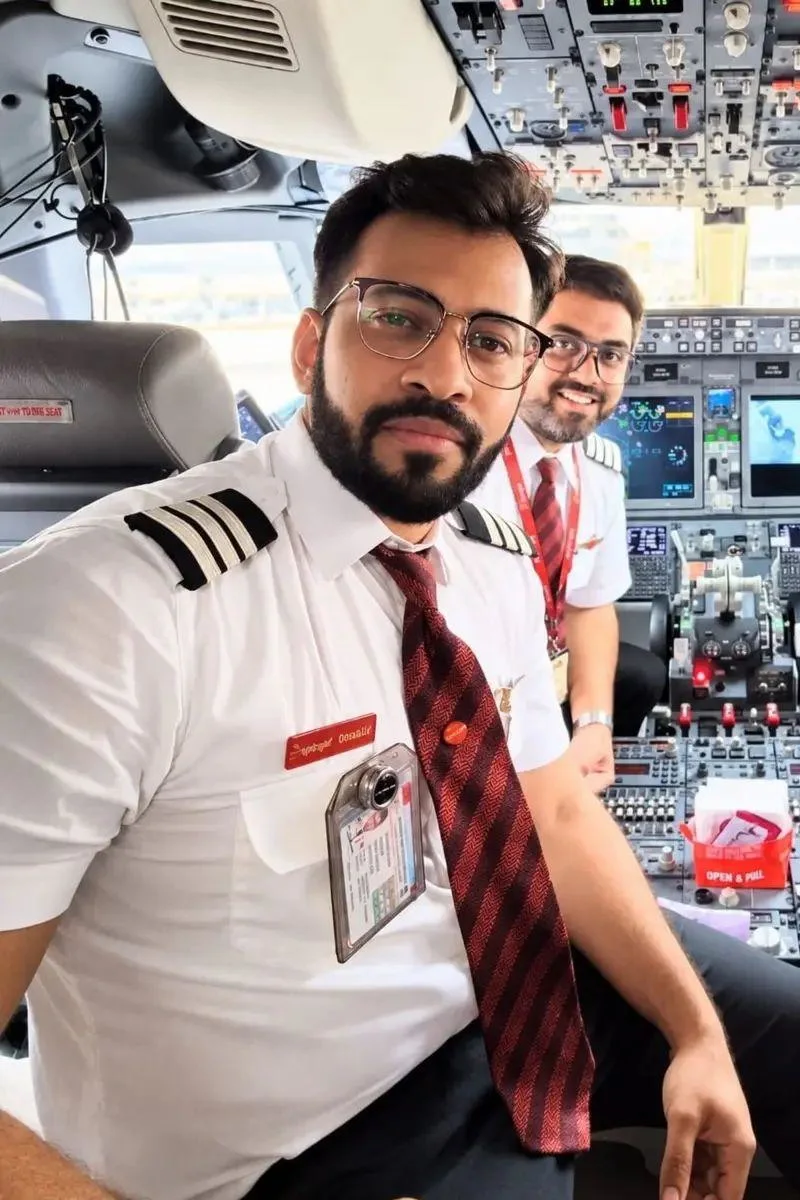
Captain Smit Machchhar, the Indian pilot who was stabbed by his co-pilot during a Flydubai flight from Dubai to Tel Aviv, has been hailed internationally for his actions during the terrifying mid-air incident.
Machchhar was seriously injured when the co-pilot allegedly attacked him inside the cockpit on Wednesday, September 30, while Flight FZ1073 was travelling towards Israel.
Despite suffering stab wounds, the experienced captain managed to open the cockpit door, allowing passengers and crew members to intervene and overpower the attacker.
The aircraft was subsequently diverted to Tabuk in north-western Saudi Arabia, where it landed safely. All 174 people aboard the flight survived the incident. Reuters reported that Machchhar later underwent surgery and remained in stable condition.
Israeli Prime Minister Benjamin Netanyahu described Machchhar as a “true hero”, while Indian Prime Minister Narendra Modi also praised his courage and presence of mind during the crisis.
Machchhar is an Indian national from Mumbai and an experienced commercial pilot with more than a decade of aviation experience.
According to details about his career, he began his aviation training in New Zealand in 2008 at Mainland Air in Dunedin. Three years later, he joined Indian airline SpiceJet as a commercial pilot.
He later moved to Dubai and joined Flydubai in 2022, where he became a captain flying Boeing 737 aircraft. His professional profile indicates that he has accumulated more than 9,750 hours of flying experience, including more than 6,400 hours as pilot-in-command.
His years of experience became particularly significant during Wednesday’s emergency, as the aircraft suddenly descended while the cockpit was under attack.
Flight FZ1073 departed Dubai International Airport early Wednesday morning, bound for Ben Gurion Airport near Tel Aviv.
According to flight-tracking data and reports from international media, the aircraft experienced a dramatic descent while it was over or near Saudi Arabia.
The situation escalated after Machchhar was attacked inside the cockpit by his co-pilot.
Israeli officials later said the co-pilot appeared to have attempted to bring the aircraft down. Netanyahu said Machchhar fought back despite being seriously wounded and managed to open the cockpit door.
Once the door was opened, passengers and crew members were able to enter the cockpit and help overpower the attacker.
Other pilots who were on board subsequently helped take control of the aircraft before it was diverted to Saudi Arabia.
The aircraft eventually landed at Tabuk Airport, bringing the emergency to an end.
The most significant part of the incident was Machchhar’s decision to open the cockpit door despite his injuries.
That action gave passengers and crew access to the cockpit and created an opportunity to stop the attacker.
Netanyahu said the Indian captain’s actions prevented what could have become a catastrophic mid-air disaster and credited him with helping save the lives of the 174 people aboard.
Reuters also reported that the plane’s passengers were unharmed and that the aircraft was eventually landed safely by another pilot team.
The Guardian reported that Machchhar’s actions, together with the intervention of passengers and other crew members, played a central role in bringing the situation under control.
People who knew Machchhar before the incident have described him as an experienced and disciplined pilot.
Philip Kean, chief executive of Mainland Air, recalled him as someone who remained calm in difficult situations.
Machchhar’s former colleague at SpiceJet, Captain Dharav Gosalia, also described him as outgoing and jovial while noting his disciplined approach to flying.
The pilot was reportedly nicknamed “Smit Mac” by friends and colleagues.
Gosalia said Machchhar had undergone years of training, including training from former Indian Air Force pilots who later moved into commercial aviation.
Interestingly, Machchhar previously revealed that becoming a pilot was not part of his original childhood plans.
Speaking on the Bona-Fide Banter podcast last year, he said he was around 19 when he enrolled in a management course and initially planned to work in his family’s business.
His career path changed after he attended an aviation seminar.
The experience sparked his interest in flying, eventually leading him into professional aviation.
Machchhar later described the difference between his professional and personal life, saying that wearing his pilot’s uniform put him in a “no-nonsense” work mode.
However, he said he had increasingly come to value spending time with his family and maintaining a healthy work-life balance.
His advice was simple: personal life should be given equal importance because doing so could help a pilot fly longer.
Machchhar had also spoken about dealing with emergencies during his aviation career.
Among the incidents he recalled was a situation involving a passenger who went into early labour while on a flight. The crew worked together to ensure that the baby was delivered safely.
He also said he had dealt with medical emergencies and minor aircraft problems that caused delays.
At the time of the podcast conversation, he said none of the aircraft he had flown had required an emergency landing.
His comments about safety now carry added significance following the cockpit attack.
Machchhar had previously expressed the view that delays were secondary to passenger safety, saying his priority was ensuring passengers walked away from the aircraft safely.
Following the incident, Machchhar received public praise from political leaders in both India and Israel.
Netanyahu called him a true hero” and said his actions helped prevent a catastrophic disaster.
Indian Prime Minister Narendra Modi also praised Machchhar, saying the pilot showed immense courage and an unwavering determination to protect other people’s lives despite being seriously injured.
Indian Foreign Minister S Jaishankar separately described Machchhar’s conduct during the emergency as demonstrating extraordinary courage and presence of mind.
On Friday, Modi spoke directly with Machchhar while the pilot was recovering in hospital. Reuters reported that Machchhar told the Indian prime minister about the attack and how he managed to open the cockpit door despite his injuries.
Before the incident, Machchhar was largely known within the aviation industry and among colleagues, friends and passengers who had encountered him during his career.
The cockpit attack has now made him the subject of international attention.
His story has spread widely across Indian social media, where users have praised his actions during the emergency.
For many of those following the incident, Machchhar’s story is not simply about a pilot surviving an attack. It is about an experienced aviation professional who, despite being seriously injured, took an action that helped give passengers and crew an opportunity to regain control of a plane in a potentially disastrous situation.
Investigations into the attack are continuing, while authorities work to establish exactly what led to the confrontation inside the cockpit and the co-pilot’s alleged attempt to take control of the aircraft.
For now, Machchhar remains in recovery after surgery, while the aviation community and officials in India, Israel and the United Arab Emirates continue to follow his condition and the investigation into the incident.