


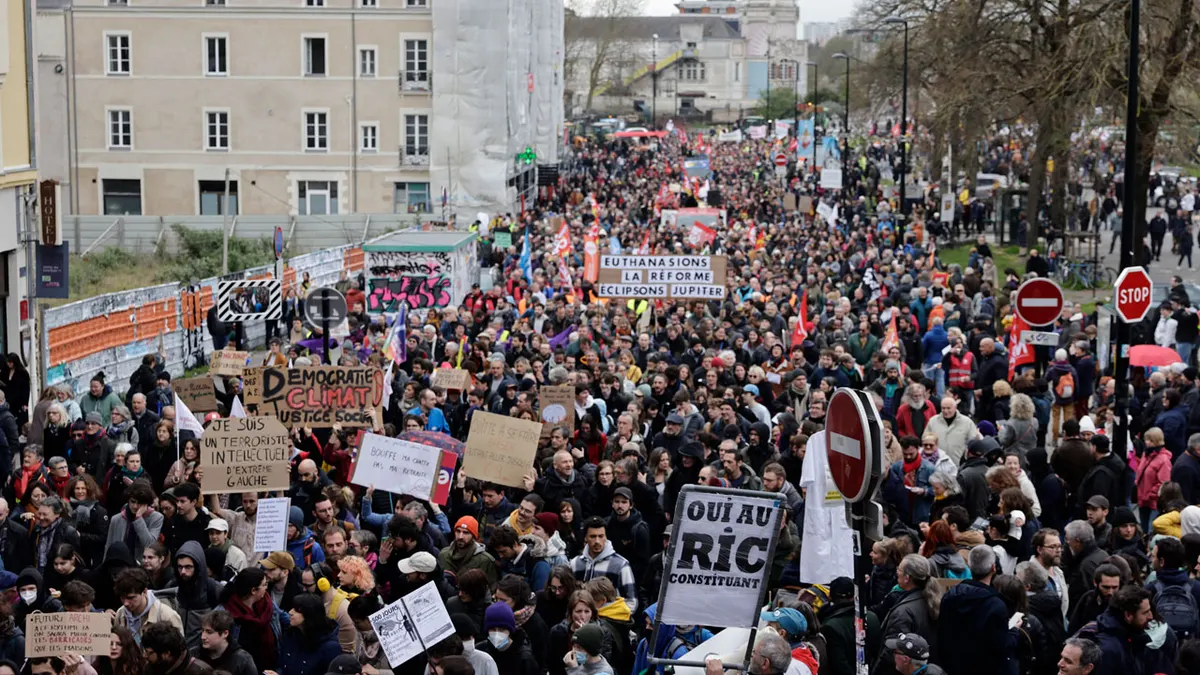
PARIS: About 400 schools and other educational institutions across France are expected to remain closed on Friday as student protests over teacher shortages, poor school infrastructure and demands for better learning conditions continue to spread.
The demonstrations, which began in the Paris region last month, have increasingly turned violent in some parts of the country, with clashes involving protesters and riot police, fires at schools and other incidents reported.
French authorities said hundreds of people have been arrested since the protests began, while dozens have reportedly been injured.
The protests have been driven largely by grievances over shortages of teachers, deteriorating school buildings, inadequate resources and demands for improved conditions for students and educators.
French Education Minister Edouard Geffray said Thursday evening that slightly more than 400 schools and other educational establishments were expected to remain closed on Friday.
The closures come as authorities attempt to contain the unrest while maintaining essential education services.
Justice Minister Gérald Darmanin said the protests had evolved beyond conventional student demonstrations, accusing what he described as an active and violent minority of targeting public property and engaging in acts of disorder.
Speaking to RTL radio on Friday, Darmanin said about 2,000 people had been arrested since the protests began, with roughly two-thirds placed in police custody.
He also questioned whether all those involved in the violence were actually high-school students.
The unrest initially emerged in the Paris region but has since spread to other parts of France.
On Thursday, students reportedly set fires at at least two high schools. In Marseille, teachers were inadvertently splashed with petrol during one incident, while a vehicle was set on fire in Strasbourg.
Riot police also clashed with young protesters in Toulouse in south-western France.
The incidents have raised concerns among French authorities about the escalation of what initially began as demonstrations over education policy and school conditions.
Darmanin said that when protesters target buses or set schools on fire, the situation becomes a public-order issue rather than simply an education protest.
The protests have highlighted longstanding concerns over teacher shortages and the condition of some school facilities.
Students and their supporters have called for more teachers, increased resources and improvements to learning environments.
The demonstrations come as the French government faces pressure to address concerns about public services and education infrastructure.
The scale of Friday’s school closures is expected to disrupt education in communities affected by the protests.
According to a source close to Prime Minister Sébastien Lecornu, intelligence agencies told a crisis meeting on Thursday that politicians from the hard left, including members of La France Insoumise (LFI), had helped initiate the protest movement.
The allegation was denied by LFI lawmaker Louis Boyard, who rejected the claim in comments to French broadcasters.
The disagreement adds a political dimension to the protests, although the demonstrations themselves have centred on education-related grievances.
The unrest has also reportedly reached neighbouring Belgium.
Some high-school students in Liège began protesting on Thursday, according to local media reports.
Authorities in Liège reportedly announced that schools across the city would close on Friday, although a municipal spokesperson had not immediately confirmed the closures.
The development suggests that concerns surrounding education conditions are not limited to France, although the circumstances behind the Belgian demonstrations remain separate from the French protests.
French authorities are now dealing with a protest movement that has combined demands for better education conditions with increasingly serious incidents of public disorder.
With around 400 schools expected to remain closed and approximately 2,000 arrests reported since the demonstrations began, the government faces pressure to address the grievances that triggered the protests while also responding to the violence.
For students, teachers and parents, the immediate issue remains access to safe and functioning schools.
For the French government, the challenge is to prevent the unrest from escalating further while addressing the underlying concerns about teacher shortages, school infrastructure and educational resources.