


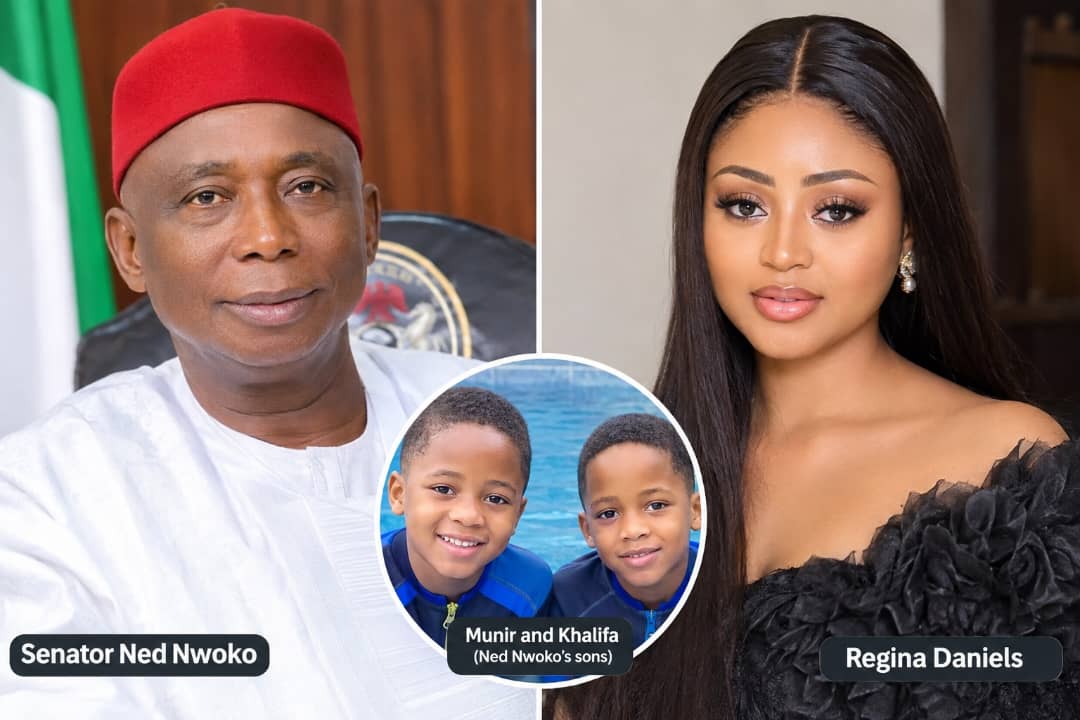
There is a lesson hidden beneath the latest drama surrounding Senator Ned Nwoko and actress Regina Daniels that Nigerians should not miss.
It is not whether Regina Daniels has returned to her husband.
It is not whether Ned Nwoko and Regina Daniels are reconciling.
It is not even whether their marriage will ultimately survive.
The real lesson is much bigger — and much more uncomfortable.
We may have tried, convicted and sentenced two people on social media without ever hearing the full case.
That should worry every one of us.
The latest development is instructive.
Regina Daniels was reportedly seen at Senator Nwoko’s residence, an occurrence that immediately generated headlines and speculation about a possible reconciliation. Some interpreted her presence as proof that the actress had returned to her husband.
Then came a clarification from her sister, Destiny Daniels, who reportedly said Regina had been granted access to visit her children and cautioned against interpreting the visit as a reconciliation.
Regina’s brother, Sammy West, similarly warned against jumping to conclusions.
Then Senator Nwoko released a heartwarming video showing himself swimming with his two sons, Munir and Khalifa.
That video, coming at precisely this moment, generated another wave of speculation.
Some Nigerians who had previously attacked or condemned Nwoko reportedly began apologising to him.
And therein lies the irony.
Yesterday, some people were certain he was the villain. Today, some are equally certain that he was the victim.
What changed?
Perhaps new information.
But if new information was capable of changing our minds so dramatically, why were we so certain in the first place?
That is the question we should be asking.
THE TYRANNY OF THE FIRST NARRATIVE
Social media has created a peculiar form of justice.
The first person to tell a compelling story often becomes the plaintiff.
The person named in the story becomes the defendant.
The audience becomes the jury.
And the comments section becomes the courtroom.
Unfortunately, there is often no evidence submitted, no cross-examination, no opportunity for the other party to present his or her case and no judge capable of insisting that the standard of proof has been met.
Yet the verdict is delivered with astonishing confidence.
A video of a distressed person can generate millions of sympathetic reactions.
A counter-video can produce an entirely different verdict.
A relative’s statement can overturn yesterday’s conclusion.
Then another post can reverse everything again.
This is not justice.
It is narrative warfare.
And celebrity marriages provide particularly fertile ground for it.
AN ALLEGATION IS NOT A CONVICTION
There is a principle embedded deeply in every serious system of justice: an allegation must be established before punishment follows.
That principle is not merely a technical legal rule.
It is a principle of civilisation.
Someone accusing another person of wrongdoing does not automatically make the accusation true.
A viral video does not necessarily provide the entire context.
A screenshot may omit the conversation before and after it.
A photograph tells us where somebody was.
It does not necessarily tell us why they were there.
And the presence of Regina Daniels at Nwoko’s residence illustrates precisely why context matters.
She was reportedly there.
Her sister says she was there to see her children.
From that information, we cannot responsibly leap to the conclusion that she has resumed the marriage.
Likewise, Nwoko’s swimming video may demonstrate affection for his children.
It does not constitute a public declaration that the marriage has been restored.
Facts must remain facts. Interpretations must remain interpretations.
That distinction has almost disappeared from our social-media culture.
THE CHILDREN ARE NOT SUPPORTING CHARACTERS
There is another dimension that deserves greater attention.
The children.
Whatever happened between the two adults, Munir and Khalifa did not create the dispute.
They should therefore not become collateral damage in it.
A child should not have to choose between father and mother because adults have fallen out.
A mother seeing her children should not automatically become evidence of reconciliation.
A father spending time with his children should not automatically become a coded message about his marriage.
Perhaps we should occasionally allow a father to be a father and a mother to be a mother without converting every family interaction into a national political thriller.
The children deserve better.
PUBLIC FIGURES ARE NOT PUBLIC PROPERTY
There is a persistent misconception that celebrities surrender all claims to privacy.
They do not.
Yes, public figures attract scrutiny.
Yes, politicians must be held accountable.
Yes, celebrities who deliberately place their private lives in the public domain should expect public interest.
But public interest is not the same as public ownership.
Senator Nwoko’s political activities are legitimate subjects of public scrutiny because he occupies public office.
His legislative performance, public statements, policies and stewardship are matters Nigerians have a right to examine.
But his marital relationship is fundamentally different.
The fact that he is a senator does not make every disagreement with his spouse a matter for national adjudication.
Similarly, Regina Daniels’ celebrity status does not eliminate her right to dignity.
There must be a line between scrutiny and voyeurism.
We are increasingly crossing that line.
THE SOCIAL-MEDIA JURY HAS NO MEMORY
One of the most disturbing features of online outrage is its complete lack of institutional memory.
People condemn today.
They forget tomorrow.
They apologise the next day.
Then they condemn somebody else the following week.
The same people who demanded justice for one person yesterday can demand punishment for that same person today, depending on whichever narrative is trending.
This is why social-media popularity cannot be allowed to become a substitute for truth.
Truth does not change because a hashtag changes.
Facts do not become different because an influencer has millions of followers.
And justice cannot be determined by the number of likes under a post.
PERHAPS WE OWE NWOKO AND REGINA AN APOLOGY
There is an important distinction here.
I am not suggesting that every allegation made against either party is false.
Nor am I suggesting that one party is necessarily innocent and the other guilty.
We simply do not possess enough verified information to make those definitive judgments about their private dispute.
That is precisely the point.
If some Nigerians now believe they owe Senator Nwoko an apology because subsequent events have challenged their earlier assumptions, perhaps there is an even larger apology we owe as a society.
An apology for judging before knowing.
And that apology should not be directed only at Nwoko.
It should also be extended to Regina Daniels if we have wrongly interpreted, amplified or weaponised claims about her.
The principle must apply equally.
WE MUST RECOVER THE DISCIPLINE OF SAYING: “I DON’T KNOW ”
Perhaps the most important sentence missing from social media today is:
“I don’t know.”
It takes intellectual discipline to say it.
It means acknowledging that a video may not contain the whole story.
It means recognising that people who are directly involved know things that outsiders do not know.
It means refusing to convert suspicion into certainty.
It means waiting for evidence.
Our culture increasingly rewards the opposite.
The person who makes the boldest accusation gets attention.
The person who expresses the greatest outrage gets followers.
The person who says, “Let us wait until we know the facts,” is frequently dismissed as weak or compromised.
That is precisely backwardness.
Restraint is not weakness. It is wisdom.
Today, it is Nwoko and Regina. Tomorrow, it could be you.
This is where the matter becomes personal.
Every Nigerian using social media should imagine what would happen if an intimate dispute in his or her family suddenly became national entertainment.
Imagine a disagreement between husband and wife being recorded.
Imagine one party telling his or her version to millions of people.
Imagine relatives taking sides publicly.
Imagine strangers who have never met either spouse confidently declaring who is wicked and who is innocent.
Imagine your children reading those comments years later.
Would we still consider the spectacle entertaining?
Perhaps not.
That is why empathy must accompany freedom of expression.
WE NEED A NEW CULTURE OF DIGITAL RESPONSIBILITY
Nigeria does not need less freedom of expression.
We need more responsible expression.
We need to teach our young people that sharing is not neutral.
Forwarding an unverified allegation can damage a reputation.
Repeating a rumour can give it the appearance of truth.
Publishing someone’s private information can expose them to harassment.
And participating in a digital mob can cause consequences that no apology can completely reverse.
Our schools, families, media organisations, religious institutions and professional bodies must therefore begin treating digital citizenship as seriously as traditional civic education.
The internet is now one of the most powerful institutions shaping public opinion.
It cannot remain an accountability-free zone.
LET NED AND REGINA TELL THEIR OWN STORY
Ultimately, the future of Ned Nwoko and Regina Daniels’ relationship belongs to them.
If they reconcile, that is their decision.
If they remain separated, that too is their decision.
If they eventually decide to say nothing about the matter, the public should respect that decision.
What Nigerians should not do is manufacture a conclusion because we desperately want one.
At the moment, the evidence does not establish that Regina Daniels has returned to the marriage.
Nor does it establish that reconciliation is impossible.
What it establishes is something much simpler:
Two parents remain connected through their children, and a great deal of public speculation surrounds their relationship.
Everything beyond that requires caution.
THE REAL VERDICT
The real verdict from this episode should not be against Ned Nwoko.
Nor should it be against Regina Daniels.
It should be against our own impatience with uncertainty.
We must stop turning every viral post into evidence.
We must stop treating allegations as convictions.
We must stop assuming that photographs contain explanations.
We must stop confusing public curiosity with public interest.
And we must stop allowing social media to transform us into judges in cases where we have neither the evidence nor the jurisdiction.
Because there is a frightening possibility that should humble all of us:
We may be completely wrong.
And when the full story eventually emerges, it may be too late to retrieve the reputations we destroyed, the relationships we damaged or the words we irresponsibly amplified.
The wiser course is therefore simple.
Before pressing share, pause.
Before condemning, investigate.
Before declaring somebody guilty, hear the other side.
Before turning someone’s private pain into public entertainment, remember their humanity.
And when the evidence is incomplete, have the courage to say:
“I don’t know.”
Sometimes, that is the most truthful verdict a society can deliver.
Frank Odion Apokwu is a Public Affairs Analyst, Social Commentator, Democratic Reforms, and Inclusive Development Advocate. He writes from Asaba.
@fapokwu@gmail.com