

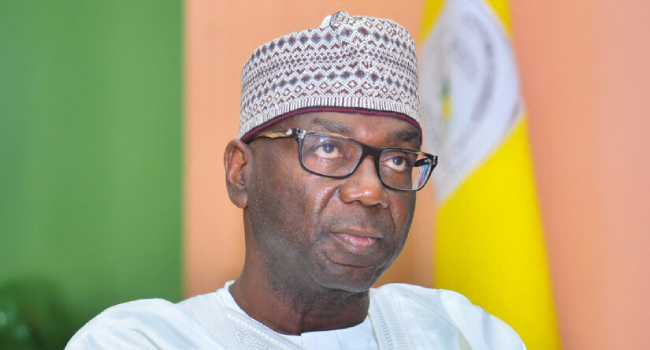
Chairman of the Nigeria Governors’ Forum (NGF) and Kwara State Governor, AbdulRahman AbdulRazaq, has revealed that state governors braced for widespread unrest following President Bola Tinubu’s decision to remove fuel subsidy in 2023, but were surprised when the policy was implemented without triggering riots or mass protests.
AbdulRazaq made the disclosure on Friday during a meeting between President Bola Tinubu and state governors at the President’s residence in Lagos.
According to the governor, many state leaders initially reacted with panic after receiving indications that the subsidy removal would proceed despite concerns over its potential economic and social consequences.
He recalled that governors first learned of the imminent policy through calls from the National Security Adviser and the Director-General of the Department of State Services while several governors were on an official trip to China.
“We went into panic mode. I sent a message to my colleagues at the Nigeria Governors’ Forum and nobody wanted to hear that,” AbdulRazaq said.
The governor explained that the officials informed them there would be no reversal of the decision, prompting urgent consultations among governors who feared severe public backlash.
According to him, governors present in China, including Lagos State Governor Babajide Sanwo-Olu and the Governor of Kaduna State, quickly met to discuss the implications of the policy and considered approaching President Tinubu to express their concerns.
“We met and asked ourselves how such a policy could be implemented. It seemed impossible. There were several phone calls back and forth to Nigeria, and we decided to seek an audience with Mr President to explain why we believed it would be difficult to implement,” he said.
However, AbdulRazaq said the planned intervention never materialised after President Tinubu invited them to dinner and outlined his vision for Nigeria.
Mr President invited us for dinner and we went. We listened to his vision for Nigeria and by the end of the evening, we could not even raise the issue.
“We did not know whether he had received intelligence reports about our intentions, but somehow we never brought up the subject,” he added.
Following the meeting, the governors returned determined to prepare for possible unrest.
AbdulRazaq disclosed that governors immediately directed security agencies across their respective states to strengthen surveillance and convened emergency State Security Council meetings in anticipation of possible demonstrations and riots.
We advised one another to convene State Security Council meetings because we were expecting serious riots. There had been protests over smaller issues in the past, and there had already been demonstrations over governance concerns before then.
Every governor was told to secure his state and prepare for the worst. Yet, when the policy was announced, nothing happened. There were no riots and no major protests anywhere in the country, he said.
The NGF chairman attributed the unexpected calm to the shock many Nigerians felt at the government’s boldness in implementing a reform that previous administrations had avoided.
I think the nation was shocked by the audacity of Mr President to implement such a major policy, he stated.
AbdulRazaq also highlighted what he described as the positive fiscal impact of the subsidy removal on state governments.
According to him, many states previously struggled financially after receiving allocations from the Federation Account Allocation Committee (FAAC), with some left with only between N100 million and N200 million after paying workers’ salaries.
He noted that the limited funds made it difficult for states to undertake meaningful infrastructure projects, forcing many to rely heavily on loans and bond issuances.
“Before now, some states were left with just N100 million to N200 million after salary payments. That amount could barely construct one kilometre of road. We had to rely on borrowing and bond markets to finance development projects,” he explained.
The governor said the situation has improved significantly since the subsidy removal, allowing states to strengthen their finances and reduce debt burdens.
Today, many states no longer need to borrow to meet basic obligations or fund development projects. In fact, several states are actively reducing their debt profiles. Delta State, for example, has completely retired its debt, while we have reduced ours by about 40 per cent, AbdulRazaq said.
He further praised the administration’s efforts to improve workers’ welfare through the recent minimum wage increase and urged President Tinubu to consider raising the national minimum wage to N100,000.
“Minimum wage has gone up and many states are already paying close to N100,000. I urge Mr President to engage with governors on the possibility of moving the national minimum wage to at least N100,000,” he said.
President Tinubu announced the removal of fuel subsidy during his inauguration on May 29, 2023, ending decades of government spending on petrol price support. While the decision initially led to a sharp rise in fuel prices and increased cost of living pressures, supporters of the policy argue that it has improved public finances and provided states with greater revenue allocations.
The subsidy removal remains one of the most significant and controversial economic reforms undertaken by the Tinubu administration.