


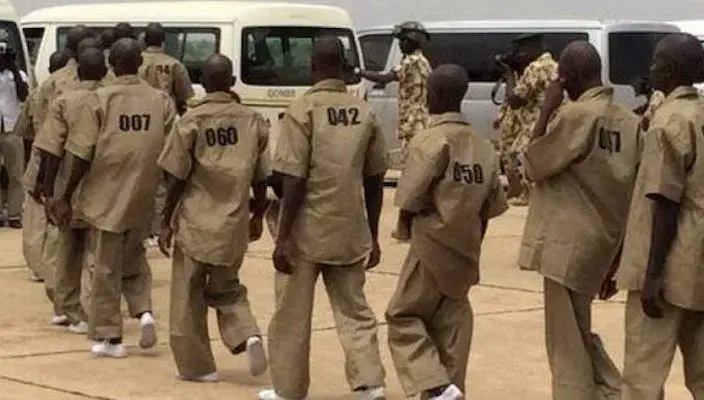
Nigerians across different regions and professional groups have criticised the Federal Government’s policy of rehabilitating and reintegrating former Boko Haram fighters, insisting that terrorists cannot genuinely repent and that victims of insurgency deserve greater attention and support.
The backlash follows the recent reintegration of 720 former insurgents, 992 spouses and 2,050 children by the Borno State Government under the controversial Operation Safe Corridor programme.
The ex-fighters, who underwent deradicalisation and skills training, were sworn in on the Holy Quran before being returned to their communities.
The programme, launched by former President Muhammadu Buhari in 2016, was designed to encourage surrendered insurgents to abandon violence and embrace peace. Authorities argue that the initiative is aimed at reducing insecurity and promoting long-term stability.
However, many Nigerians say the policy sends the wrong signal and risks rewarding perpetrators while neglecting victims and demoralising security personnel.
Former President of the Ijaw National Congress, Prof. Benjamin Okaba, described the execution of the programme as dangerously flawed.
According to him, while deradicalisation may have strategic value, community reintegration remains poorly implemented and lacks transparency.
The policy may be necessary from a security standpoint, but its success should be measured by how safe communities are years after these ceremonies, not by the number of people processed,he said.
Convener of the South South Reawakening Group, Elder Joseph Ambakederimo, argued that known terrorists should be eliminated rather than reintegrated.
He pointed to conflicting positions within government, noting that while Defence Minister General Christopher Musa advocates a hardline approach, Chief of Defence Staff General Olufemi Oluyede supports reintegration.
The fight against terrorism cannot succeed with divided strategies. Any identified terrorist should be neutralised,” he said.
Coordinator of the Niger Delta Peace Coalition, Zik Gbemre, questioned the sincerity of repentant insurgents and warned that Nigeria lacks effective systems to monitor them after reintegration.
He said millions of displaced persons and victims continue to suffer while former terrorists receive food, training and financial support.
It makes it look as though government cares more about criminals than the people who suffered because of them, he stated.
Civil society advocate Elkanah Oluyori said Operation Safe Corridor hurts both soldiers and victims.
According to him, troops who risk their lives daily may view the programme as rewarding the very people they fought against, while victims are left without equivalent support.
Dr. Victor David, Executive Director of Vital Partners for Development, also maintained that repentance should be demonstrated over time rather than assumed through oath-taking.
The programme appears to reward perpetrators while victims remain neglected,” he said.
Several stakeholders insisted that insurgents should face prosecution rather than rehabilitation.
Coordinator of the Forum of Delta State NGOs, Deacon Okezi Odugala, described the policy as evil and called for capital punishment for terrorists.
Public analyst Ayo Fadaka said terrorism amounts to treason and argued that Operation Safe Corridor has failed.
“The policy should be scrapped immediately. It undermines the sacrifices of soldiers and insults the memory of victims, he said.
Similarly, National President of the Igbo Women Assembly, Lolo Nneka Chimezie, described the repentant-terrorists policy as a major mistake, insisting that justice should come before rehabilitation.
Not everyone rejected the programme.
President of the Progressive Muslim Clerics in Ogun State, Alhaji AbdulWasiu Akinyemi, argued that some individuals were forced into Boko Haram and deserve rehabilitation if investigations show they did not willingly embrace the ideology.
General Secretary of the Coalition of Democratic Formations, Nelson Ekujumi, said reintegration is part of a broader non-kinetic approach aimed at weakening terrorist groups.
“A terrorist can genuinely repent. Some joined under pressure or coercion and should be given a second chance,” he said.
Former NBA Vice Chairman, Moruff Balogun, also maintained that repentance is possible, though trust must be earned over time through conduct rather than declarations.
Human rights activist Femi Aborisade called for greater transparency, insisting rehabilitation should not replace justice.
He urged the government to publish data on the programme’s cost, effectiveness and long-term outcomes.
Youth groups, including the Coalition of Nigerian Youth Leaders, also demanded an independent audit of Operation Safe Corridor and stronger support for victims and families of fallen soldiers.
For many Nigerians, the debate is no longer about whether terrorists can repent, but whether the country possesses the capacity to verify such repentance without compromising national security or abandoning those who have paid the highest price for the insurgency.


