


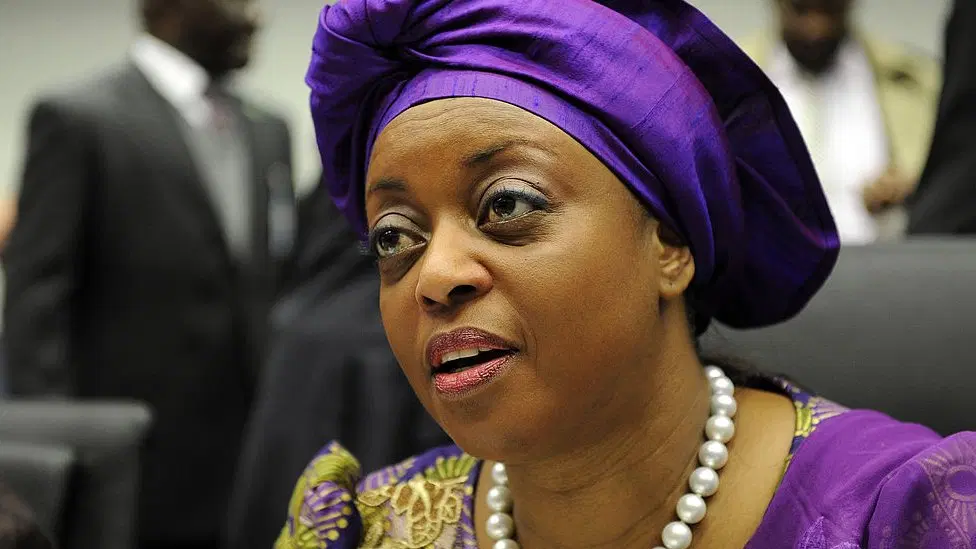
The Economic and Financial Crimes Commission (EFCC) has urged the Federal High Court in Abuja to disregard the acquittal of former Minister of Petroleum Resources, Diezani Alison-Madueke, by a United Kingdom court, arguing that the judgment has no bearing on the ongoing legal proceedings over assets linked to her.
The anti-graft agency made the submission in a further counter-affidavit filed in response to Diezani’s application seeking to tender the June 17 judgment of the Southwark Crown Court in London.
The UK court discharged and acquitted the former minister in proceedings involving allegations of bribery and corruption.
However, the EFCC argued that the UK proceedings were separate from the Nigerian for
Justice Inyang Ekwo had earlier, on July 1, granted Diezani permission to present the UK judgment as evidence in the Nigerian proceedings.
The EFCC, however, maintained that the proceedings before the Southwark Crown Court had no connection with the substantive suit before the Federal High Court in Abuja.
The commission argued that the UK case was not a proceeding before a Nigerian court and therefore had no bearing on the forfeiture proceedings.
The EFCC also asked the court to dismiss Diezani’s application and supplementary affidavit, alleging that some of the claims contained in the documents were misleading.
According to the commission, the assets at the centre of the dispute were covered by final forfeiture orders issued by Nigerian courts.
The EFCC said the orders remained valid and had not been set aside by any competent court.
It specifically cited final forfeiture orders made by Justice C.A. Obiozor of the Federal High Court on July 9, 2019, and another order issued by Justice I.N. Oweibo on September 10, 2019.
The commission maintained that the sale of the properties was conducted pursuant to those orders and in accordance with due process.
It also told the court that notices had been published in newspapers inviting interested parties to show cause why the properties should not be forfeited before the final orders were made.
“The final forfeiture orders pursuant to which the sale of the properties was conducted are still in force and have not been set aside. The forfeited properties were disposed of in accordance with due process of law, the EFCC stated.
Diezani, through her counsel, Prof. Mike Ozekhome, SAN, has asked the court to direct the EFCC to recover properties allegedly sold to third parties.
In the suit, marked FHC/ABJ/CS/21/2023, the former minister alleged that the EFCC began disposing of assets linked to her without giving her a fair hearing.
She further argued that some of the final forfeiture orders were obtained through what she described as misrepresentation, suppression and non-disclosure of material facts.
The former minister also maintained that she had never been convicted of any unlawful activity that could justify the forfeiture of her properties.
According to her, the courts lacked jurisdiction to issue the forfeiture orders without hearing her.
Diezani also told the court that she had been outside Nigeria since 2015 while receiving medical treatment and was not served with the relevant court processes.
She challenged the basis on which the forfeiture orders were obtained, arguing that they were made under a civil standard of proof rather than the stricter standard applicable to criminal allegations.
She further disclosed that she had three suits pending against the EFCC in Lagos and argued that the disputed assets should not have been sold while the forfeiture orders were being challenged.
The EFCC, however, maintained that criminal proceedings had been instituted against Diezani in different Nigerian courts following investigations into her activities while she served as a public official.
The commission cited charges including FHC/ABJ/CR/208/2018 before the Federal High Court and HC/ADYL/56C/2017 before the Adamawa State High Court.
The EFCC’s position is that the existence of those proceedings, together with the final forfeiture orders already issued by Nigerian courts, means the UK judgment should not affect the Nigerian asset-forfeiture proceedings.
Justice Inyang Ekwo has adjourned the matter until November 11 for the hearing of the pending applications.
The court’s eventual ruling will determine how the parties’ competing arguments over the UK judgment, the Nigerian forfeiture orders and the disputed properties proceed.