


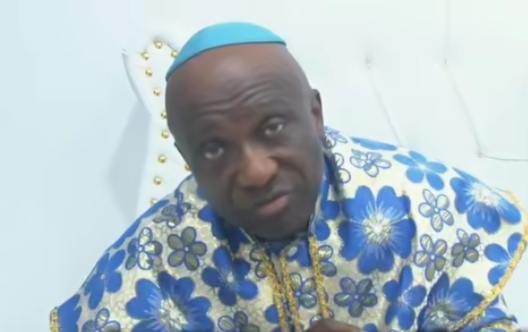
The Leader of INRI Evangelical Spiritual Church, Primate Elijah Ayodele, has reportedly warned former Vice-President Atiku Abubakar to prepare for a series of allegations that could emerge against him as political activities intensify ahead of Nigeria’s 2027 presidential election.
In a video circulating on social media, the cleric cautioned Atiku to be ready to defend himself against allegations he suggested could be raised against the former vice-president in the coming days.
Ayodele’s warning, as conveyed in the video, suggests that Atiku could face renewed political and public scrutiny, including claims he may not presently anticipate.
The cleric urged the former vice-president to prepare for the possibility of multiple accusations, warning that the development could pose a serious challenge to his political ambitions if he is unprepared to respond.
The warning comes amid escalating political exchanges between the ruling All Progressives Congress (APC) and opposition figures positioning themselves for the 2027 presidential election.
However, the specific allegations Ayodele said could emerge have not been independently established, and his prediction should not be interpreted as evidence that any wrongdoing has occurred.
Ayodele has previously made public predictions about the 2027 election and the political prospects of major contenders.
In a report published on September 24, 2026, the cleric described the forthcoming election as an election of mass destruction and warned Atiku about the political challenges he could face if he failed to adopt what Ayodele considered an effective strategy.
He also made predictions concerning the APC, the opposition and the possible outcomes of the election. These remain his forecasts rather than established electoral outcomes.
The latest warning, if accurately represented in the circulating video, adds another dimension to the political conversation surrounding Atiku as he prepares for another presidential contest.
The allegation of possible fresh claims against the opposition figure also comes against the backdrop of renewed exchanges between the APC and its political opponents over corruption allegations, past controversies and the records of leading politicians.
Atiku Abubakar has remained a prominent figure in Nigerian politics since the return to democratic government in 1999.
He served as vice-president under former President Olusegun Obasanjo from May 1999 to May 2007, having emerged as Obasanjo’s running mate in the 1999 presidential election.
During his eight years in office, Atiku chaired the National Council on Privatisation and was associated with the administration’s privatisation programme and economic reform efforts.
His relationship with Obasanjo later deteriorated, particularly over disagreements surrounding constitutional changes and the controversial third-term debate. The dispute became one of the defining political episodes of the administration’s second term.
After leaving office in 2007, Atiku continued pursuing his ambition to become Nigeria’s president, moving between political parties and participating in several presidential contests.
He contested the 2007 presidential election under the Action Congress, returned to the Peoples Democratic Party (PDP) and sought its presidential ticket in 2011, before joining the APC in 2014.
He later returned to the PDP and emerged as its presidential candidate in 2019 and 2023.
In the 2019 election, Atiku lost to former President Muhammadu Buhari. He again finished behind the winner in 2023, when Bola Ahmed Tinubu was declared president-elect.
Atiku challenged the 2023 result in court, but his legal challenge was unsuccessful.
His repeated presidential campaigns have made him one of Nigeria’s most enduring opposition figures, while his political journey has also attracted criticism from opponents over his past affiliations, economic policies and controversies associated with his time in public life.
As the 2027 election approaches, the former vice-president faces the challenge of presenting his political record to voters while responding to criticism from the ruling party and other political opponents.
The political environment has become increasingly contentious as leading politicians and parties prepare for the next general election.
On September 24, 2026, the APC renewed its criticism of Atiku, citing several past corruption-related controversies, including matters connected to the Petroleum Technology Development Fund, the Siemens bribery investigation and the case involving former United States congressman William Jefferson.
These matters have different histories and legal circumstances and should not be treated as proof of criminal guilt. Atiku has previously denied wrongdoing in relation to allegations against him, while a 2026 AFP fact-check noted that a 2010 US Senate report frequently circulated in recent online claims did not result in criminal charges against him.
The renewed exchanges illustrate how past controversies can become part of political messaging as parties attempt to challenge the credibility of their opponents.
Ayodele’s reported warning that further allegations could emerge against Atiku therefore comes at a time when political narratives, public statements and competing claims are likely to receive greater attention.
Nevertheless, whether any new allegations will actually emerge, who might make them and what evidence might support them remain unknown.
Atiku has also been involved in legal challenges concerning President Bola Tinubu’s academic qualifications.
The controversy became prominent after the 2023 presidential election, when Atiku’s legal team obtained records from Chicago State University through proceedings in the United States.
The records became central to Atiku’s claims concerning the academic certificate Tinubu submitted in connection with his presidential candidacy. Tinubu’s representatives rejected allegations of certificate forgery and maintained that the accusations were unfounded.
The issue has remained part of the wider political dispute between the two men.
In a report dated August 14, 2026, The Guardian Nigeria reported that Atiku had filed a fresh suit at the Federal High Court in Abuja challenging Tinubu’s qualification to contest the 2027 presidential election. The action reportedly invoked constitutional provisions relating to eligibility and the presentation of allegedly forged certificates.
The filing of a lawsuit represents a legal challenge, not proof that the allegations have been established. The claims and Tinubu’s response must be considered in light of the evidence and any applicable court decisions.
The dispute demonstrates that the political contest between Atiku and Tinubu extends beyond campaign rhetoric to questions concerning constitutional eligibility, public accountability and the interpretation of official records.
Tinubu has also faced scrutiny over historical drug-related allegations linked to financial forfeiture proceedings in the United States.
The controversy has been repeatedly raised by political opponents, including in debates surrounding his eligibility to contest the presidency.
Such allegations require careful distinction between documented legal proceedings, claims made by political actors and conclusions that have been established by a competent court.
The existence of historical allegations or a financial forfeiture proceeding should not automatically be presented as proof of a criminal conviction. Tinubu and his representatives have disputed accusations raised against him in connection with his past.
The controversy has nevertheless remained part of the political debate surrounding the president, particularly in discussions about transparency, character and eligibility for public office.
For Atiku, who challenged Tinubu’s 2023 election victory and has continued to question aspects of his qualifications, the issue remains politically significant. However, any new claim must be supported by verifiable evidence rather than speculation.
There have also been claims circulating in political discussions about a possible trip by Atiku to the United States to meet President Donald Trump in connection with Nigeria’s 2027 election.
Such a meeting, if it were to take place, would attract attention because of the importance of Nigeria-US relations and the international interest surrounding Nigeria’s electoral process.
However, RapidoSpace News has not independently verified a specific prophecy by Ayodele predicting that Atiku would travel to the United States to meet Trump over the 2027 election. Nor is there verified evidence in the material reviewed for this report confirming that such a meeting has been scheduled.
Consequently, the reported prediction should be treated cautiously and should not be presented as a confirmed diplomatic engagement.
Atiku’s political associates and other opposition figures have previously appealed to international leaders on matters concerning Nigeria’s political environment. Such appeals, however, are different from a confirmed meeting with a sitting US president.
The reported warning places renewed focus on the role of allegations and counter-allegations in Nigeria’s approaching election season.
For Atiku, the immediate question is whether any new accusations will emerge and, if they do, whether they will be supported by credible evidence.
For the APC, opposition criticism of Tinubu’s record and eligibility remains part of the broader political contest. For the opposition, allegations directed at its leading figures may require clear responses and, where appropriate, documentary evidence to address public concerns.
The central issue for voters is not simply whether politicians make allegations against one another, but whether those claims can withstand independent scrutiny.
Political predictions may generate headlines and public debate, but they do not establish guilt, determine court outcomes or settle electoral questions.
As the 2027 election approaches, developments involving Atiku, Tinubu, the APC and opposition parties are likely to remain prominent in national political discourse.
RapidoSpace News will continue to monitor the unfolding political developments, examine claims against available evidence and report verified updates as they emerge.


