


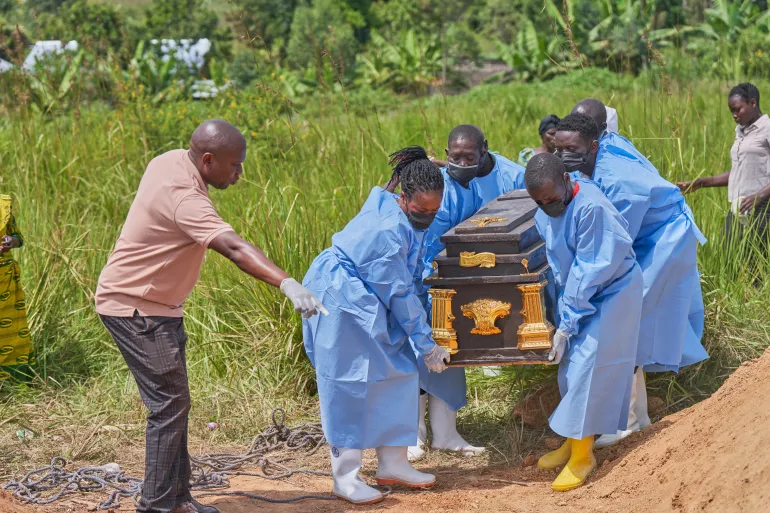
The Democratic Republic of the Congo (DRC) is facing a rapidly worsening Ebola outbreak after health authorities confirmed a record daily spike in infections, pushing total confirmed cases to 782 and deaths to 181.
According to the country’s Ministry of Public Health, 72 new infections were recorded within a 24-hour period, marking one of the sharpest single-day increases since the outbreak began.
The outbreak is being driven by the rare Bundibugyo strain of the Ebola virus, which has no approved vaccine or specific treatment, making containment efforts more difficult compared to previous Ebola outbreaks in the country.
Officials confirmed that 32 additional deaths were recorded alongside the new infections, raising the total fatalities to 181. While 40 patients have reportedly recovered, health experts warn that the situation remains highly unstable.
The virus has primarily affected Eastern Ituri province, which accounts for nearly 95 per cent of confirmed cases. However, it has now spread into North Kivu and South Kivu provinces, and even crossed into neighbouring Uganda.
Health authorities say the outbreak’s spread is being worsened by ongoing insecurity in the region, including armed conflict, displacement of civilians, and limited access to affected communities.
One of the major concerns raised by health officials is the sharp decline in contact tracing coverage, which has dropped to 56.5 per cent—far below the 95 per cent target needed for effective outbreak control.
Doctors Without Borders (MSF) warned that the true scale of the outbreak may be larger than reported due to significant gaps in surveillance, testing, and reporting systems.
The rising insecurity and weak monitoring systems mean we may not be seeing the full extent of transmission,” the organisation cautioned.
The World Health Organization (WHO) has announced an expansion of diagnostic testing and contact tracing operations in affected regions, while regional health bodies are also stepping up emergency response measures.
Jean Kaseya, Director-General of the Africa Centres for Disease Control and Prevention (Africa CDC), called for urgent international support to contain the outbreak.
We remain committed to supporting affected countries until transmission is stopped. We call on partners and donors to urgently mobilise resources to strengthen the response and save lives,” he said.
However, humanitarian agencies say funding gaps remain a major obstacle, with MSF estimating that at least $21.5 million is urgently needed to strengthen response efforts.
Health experts warn that ongoing conflict in eastern DRC is significantly complicating containment efforts.
Ituri province, the epicentre of the outbreak, is also a region plagued by long-standing armed violence involving multiple militant groups, including the M23 rebel movement, which has destabilised parts of North Kivu, including the city of Goma.
Nearly one million people have been displaced in the region due to violence, making it harder for health workers to track infections and deliver care.
Officials also noted that artisanal mining activities in remote areas have contributed to the spread of the virus, as workers frequently move between isolated sites, creating hidden transmission routes.
Unlike the Zaire strain responsible for previous Ebola outbreaks in the DRC, the current Bundibugyo strain has no approved vaccine or treatment, further complicating containment efforts.
Experts say this makes rapid detection, isolation, and contact tracing the only effective tools for controlling the outbreak.
The outbreak has now reached neighbouring Uganda, raising concerns of wider regional spread if urgent containment measures are not strengthened.
Public health agencies continue to warn that without improved surveillance, funding, and security in affected areas, the outbreak could expand further.
As the crisis deepens, international health organisations are calling for coordinated global support to prevent a larger regional health emergency.