


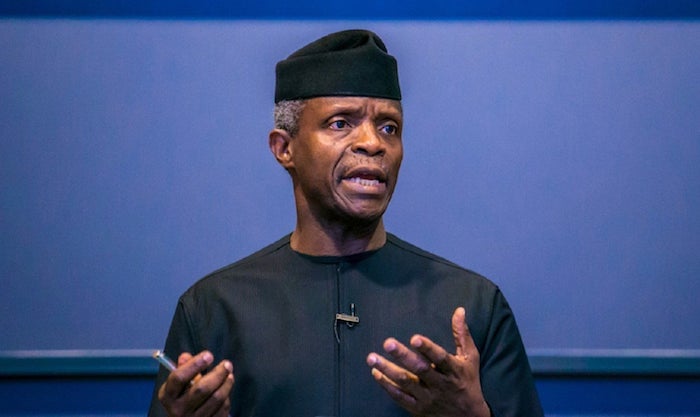
LAGOS: Former Vice President Yemi Osinbajo has called for greater investment in open and distance learning as Nigeria searches for sustainable ways to expand access to university education.
Osinbajo said the growing number of young Nigerians seeking admission into tertiary institutions makes it increasingly difficult for the conventional university system to meet the country’s educational needs.
He spoke on Tuesday in Lagos at the fifth International Colloquium of the University of Lagos Distance Learning Institute (DLI), themed, Reimagining Open Distance Learning Ecosystem: Technology, Policy and Institutional Priorities.
According to the former vice president, more than 2.2 million Nigerians apply for university admission through the Joint Admissions and Matriculation Board every year, while existing tertiary institutions are able to accommodate only about a quarter of the applicants.
He warned that the pressure on universities could become significantly greater in the coming years as Nigeria’s population continues to expand.
Osinbajo said Nigeria’s population could approach 250 million by 2036, potentially pushing the number of annual university applicants to about 2.7 million or even above three million.
He noted that relying solely on conventional universities would require massive investments in lecture halls, laboratories, campuses, hospitals and other infrastructure.
Osinbajo argued that open and distance learning should not be regarded merely as an alternative to conventional university education.
Rather, he described it as a national necessity that could help Nigeria provide higher education opportunities to millions of citizens who may otherwise be unable to secure admission into traditional institutions.
He also highlighted the growing role of technology and artificial intelligence in transforming the education sector.
According to him, universities could deploy AI-powered learning tools to provide personalised instruction, explain difficult concepts, assess students’ understanding, translate educational materials and offer immediate feedback.
He urged policymakers, university authorities and other stakeholders to develop clear policies covering technology adoption, lecturer training, assessment methods and the responsible use of artificial intelligence in higher education.
The former vice president also stressed the importance of lifelong learning as the nature of employment continues to change.
He noted that professionals in fields such as law, accounting, banking and engineering would increasingly need to return to education throughout their careers to acquire new skills and remain relevant.
Vice-Chancellor of the University of Lagos, Prof. Folasade Ogunsola, also described open and distance learning as crucial to expanding access to higher education.
She said Nigeria’s traditional university model was becoming increasingly inadequate given the size and growth of the country’s youthful population.
Ogunsola noted that Nigeria has about 89 million people between the ages of 15 and 30, while the country’s average age is about 19.
She said distance learning could provide opportunities for workers, people living with disabilities and Nigerians who reside far from university campuses to pursue higher education through flexible learning arrangements.
The vice-chancellor disclosed that UNILAG no longer indicates “distance learning” on certificates awarded to graduates of its DLI programmes, reflecting the institution’s position that students who study through distance learning should receive equal recognition with graduates of conventional programmes.
She, however, stressed that open and distance learning must evolve beyond simply delivering educational content.
According to her, the sector should focus on creating connected learning environments that encourage student engagement, personalised education and improved academic outcomes.
Director of the DLI, Prof. Risikat Dauda, identified open and distance learning as an important tool for expanding educational access, addressing skills shortages and preparing Nigerians for a rapidly changing labour market.
She listed poor broadband infrastructure, high internet data costs, inadequate digital literacy and concerns over how employers perceive distance-learning qualifications among the major challenges facing the sector.
Both speakers called for stronger investment and policy support to enable technology-driven education to reach more Nigerians and help the country bridge its widening higher-education access gap.


