


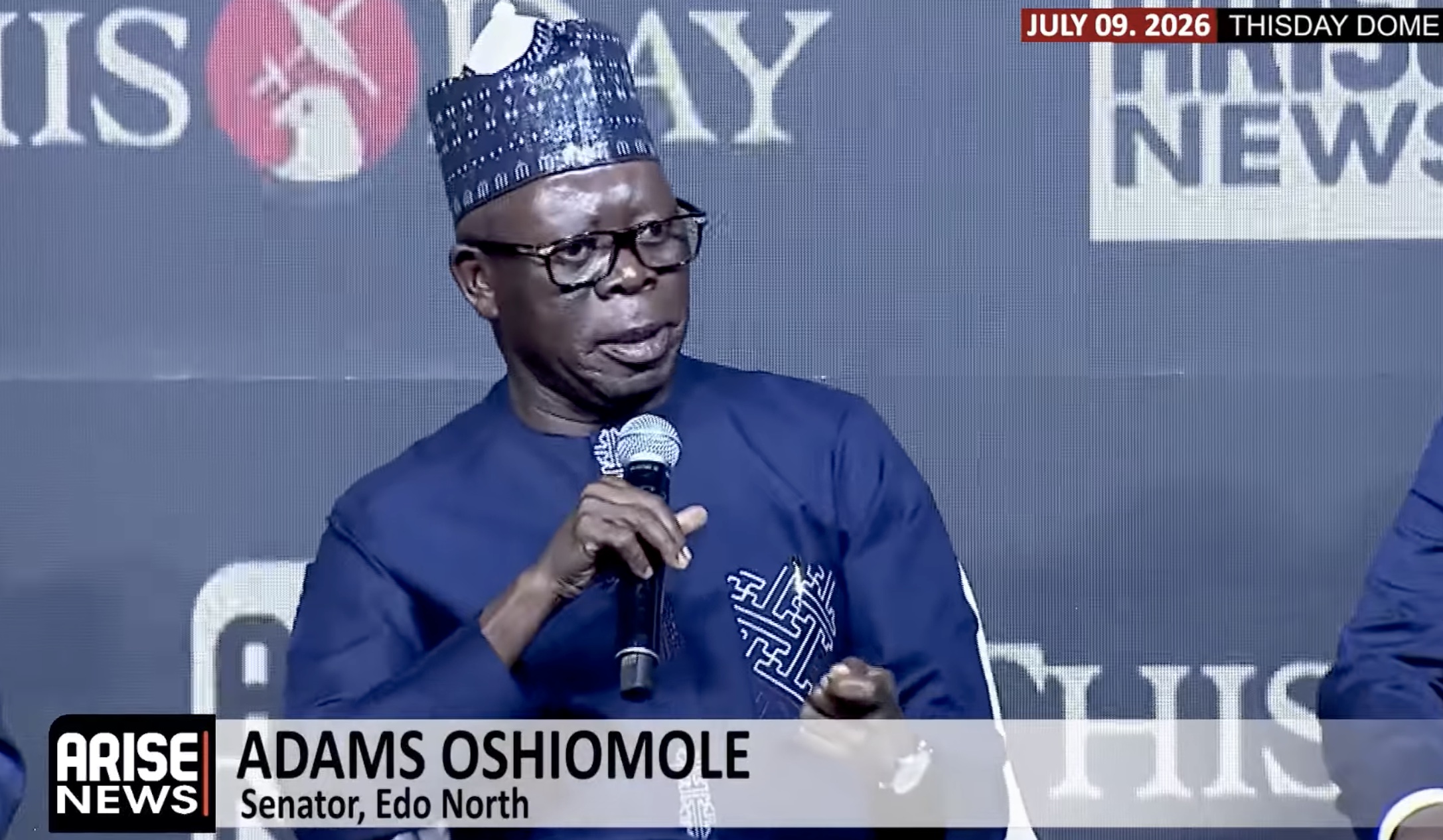
Senator Adams Oshiomhole, representing Edo North Senatorial District, has renewed his support for the establishment of state police, arguing that governors cannot effectively safeguard lives and property without having operational control over security agencies in their states.
Speaking during the ARISE News Town Hall on State Police, the former Edo State governor described Nigeria’s current policing arrangement as contradictory, noting that while the Constitution designates governors as chief security officers, it does not empower them to command, recruit, discipline or deploy police personnel.
Governors Have Responsibility Without Authority – Oshiomhole
Oshiomhole maintained that the existing centralized policing system has failed to address Nigeria’s worsening security challenges and called for constitutional reforms that would grant governors direct control over state policing.
According to him, assigning governors responsibility for security without providing the authority to enforce it creates a major governance gap.
He likened the situation to being called a husband without having a wife, stressing that governors cannot issue operational directives to police officers, promote or discipline them despite being held accountable for security failures.
Funding Is About Priorities, Not Capacity
Addressing concerns that many states may lack the financial capacity to sustain state police, Oshiomhole argued that government spending reflects priorities rather than limitations.
He said every tier of government allocates resources based on what it considers important, insisting that states committed to improving security would make adequate budgetary provisions for state policing.
Edo Experience Shows Structural Weakness
Drawing from his tenure as governor of Edo State, Oshiomhole revealed that his administration invested heavily in operational vehicles, communication equipment and logistics for the Nigeria Police Force.
However, he lamented that despite providing these resources, he had no legal authority to determine how they were deployed or to discipline officers who allegedly mismanaged or abused the equipment.
According to him, governors often bear the financial burden of supporting policing without possessing the constitutional powers required to ensure accountability.
Abuse of Power Already Exists
Responding to fears that governors could misuse state police for political purposes, the senator argued that abuse of law enforcement already occurs under the existing centralized police structure.
He noted that Nigerians have repeatedly witnessed allegations of police being influenced by both federal and state authorities, adding that abuse is not exclusive to any particular policing model.
Oshiomhole said democratic institutions provide mechanisms for holding governors accountable, including elections and media scrutiny.
He argued that any governor who abuses state police should face political consequences through the ballot box.
Abuja Allegedly Overruled Local Security Decisions
The lawmaker recalled several instances during his administration when security decisions taken within Edo State were allegedly reversed by authorities in Abuja.
He claimed that suspects arrested by the state Commissioner of Police were later released on directives from the federal level, despite concerns raised by the state government.
He also recounted the assassination of one of his personal aides, alleging that conflicting investigation reports from the Department of State Services (DSS) and the Nigeria Police prevented effective prosecution of the case.
According to Oshiomhole, the situation exposed the limitations governors face despite being constitutionally responsible for maintaining peace and security.
Former Governor Recounts Police Commissioner Incident
Oshiomhole also narrated what he described as one of the most frustrating moments of his administration following a major fire outbreak in Edo State.
He said he requested a briefing from the state Commissioner of Police to determine whether the incident resulted from arson or an electrical fault but alleged that the police chief declined to report to him despite repeated requests.
The former governor argued that such incidents demonstrate why governors require operational authority over policing if they are to discharge their constitutional responsibilities effectively.
Constitutional Reform Needed
Oshiomhole insisted that Nigeria must either amend the Constitution to remove the designation of governors as chief security officers or provide them with the legal instruments necessary to perform the role.
He stressed that maintaining the current arrangement is unsustainable because citizens naturally hold governors responsible whenever insecurity occurs within their states.
Nigeria Should Act on State Police Debate
The senator said discussions on state police have continued for several years without meaningful implementation.
According to him, Nigeria cannot continue operating the same centralized policing model while expecting significantly different security outcomes.
He cited the United States as an example of a federal system where state and federal police coexist and complement each other despite occasional jurisdictional disagreements.
Multiple Security Agencies Already Exist
Oshiomhole further argued that Nigeria has already acknowledged the limitations of relying solely on one police force through the creation of agencies such as the Federal Road Safety Corps (FRSC) and the Nigeria Security and Civil Defence Corps (NSCDC).
He said these institutions demonstrate that multiple security agencies can coexist successfully while addressing different aspects of national security.
Citizens Should Know Who to Hold Accountable
Concluding his remarks, Oshiomhole said establishing state police would improve accountability by ensuring governors have the authority to respond directly to security threats within their states.
He argued that if governors are empowered to deploy state police and still fail to protect citizens, voters would have clear grounds to hold them accountable during elections.
According to the senator, decentralizing policing would strengthen Nigeria’s federal structure, improve security response and enhance governance across the country.