


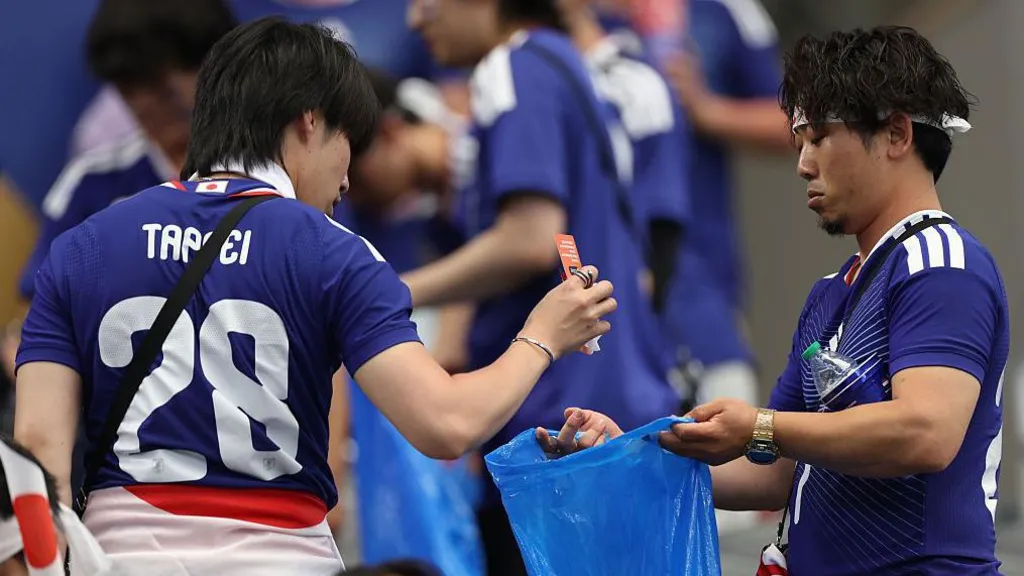
Japanese football supporters are once again earning global admiration for their habit of cleaning stadiums after matches at the 2026 FIFA World Cup—but this time, the tradition has sparked an uncomfortable debate at home over gender roles and unpaid domestic work.
For years, images of Japanese fans carefully collecting trash in stadiums after matches have gone viral, reinforcing a reputation for discipline, respect and cleanliness.
However, recent photos showing fans tidying up stands at World Cup venues have triggered a wave of online criticism in Japan, with some arguing that the behaviors highlight a double standard in household responsibilities.
The controversy began after a viral post juxtaposed a man cleaning a stadium with an image of him relaxing at home while his partner handled household chores such as washing dishes and laundry.
The post, which gained tens of thousands of likes on X (formerly Twitter), argued that Japanese men should contribute more to domestic responsibilities, noting that their participation in housework remains among the lowest in developed countries.
One widely shared comment summed up the frustration: Everyone wants to save the world, but no one wants to help mom do the dishes.
According to Organisation for Economic Co-operation and Development (OECD) data, Japanese women spend more than three hours daily on unpaid domestic work, compared to just 47 minutes for men.
The gap is even wider in households with young children. A 2021 government survey found that in dual-income families with children under six, women spend more than seven hours a day on chores, while men spend less than two hours.
These figures have intensified debate over whether public displays of cleanliness contrast sharply with private household inequalities.
Some social media users have criticised what they see as inconsistency—praised behaviour in public spaces but unequal participation in home life.
Others, however, argue that stadium cleanups should not be politicised, saying the practice reflects cultural values of respect and responsibility that should be celebrated rather than criticised.
One user wrote: Where’s the embarrassment in that? It’s better than reports of Japanese people littering abroad.
Japanese fans’ tradition of cleaning stadiums has influenced supporters from other countries as well. Videos have emerged of Portuguese fans and others adopting similar behaviour at international matches, using plastic bags to collect rubbish after games.
Cleanliness and respect for public spaces remain deeply rooted in Japanese culture, where fans often leave stadiums spotless after cheering for their teams.
While the practice continues to earn international praise, the conversation in Japan highlights a broader societal issue: the uneven distribution of unpaid domestic labour between men and women.
Experts say the debate reflects changing expectations among younger generations, who are increasingly questioning traditional household roles.
As the World Cup continues, Japan’s fans remain both celebrated abroad and scrutinised at home showing how a simple act of cleanliness can open up deeper conversations about equality and modern family life.


