


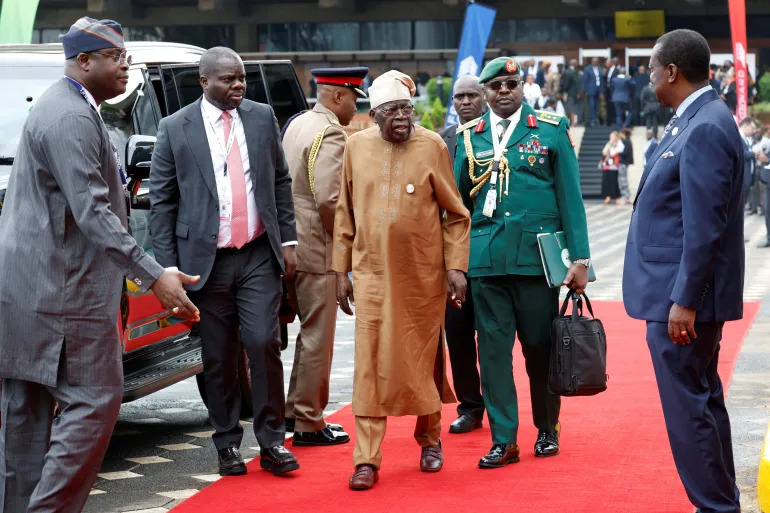
ABUJA: As Nigeria moves closer to the 2027 presidential election, President Bola Tinubu is facing a difficult political test: convincing Nigerians that the economic reforms introduced by his administration will eventually improve their lives despite the hardship many households are experiencing today.
Tinubu removed the petrol subsidy shortly after assuming office in 2023 and introduced foreign-exchange reforms that allowed the naira to trade more freely. The government has defended the measures as necessary steps to strengthen public finances, attract investment and address long-standing structural problems in the economy.
However, the immediate impact has been painful for many Nigerians. Food prices, transportation costs and the prices of everyday goods have risen, leaving families with less purchasing power.
For small business owners, the pressure is particularly obvious.
In Ilorin, Kwara State, 43-year-old Shukurat Oyedele continues to open her plastic goods shop every morning, even though customer traffic has dropped sharply. She told Al Jazeera that many people still want to buy her products but can no longer afford them.
A 21-litre bucket that sold for about ₦1,500 two years ago now costs roughly ₦3,200, according to Oyedele. The increase has forced some customers to postpone purchases or settle for smaller quantities. Her own profits have also declined, leaving her with a shop that is less stocked than it used to be.
Her experience reflects a wider political problem for Tinubu.
The government can point to improving economic indicators and greater macroeconomic stability, but ordinary Nigerians tend to judge the economy by the price of food, transport and household necessities.
The government has to convince Nigerians that those gains will eventually translate into better lives, Sekinat Ojeniyi, a senior analyst at Africa Practice, told Al Jazeera, stressing the difficulty of asking citizens to continue making sacrifices before they see meaningful improvements.
Tinubu’s economic reforms were welcomed by some investors and economists who had argued for years that Nigeria needed to tackle its structural economic weaknesses. But the political challenge is that reforms can take time to produce visible benefits, while their costs are often felt immediately.
For millions of Nigerians, economic statistics offer little comfort when their household budgets are already under severe pressure.
Cheta Nwanze, a partner at SBM Intelligence, noted that voters experiencing economic hardship at home are unlikely to judge the government primarily by GDP figures.
That disconnect could become one of the central issues of the 2027 campaign.
For families such as Oyedele’s, the changes are being felt at the dinner table. She described how rising costs have forced her family to change the way they prepare meals, with cheaper alternatives replacing foods they previously bought regularly.
Economic hardship is not Tinubu’s only political challenge.
Insecurity remains a major concern across parts of northern and central Nigeria, where communities continue to deal with banditry, kidnapping, armed attacks and farmer-herder violence.
Anne Ochayi, a 31-year-old lawyer living in Makurdi, Benue State, said insecurity has become a constant source of fear. She worries about violence not only while travelling but also about the possibility of attacks reaching people’s homes.
The security situation gives opposition politicians another powerful issue with which to challenge the government.
Yet widespread dissatisfaction does not automatically translate into an electoral upset.
Former Vice-President Atiku Abubakar and former Anambra State Governor Peter Obi remain among the prominent opposition figures seeking to challenge Tinubu. However, efforts to unite the opposition around a single presidential candidate have so far not succeeded.
This fragmentation could be crucial.
According to Nwanze, Nigeria’s electoral system tends to favour an opposition that can consolidate votes against an incumbent. If major opposition figures contest separately, Tinubu could benefit even if public dissatisfaction with his administration remains significant.
In other words, anger alone may not be enough to defeat an incumbent. The opposition would also need an effective strategy for converting that anger into a coordinated electoral challenge.
While Tinubu faces criticism over the economy and security, his All Progressives Congress retains a major advantage: political organisation.
The APC controls the federal government and maintains extensive political structures across the country. Those structures could prove important during the 2027 campaign, particularly at the grassroots level.
Nwanze described the party’s advantage as being more about organisation than popularity.
Africa Practice analyst Sekinat Ojeniyi also cautioned against treating the 2027 election simply as a referendum on Tinubu.
The election, she argued, will also test the quality of Nigeria’s opposition and whether the political system is giving voters meaningful alternatives.
For many Nigerians, however, the political arguments may ultimately come down to something much simpler: whether life becomes easier.
Thomas Eneji, a ride-hailing driver in Abuja, said he intends to vote in 2027 but wants a government capable of reducing the pressure on workers. Rising fuel costs, he explained, have made it increasingly difficult for drivers to earn enough to survive.
At the same time, he remains concerned about whether votes will genuinely produce political change.
That concern captures the wider challenge facing Nigeria’s political class.
Tinubu may argue that his reforms are laying the foundation for a stronger economy, while opposition parties are likely to focus on the immediate hardship Nigerians are experiencing.
The real question is whether voters will be willing to wait for the promised benefits of reform or demand a different direction in 2027.
For the president, the coming election will therefore be about more than defending an economic record. It will be a test of whether his government can turn promises of long-term recovery into improvements Nigerians can actually see and feel in their daily lives.


