


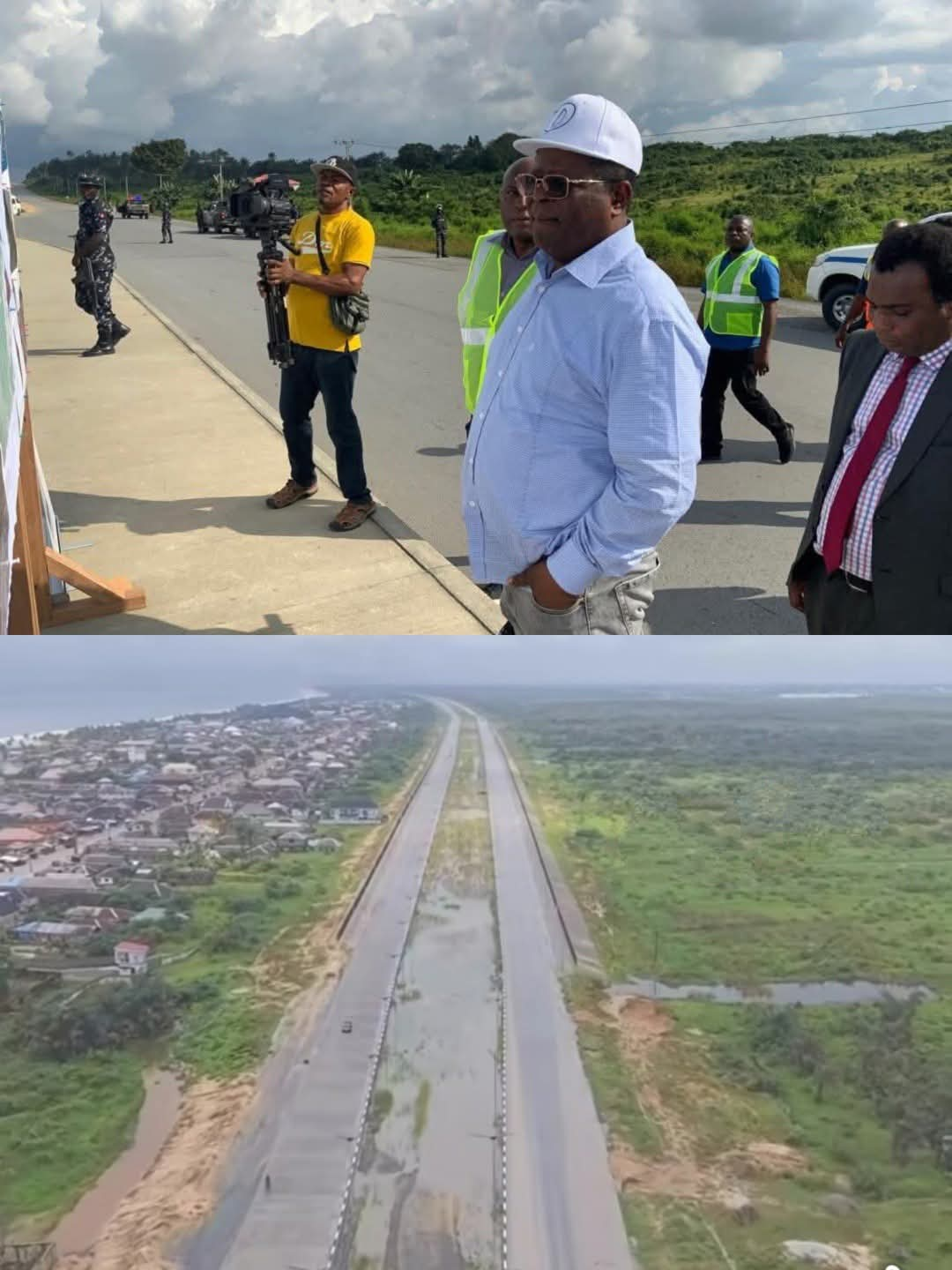
Major infrastructure projects must be judged not only by their cost, speed of construction or engineering complexity, but also by their fidelity to stated objectives, transparency of decision-making and benefits to the communities they are designed to serve.
The controversy surrounding the Lagos–Calabar Coastal Highway therefore raises an important question: are the reported route adjustments justified engineering decisions, or do they risk weakening the connectivity and development objectives that underpin the project?
The answer should not rest on speculation, political rhetoric or premature allegations. It must emerge from verifiable engineering information, a clearly defined route and an accountable explanation from the Federal Government.
Reconciling the Government’s Explanations
The Federal Government has defended adjustments to sections of the highway, with the Minister of Works, David Umahi, citing difficult terrain, deep pits and challenging subsoil conditions in parts of Ondo State.
These are legitimate engineering considerations. A highway alignment cannot responsibly ignore ground conditions, construction risks, environmental consequences or long-term maintenance requirements. Where investigations demonstrate that a different alignment would improve safety, durability or value for money, a redesign may be justified.
However, the controversy has been compounded by differing public explanations about the relationship between the coastal highway and the existing East-West Road.
In October 2026, the Minister clarified that the East-West Road would be connected to the coastal highway through a spur rather than by diverting the main highway. He described his earlier use of the word “divert” as a slip of the tongue and maintained that the main alignment remained intact.
That clarification is important, but it does not, by itself, resolve every question about the route. A public statement is not a substitute for the relevant alignment maps, chainages and approved section-specific engineering records.
The appropriate response is neither to dismiss the Minister’s explanation nor to accept it without examination. The Government should provide the technical information needed to establish precisely what has changed, what remains unchanged and why.
What Exactly Changed in Ondo State?
The reported redesign in parts of Ondo State is central to the controversy. The Minister has attributed the adjustments to terrain and subsoil challenges. These explanations should be evaluated on their engineering merits.
Yet the public still needs a clear account of the affected locations, the original and revised alignments, the reasons for each material change and the implications for adjoining communities.
It is equally important to recognise a distinction the Minister has made: there is no single, complete detailed engineering design covering the entire 750-kilometre highway. Design work, geotechnical investigations and environmental assessments are being undertaken section by section.
Consequently, it would be inaccurate to assume that one comprehensive, final engineering design already exists for every kilometre of the project. The demand for transparency must instead focus on the relevant designs and approvals for the sections where alignment decisions have been made or are being considered.
That approach would allow the public to distinguish a technically necessary adjustment from a change that might undermine the project’s original objectives.
The National Assembly’s Concern Deserves Attention
On 21 October 2026, the House of Representatives called for a review of the reported realignment. The concerns raised included the proposed route through Ondo State and the Escravos–Ogheye–Ugborodo corridor in Delta State, as well as the implications for connectivity, trade, economic opportunities and access to oil and gas infrastructure.
The House’s intervention does not establish that the highway has been formally diverted or that any state has been excluded. It does, however, underline the public importance of the questions being asked.
The coastal highway was conceived as more than a road between two distant points. Its broader promise includes improved movement along the coastline, access to economic centres, stronger commercial links and opportunities for communities that have historically faced infrastructure deficits.
Any redesign should therefore be assessed against both its engineering rationale and its implications for those objectives.
Engineering Efficiency Must Include Coastal Connectivity
The Federal Government is right to insist that engineering decisions must respond to actual ground conditions. No responsible administration should preserve a problematic alignment merely because it appeared in an earlier plan.
But engineering efficiency should not be defined narrowly as the easiest or cheapest route to construct. It must also account for connectivity, safety, resilience, environmental effects, maintenance costs and the economic purpose of the infrastructure.
If a revised alignment is technically superior, the Government should be able to explain why. If a spur is intended to connect the coastal highway to the East-West Road, its location, length, function and relationship to the main route should be clearly shown.
Likewise, if the route is expected to serve particular coastal communities and economic corridors, the Government should explain how those connections will be maintained or improved under the final design.
This is not an argument for political interference in engineering. It is a call for engineering decisions to be transparent, defensible and consistent with the public purposes for which the project was approved.
Transparency Is Part of Sound Engineering Governance
The most effective way to resolve the controversy is for the Federal Ministry of Works to publish an authoritative route map showing the proposed alignment through the affected sections, including the relevant Ondo axis and the connection to the East-West Road.
The Ministry should also make available, subject to legitimate legal, security and commercial restrictions, the relevant section-specific design approvals and technical explanations for material realignments. A clear schedule identifying affected chainages, the reasons for changes and their implications for community access would be particularly helpful.
Such disclosure would allow legislators, affected communities, professional bodies and the wider public to engage with the actual engineering decisions rather than competing interpretations of public statements.
Transparency would also protect the Government against unfounded allegations. Where decisions are technically sound, documentary evidence is the strongest defence. Where further work is necessary, early clarification can help correct problems before they become more expensive or difficult to resolve.
Accountability Without Prejudice
The present controversy should not be turned into an excuse for unsupported allegations of corruption, deliberate regional discrimination or abandonment of the project. The available public information does not establish such conclusions.
Equally, the absence of proof of wrongdoing should not be used to discourage legitimate scrutiny. Public infrastructure is financed and delivered in the public interest. Citizens are entitled to reasonable explanations of major decisions affecting its route, design and expected benefits.
The proper standard is evidence-based accountability: establish the facts, publish the relevant technical records and assess the decisions against engineering requirements and the project’s stated objectives.
Conclusion: Publish the Route, Explain the Changes
The Lagos–Calabar Coastal Highway remains a project of considerable national significance. Its success will depend not merely on kilometres completed, but on whether it provides safe, durable and meaningful connectivity while delivering the economic and social benefits used to justify the investment.
The Federal Government should therefore remove the uncertainty surrounding the reported realignments. It should clarify the main route, explain the Ondo adjustments, show how the proposed spur will connect with the East-West Road and identify how the needs of affected coastal communities will be addressed.
These are reasonable demands, not a verdict against the project or its engineers.
A sound engineering decision should withstand public explanation. A major national infrastructure project should also inspire confidence that technical efficiency and equitable development are complementary responsibilities.
The Government has an opportunity to settle the controversy with evidence rather than assertion. It should take it.
Frank Odion Apokwu is a Public Affairs Analyst Democratic Reforms and Inclusive Development Advocate. He writes from Asaba.


