


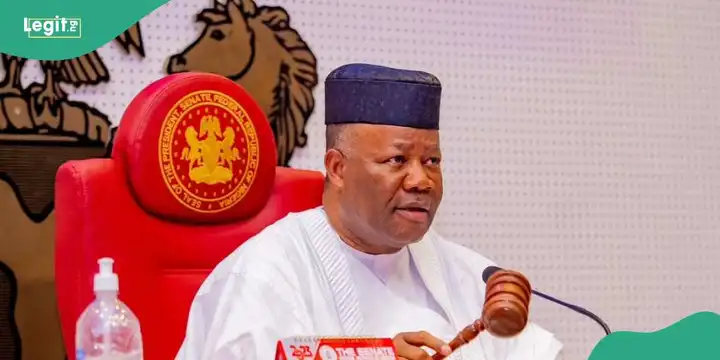
Senate President Godswill Akpabio has challenged former Rivers State Governor Rotimi Amaechi to produce documentary evidence supporting his allegation that 50 per cent of payments to contractors handling Niger Delta Development Commission (NDDC) projects were deducted.
The Office of the President of the Senate has challenged former Rivers State Governor and ex-Minister of Transportation, Rotimi Amaechi, to provide verifiable evidence to substantiate his allegation that Senate President Godswill Akpabio introduced a 50 per cent deduction from payments to contractors executing projects for the Niger Delta Development Commission (NDDC).
The challenge followed allegations reportedly made by Amaechi at a political rally in Bauchi State on Saturday, where he accused Akpabio of introducing the controversial deductions.
Responding to the allegation, Akpabio’s Special Adviser on Media and Publicity, Eseme Eyiboh, said the claim was serious and required proper scrutiny but insisted that political statements must be supported by verifiable facts.
In a statement, Eyiboh said Amaechi had yet to present contract documents, payment records, identifiable transactions or other evidence establishing the alleged deductions.
He challenged the former governor to identify the contracts involved, the contractors allegedly affected, when the deductions were made and the payment arrangements through which they were supposedly implemented.
Eyiboh also demanded evidence linking Akpabio personally to the alleged financial transactions.
“An allegation delivered before an enthusiastic political audience does not, by that circumstance alone, acquire the status of an established fact,” Eyiboh stated.
He maintained that neither the political standing of an accuser nor the strength of the language used could replace documentary evidence.
According to him, if Amaechi possesses credible information indicating unlawful deductions from payments to NDDC contractors, he should submit the relevant documents to appropriate investigative authorities for examination.
“The questions are straightforward: Which contracts are involved? Which contractors were affected? When were the alleged deductions made? Through what payment arrangements did they occur? What evidence establishes the personal involvement attributed to the President of the Senate?” he asked.
The Senate President’s media aide described these questions as basic requirements of accountability and standards of proof, stressing that public figures, particularly individuals who have previously occupied high government positions, should understand the difference between political allegations and demonstrable wrongdoing.
The development adds another dimension to the political exchanges involving prominent Nigerian political figures, as the Senate President’s office insists that Amaechi must substantiate his claims with verifiable evidence.