


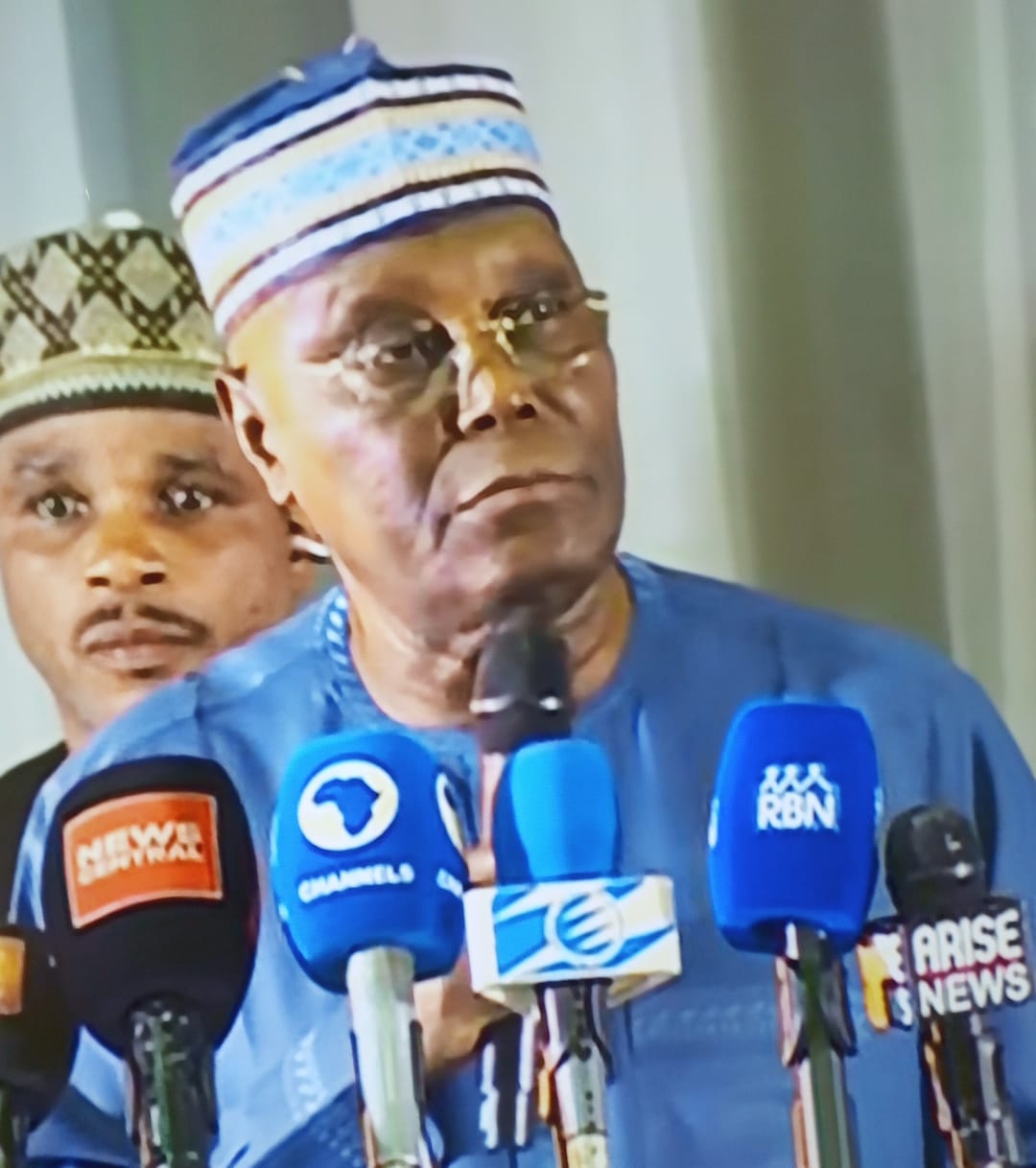
KADUNA: Minister of Aviation and Aerospace Development, Festus Keyamo, SAN, CON, has accused former Vice President Atiku Abubakar of being particularly apprehensive about the All Progressives Congress (APC) presidential campaign rally in Kaduna State, arguing that President Bola Ahmed Tinubu’s political strength in the North could undermine the ADC candidate’s calculations ahead of the 2027 general elections.
Keyamo made the allegations in a political commentary titled “Why Atiku Abubakar Is Particularly Jittery About the Kaduna Flag-Off,” in which he claimed that the former vice president was increasingly concerned about the APC’s growing campaign momentum and political structures in northern Nigeria.
According to Keyamo, Atiku’s political strategy was largely built around securing substantial northern votes, based on the expectation that Tinubu would face limited competition in the region and depend mainly on support from the South.
The minister argued that the APC’s presence and political organisation in the North had complicated that calculation, prompting what he described as attempts to portray the President as facing widespread rejection.
In his commentary, Keyamo accused opposition supporters of staging incidents involving the removal of Tinubu’s campaign posters and circulating the videos online to create the impression that the President had lost popular support in the North.
He also alleged that disinformation was being circulated to suggest that support for Tinubu in the region was being secured through massive financial inducements.
Keyamo specifically dismissed a purported letter alleging that N2.3 trillion had been earmarked for the Kaduna rally, describing it as fake and part of an alleged effort to discredit the President’s campaign.
However, the allegations concerning staged incidents, disinformation and the purported campaign expenditure were presented by Keyamo and were not independently established in the material available.
The minister maintained that the objective of such activities was to create public perception of a widespread rejection of Tinubu ahead of the 2027 elections.
Keyamo argued that Atiku’s electoral calculations depend heavily on his ability to consolidate support across northern Nigeria, particularly because of the political challenges he could face in the South.
He cited the 2023 presidential election, claiming that Atiku lost across the North-Central states and all Southern states except Osun State.
The minister said Atiku had initially expected Tinubu to concentrate his electoral efforts in the South, potentially leaving northern votes as a major battleground for the former vice president.
Keyamo further alleged that Atiku supported southern presidential candidates in previous political calculations to divide votes in the region and improve his chances in the North.
He argued that the emergence of strong APC campaign structures across northern states had weakened the assumptions underlying that strategy.
According to him, even if Atiku were to win some northern states, Tinubu’s potential victories in the Middle Belt and Southern Nigeria could prove decisive.
Nevertheless, the eventual distribution of votes in 2027 remains uncertain, and the minister’s projections represent his political assessment rather than an established electoral outcome.
The aviation minister also challenged what he described as Atiku’s expectation of replicating former President Muhammadu Buhari’s electoral success in 2015.
Keyamo argued that Buhari’s victory was shaped by political circumstances that cannot simply be reproduced by another candidate.
He further attacked Atiku over corruption-related concerns, using his commentary to question the former vice president’s political appeal among northern voters.
These remarks reflect Keyamo’s partisan assessment. They do not establish criminal wrongdoing by Atiku, and the former vice president’s response to the allegations was not included in the commentary.
The Kaduna campaign flag-off is framed by Keyamo as a significant test of the APC’s northern political strength and the ADC’s prospects of building a competitive national coalition.
For the ruling party, strong mobilisation in northern states could strengthen its campaign narrative and challenge opposition expectations about regional voting patterns.
For Atiku and the ADC, the broader challenge will be to build support across different regions, maintain political alliances and convince voters that the party offers a credible alternative.
Nigeria’s electoral landscape, however, extends beyond regional calculations. Economic conditions, security, governance, party organisation, candidate appeal and voter turnout could all influence the outcome.
Keyamo concluded his commentary with a sharp metaphor aimed at Atiku, describing him as a butterfly that thinks it is a bird, in an apparent attempt to ridicule what he considers an overestimation of the former vice president’s electoral strength.
The exchange underscores the increasingly combative political atmosphere surrounding the 2027 presidential contest, with both regional influence and national alliances expected to shape the campaigns