


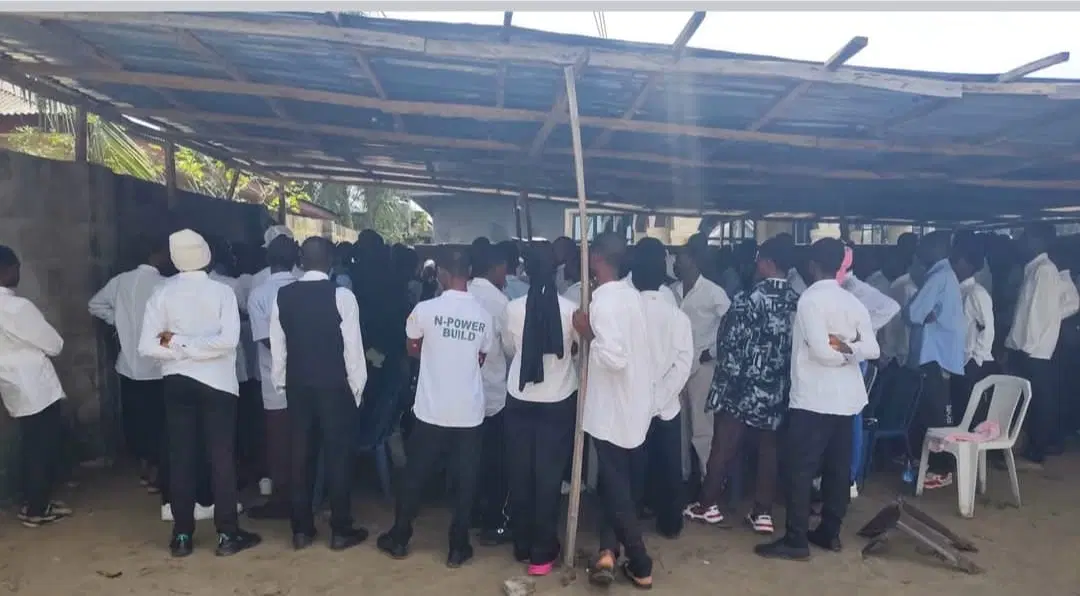
The Nigeria Security and Civil Defence Corps (NSCDC) has uncovered a suspected fake university operating from a three-bedroom apartment in Badagry, Lagos State, rescuing 106 young people allegedly deceived with promises of admission into a foreign university.
The operation, carried out by the NSCDC Badagry Area Command, also led to the arrest of the alleged proprietor of the illegal institution, who is accused of recruiting students from across Nigeria and neighbouring West African countries through an elaborate online admission scam.
According to the NSCDC, the raid followed several days of intelligence gathering and covert surveillance before operatives stormed the apartment in Ilado, Olorunda Local Council Development Area, in the early hours of Monday.
Speaking after the operation, the Badagry Area Commander, Chief Superintendent Gbenga Ekunola, disclosed that the institution had no official name, registration, signboard or recognized campus, yet allegedly portrayed itself online as a distance-learning centre affiliated with a foreign university.
We got reliable intelligence about the activities going on there. Our officers monitored the place for days before moving in. We have arrested the proprietor, who is assisting with our investigation, while the students have been taken into our protective custody,” Ekunola said.
Investigators found that most of the rescued students, aged between 19 and 24, had travelled from different parts of Nigeria, including Kogi, Oyo and several northern states. Others reportedly came from neighbouring countries such as Niger, Cameroon and Togo after responding to online advertisements.
Preliminary investigations revealed that the victims were persuaded to pay admission and processing fees ranging from ₦200,000 to ₦1.5 million, while some foreign nationals reportedly paid between $400 and $500 in exchange for promises of admission into an overseas tertiary institution.
Authorities further discovered that the admission scheme allegedly required students to recruit additional participants in return for commissions, turning the operation into what investigators described as a Ponzi-style recruitment network.
One of the victims reportedly admitted paying $400 before convincing his brother in Kogi State to enrol, adding that he had already begun receiving referral commissions.
Investigators uncovered another aspect of the operation, alleging that some participants were also involved in marketing unidentified products online while earning commissions from both product sales and the recruitment of new members.
The NSCDC believes the operation combined fraudulent university admissions with multi-level marketing tactics designed to expand the network rapidly.
Ekunola expressed concern that many parents had little or no knowledge of what their children were actually doing in Badagry.
“We have started contacting their families. One parent told us her child informed the family that he came to Badagry to learn a trade, not to attend a university. That shows many of these parents were completely unaware,” he said.
He added that all 106 rescued youths would undergo profiling before being reunited with their families once investigations are completed.
Investigation widens
The NSCDC said anyone found culpable in operating the alleged fake university would face prosecution in accordance with Nigerian law.
The agency also confirmed that investigations have been expanded to identify other collaborators, dismantle the wider network and determine whether similar fraudulent admission schemes are operating elsewhere in the country.
The discovery has renewed concerns over the growing prevalence of fake online admission offers targeting young Nigerians and foreign nationals seeking educational opportunities abroad.


